
Sylwia Kocur
Content Marketing Specialist
I joined Text to help introduce our products to companies looking for a reliable and forward-thinking partner in global communication. With experience as both a Product Expert and now a Content Writer, I understand what businesses need and help them discover how Text can support their goals.
Your clients don't fit into a box. So why should their tech stack?
You already know that every client has their own systems, their own workflows, and their own idea of how things should work. Pre-built connectors cover a lot of ground, but when a client's business logic doesn't match what's available out of the box, custom API integration is where you earn your margin.
And with the Text platform's full API collection at your disposal as a Solution partner, there's a lot you can build.
This article walks through the real use cases: what's possible, how complex it gets, and how to manage it all without running a dedicated dev team.
Why native integrations stop being enough
Native integrations are fast and frictionless. A few clicks, some credentials, and your client's CRM is talking to LiveChat. For straightforward setups, they work well.
But clients grow. Their software systems get more complex. A mid-sized ecommerce business might run a custom-built order management tool alongside their accounting software, with data flowing between platforms that no pre-built connector was ever designed to bridge. A financial services firm might have legacy systems that predate modern APIs entirely. A SaaS company might need a chatbot that exchanges data with internal tools in real time.
That's where native integrations hit a wall. They're built around standard workflows, not your client's specific business processes. They offer standardized features, not full control over how data formats, API endpoints, and business logic behave at every step.
Custom API development fills that gap. And as a Solution partner, offering custom integration services is one of the clearest ways to differentiate your practice and grow your revenue.
The Text platform API collection — what you're actually working with
Before diving into use cases, it helps to know what's available. The Text platform gives partners access to a comprehensive API collection built across all three core products.
For LiveChat, you get Messaging APIs that cover programmable chat, omnichannel routing, and real-time agent-facing data. The Configuration API handles settings, automation rules, webhooks, and bot agents. Data and Reporting APIs pull detailed performance data you can feed into custom dashboards or third-party analytics tools.
For ChatBot and HelpDesk, the same principles apply. You can build bots that connect to any external service, trigger ticket creation based on custom logic, automate workflows across multiple platforms, and surface integrated data wherever your client needs it.
Full documentation access, free and unlimited API use, and SDKs in multiple languages are all included under the Text Partner Program's Solution tier. That means your integration costs stay predictable as a Solution partner — you're not paying per call or per seat for API access.
Real use cases worth building
Use case | Product | What you build | Partner revenue model |
|---|---|---|---|
CRM and accounting software connection | LiveChat | Custom data sync that surfaces client history inside the agent app in real time | One-time build fee + ongoing maintenance retainer |
Automated multi-step workflows from chat events | ChatBot | Webhook-driven automation connecting chat to pipeline tools, task managers, and internal comms | Project fee + recurring support agreement |
Legacy system bridge | LiveChat | Middleware layer that reads, transforms, and pushes data from on-premise systems to modern APIs | Complex project billing + long-term maintenance contract |
Custom HelpDesk ticket routing | HelpDesk | Configuration API rules applying multi-variable business logic to ticket assignment and escalation | Build fee + monthly retainer for rule updates |
Reporting and analytics layer | LiveChat | Data pipeline feeding chat and support metrics into the client's BI tools or custom dashboards | Initial build + recurring data maintenance fee |
Connecting LiveChat to custom CRM or accounting software
Most CRM and accounting software tools have their own APIs, but getting them to talk to LiveChat in a way that actually matches how a client works requires custom logic. Out-of-the-box integrations will sync basic contact data. A custom API integration can go further.
You can build a solution that pulls a visitor's full purchase history from the client's accounting software and surfaces it inside the LiveChat agent app before the chat even starts. Agents see the customer's last order, outstanding balance, and previous support tickets — all without switching tabs. That's the kind of enhanced functionality that clients notice in their customer satisfaction scores, and it's something no pre-built connector delivers.
The business goal is simple: agents spend less time searching, and customers get faster, more informed answers. For your client, that's a direct reduction in average handle time. For you, it's a billable build with clear ROI.
Appsvio, a company that builds Jira apps for the Atlassian ecosystem, took exactly this approach. Rather than relying on a standard chat setup, they used the LiveChat API to embed live chat directly inside their own product configuration pages, so customers could reach the support team without ever leaving the app they were configuring.
Chris Skoropada, CEO at Appsvio, says they did something "in the marketplace they hadn't seen before."
The result was faster, more contextual support that also became a direct source of product feedback and new feature ideas. That's the kind of tailored connection between software systems that custom API development makes possible and that no pre-built connector was going to deliver.
Triggering automated workflows from chat events
ChatBot runs on visual flows, and those flows are powerful. But some automated workflows involve multi-step processes spanning multiple platforms, and they require more than a drag-and-drop builder.
Think about a lead qualification flow for a B2B SaaS client. A prospect fills out a chat form, and your custom integration fires a webhook that simultaneously creates a deal in their pipeline tool, schedules a follow-up task in their project management app, and sends a Slack message to the assigned sales rep — all within seconds of the chat ending. The whole thing runs without a human touch.
That's a workflow that no no-code solution can replicate when the client's stack is specific enough. It's where your technical expertise as a Solution partner creates real value, and where you can build recurring revenue through ongoing maintenance and support agreements.
Bridging legacy systems to modern chat
Legacy systems are one of the more interesting challenges in custom API development. A client might be running an on-premises database from 10 years ago that stores their entire customer records. There's no modern API. No webhooks. Just structured data sitting behind old protocols.
Custom API integration lets you build a middleware layer: a lightweight service that reads from the legacy system, transforms the data into formats that LiveChat can consume, and pushes it to the right API endpoints in real time. The client keeps their existing infrastructure, but their support agents suddenly have access to data they couldn't reach before.
This kind of work is complex, and it should be priced accordingly. But it's also the work that cements long-term client relationships. Once you've built the integration layer between a client's legacy system and their Text products, you become the person who understands how their entire stack fits together. That's not a relationship they switch out of lightly.
Custom HelpDesk ticket routing based on business logic
HelpDesk's built-in automation handles common routing tasks well. But some clients have complex workflows that depend on business logic you can't configure through a standard interface.
A professional services firm might need tickets routed based on client tier, contract value, and issue category simultaneously — with escalation rules that trigger different automated responses depending on which combination applies. You can build that routing logic through the Configuration API, attaching custom properties to tickets and writing rules that treat them accordingly.
The result is a support operation that behaves exactly the way the client's business demands. Repetitive tasks that agents used to handle manually disappear into automated workflows, and the team focuses on the work that actually needs human judgment.
Building reporting and analytics layers
The Data and Reporting APIs are genuinely underused. Most solution partners deploy LiveChat and move on. But clients who care about operational efficiency want to see their support data sitting alongside their business metrics in a single dashboard.
You can pull chat volume, response times, resolution rates, and CSAT data from LiveChat's reporting API and push it into whatever business intelligence tool a client runs — whether that's a custom-built dashboard, a third-party analytics platform, or a simple scheduled report that lands in their inbox every Monday morning.
For clients who operate across multiple platforms, building this kind of integrated data layer is often the difference between having data and actually using it. And for you, it's a service that generates recurring revenue without requiring ongoing development work once the integration is live.
GetResponse, one of the world's largest email marketing platforms with 350,000+ customers across 182 countries, is a real example of this in action. Their team built a custom integration between LiveChat and their in-house customer support system, making all chat transcripts available inside their internal platform and giving them the ability to build and modify detailed statistics to match their specific needs.
Marcin Łańcucki at GetResponse says the integration helped them "analyze the quality of the interaction and build and modify detailed statistics to match our current needs."
The payoff was measurable — lower churn and stronger customer retention. That's exactly the outcome clients are looking for, and exactly the kind of work that distinguishes a Solution partner with custom API development capabilities from one that only handles out-of-the-box deployments.
What custom API development involves
If you're newer to building custom APIs on the Text platform, it's worth mapping out the core components of a typical project.
API design comes first. Before writing a line of code, you need to understand the client's data flows, their existing software applications, and what the integration needs to accomplish. This is where the business logic gets defined: what triggers what, what data moves where, and what the system does when something fails.
Security protocols matter from the start. The Text platform uses OAuth-based authorization, and any custom integration you build needs to handle authentication, rate limiting, and token management correctly. API security isn't an afterthought — it's part of the design.
Development and testing follow. The Text platform provides SDKs and app templates to speed up the build. User acceptance testing with the client before go-live is non-negotiable, especially for integrations that touch customer-facing workflows.
And then there's ongoing maintenance. APIs change. Security patches get released. The client's other software systems get updated and occasionally break the data connection. Solution partners who include ongoing maintenance in their engagement model turn one-time project revenue into predictable monthly income.
Managing it all through the Text Partner Program
You don't need to run this as a solo operation. The Text Partner Program's Solution tier is built for exactly this kind of technical work.
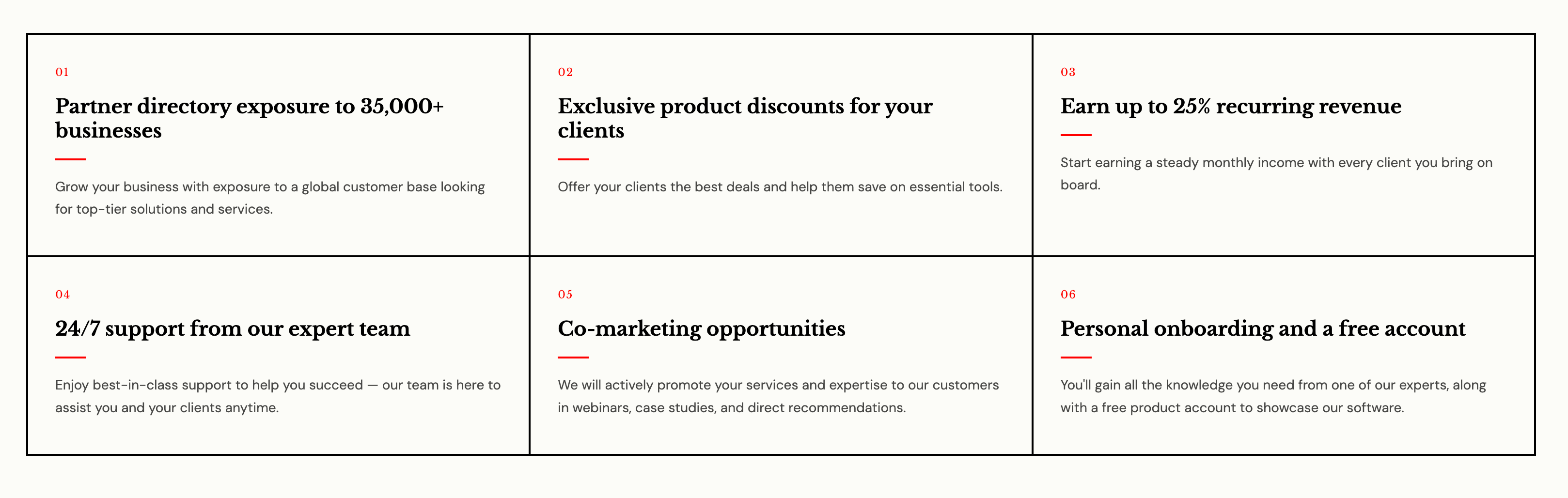
As a Solution partner, you get full access to all Text platform APIs and SDKs at no additional cost. You get a Partner console to manage client licenses and deployments. You get access to technical documentation, including developer preview releases, before they go public. And as you scale your integrations and grow the client base you manage, you move through tiers (Bronze, Silver, and Gold), unlocking higher revenue share, co-marketing opportunities, and a dedicated account manager.
Custom integrations you build stay private to each client. That's actually a feature, not a limitation. You're not sharing your work with competitors or commoditizing the solution you spent time architecting. The integration belongs to the client relationship, which makes it a retention asset for your business as much as a technical deliverable.
Recognition as a Solution partner comes through the Text partner directory. Claiming your profile and keeping it current means businesses searching for experts who work with LiveChat, ChatBot, and HelpDesk can find you. Combined with a portfolio of custom integration work, that profile becomes a sales tool. Potential clients don't just see that you're a partner — they see what kind of partner you are.

That's the framing that matters. Custom API integration services aren't just a technical offering — they're how you position your practice as the firm that can do what off-the-shelf tools can't.
Where to start
If you're already a Solution partner and haven't explored the API collection yet, the Text platform documentation is the fastest place to get oriented. Start with the Messaging APIs for LiveChat, work through the Configuration API for automation and bot logic, and look at the Data and Reporting APIs if any of your current clients have asked for custom analytics.
If you're considering joining the Text Partner Program specifically to offer custom integration services, the Solution tier is the right entry point. The onboarding includes one-on-one sessions with a Text expert, and the demo accounts let you build and test before committing to a client deliverable.
Everyone has AI. The question your clients are actually asking is whether their AI does something useful inside their specific business. Custom API integration is how you make that answer yes.
FAQs
What is a custom API integration?
A custom API integration connects two or more software systems using purpose-built logic rather than a pre-built connector. It gives you full control over how data flows between platforms, what triggers what, and how business-specific rules get applied — something standard solutions can't do.
How is custom API integration different from using native integrations?
Native integrations handle common tasks quickly but follow fixed logic. Custom API integration lets you define exactly how systems exchange data, handle edge cases, and apply your client's specific business processes — with no dependency on what a pre-built connector happens to support.
What does custom API integration services actually include?
Typically: API design, security protocols, development, user acceptance testing, and ongoing maintenance. For solution partners, it also includes understanding a client's existing software systems and building integration logic that fits their workflows — not forcing their workflows to fit the integration.
How much does custom API integration cost?
Costs vary with workflow complexity, the number of systems involved, and legacy infrastructure. Simple integrations can take days; more complex projects involving legacy systems or multi-step processes take longer. Ongoing maintenance adds a predictable recurring fee — and for partners, that's a feature, not a cost.
Do I need a dedicated dev team to build custom API integrations on the Text® platform?
Not necessarily. The Text® platform provides SDKs, app templates, full documentation, and developer support. Many solution partners handle custom API development with a small technical team or a single developer, especially for client-specific builds that don't require building from scratch every time.