
Sylwia Kocur
Content Marketing Specialist
I joined Text to help introduce our products to companies looking for a reliable and forward-thinking partner in global communication. With experience as both a Product Expert and now a Content Writer, I understand what businesses need and help them discover how Text can support their goals.
Everyone has AI. The real question is whether the AI your clients are running actually does anything for their bottom line, or just keeps the queue moving.
Here's the thing most people in the call center space miss: the contact center has quietly become one of the most valuable pieces of a modern business. Not the most celebrated, maybe. But every single day, it handles hundreds or thousands of conversations with people who either want to buy something, have already bought something, or need a reason to come back.
That's not a cost center. That's a revenue floor.
And as a Text partner, you're sitting right on top of it.
The phone isn't dead. But it's not running the show anymore
Call centers have been rebranding as "contact centers" for a reason. Voice is still in the mix, but chat has taken over as the default channel for a huge share of customer interactions. Customers want answers fast, on their terms, without sitting on hold.
What does that mean in practice? It means your clients' call center agents are now fielding chats, emails, and tickets alongside voice calls, often all at once. The old model of one agent, one call, one resolution doesn't hold up anymore.
This is where modern AI call center technology changes everything. Not by replacing human agents, but by making the whole operation work differently. Smarter routing. Instant responses to routine questions. Real-time help for agents mid-conversation. And measurable, attributable revenue outcomes tied directly to customer conversations.
The numbers behind AI-powered call centers are hard to ignore. Research consistently shows that AI can handle 60–70% of routine customer inquiries without a human agent ever getting involved — that's the majority of incoming volume taken off your clients' plates before a single call center agent picks up. Agent productivity climbs when AI takes care of the repetitive tasks: after-call work, note-taking, ticket routing, and follow-ups. And operational costs? Organizations that implement AI well see significant drops — some reporting 30% savings in the first year, others achieving reductions well beyond that as the technology matures in their environment. The ROI window is typically three to six months. That's a business case that tends to get leadership attention fast.
That's the business case you're selling. And it's a strong one.
What "AI that actually does something" looks like in a call center
There's a lot of noise in the AI tools space right now. Every vendor has AI. Every platform has "intelligent" something. So what makes the difference?
The gap isn't in the technology. It's in what the technology is built to do.
Most AI call center software is built for efficiency. It handles volume, reduces handle time, and keeps the queue manageable. That's useful. But call center efficiency isn't the same as profit.
Text is built to generate profit. The whole platform is oriented around one idea: customer conversations are where buying decisions happen. Every chat, every ticket, every support interaction is a chance to identify buying intent, act on it, and turn it into revenue.
That shift in perspective is what you're bringing to your clients. Not "here's a tool that answers questions faster." Instead: "Here's a platform that turns your contact center into a sales channel."
The market is moving this way regardless. Your clients are going to adopt it. The question is whether they do it with a partner who understands the revenue angle — or whether they go it alone with a generic AI tool that just handles tickets.
What Text does in a call center — and why it's different
Most call center AI software is built to handle conversations. Text is built to generate profit from them. That's not a rebranding exercise. It's a fundamentally different product logic.
Here's how it actually works.
Text tracks visitor behavior in real time before a single message is sent. Pages visited, time on site, products compared, moments of hesitation: the platform reads these signals continuously and builds a live picture of who's on the site and what they're likely to do next. When a high-intent signal appears, Text acts on it. A proactive message triggers. An AI agent engages. The conversation starts at exactly the right moment, with context already loaded.
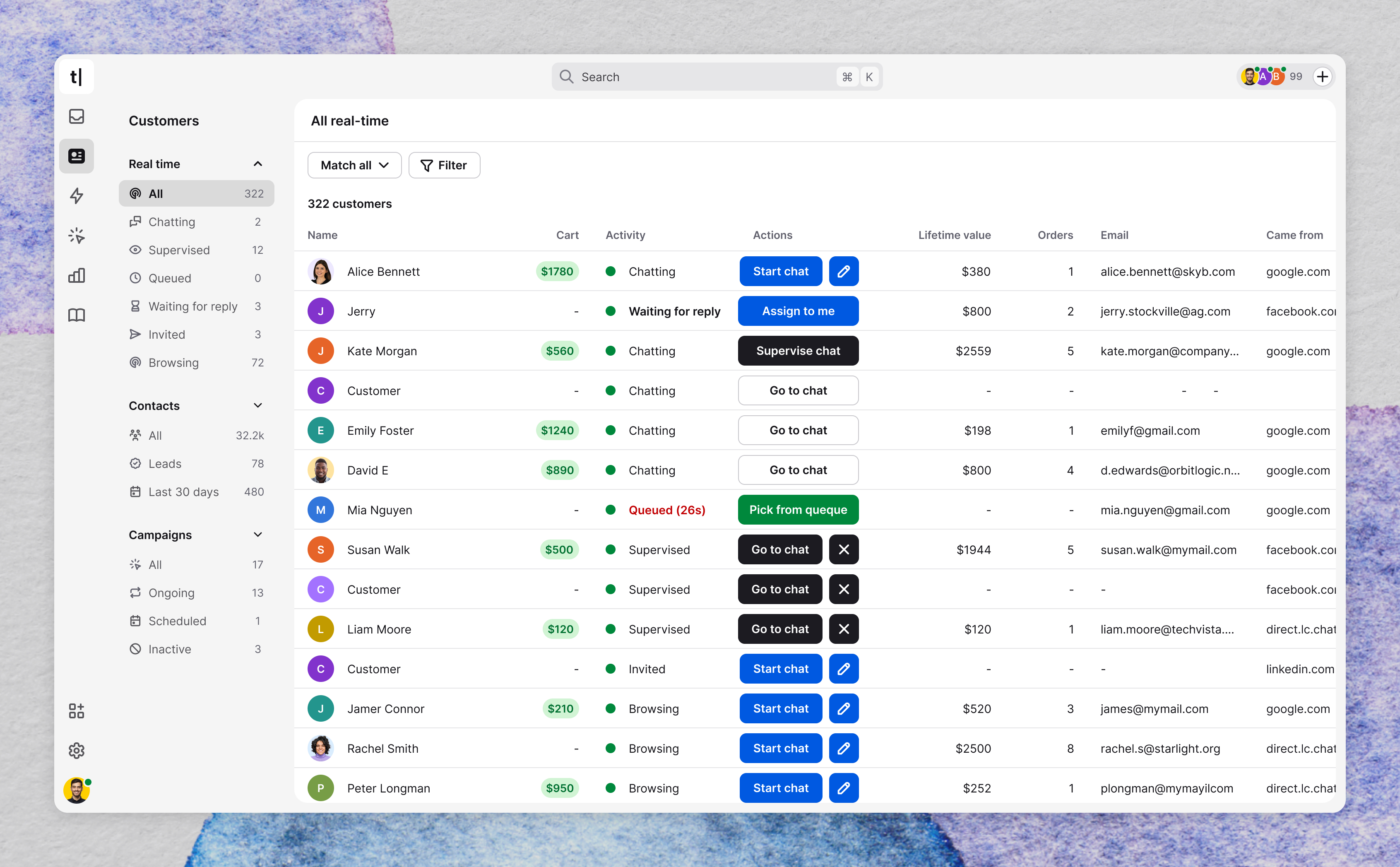
The AI agent isn't a basic chatbot that matches keywords to scripted customer inquiries and replies with natural language processing. It's trained on a company's product catalog, brand voice, customer history, and business rules. It can recommend products, answer complex questions, qualify leads, offer discounts after successful resolutions, and close sales — autonomously, 24 hours a day. When a conversation needs a human, the handoff happens with full customer data context intact. The agent doesn't start from scratch. They pick up exactly where the conversational AI left off.
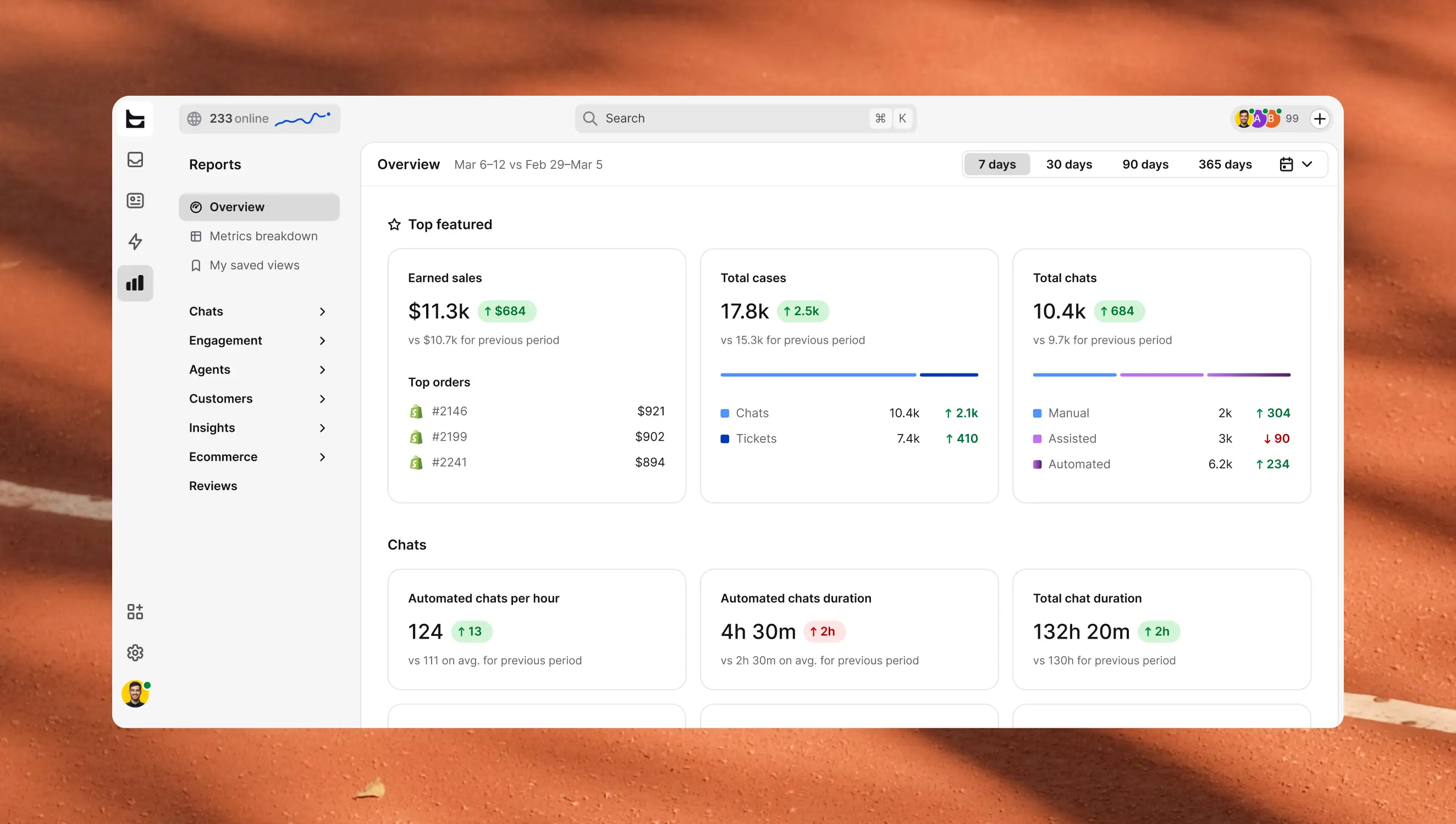
The results from Text's own deployment data are concrete. Across a test group of nearly 600 ecommerce vendors, chatting with Text's AI agents improved conversion rates to order by 266%. Chat sales attribution increased by 39% in a single month. Those aren't projections, they're outcomes from live customer deployments in March and April 2026.
What makes this relevant to call center partners specifically is the measurement layer. Text doesn't measure success in tickets closed or average handle time. It measures revenue generated, leads captured, and outcomes attributable to specific conversations. Every interaction produces a data point. Call center managers get visibility they've rarely had: not just "how fast did we respond" but "how much did this conversation contribute to the business."
That shift, from support metrics to revenue metrics, is what "AI that actually does something" looks like in practice. And it's the story you're telling your clients when you bring Text into a call center conversation.
The numbers that make this easy to sell
Partners often ask how to start the conversation with a prospective client. The answer is usually: with the math.
Most contact center managers already know how much their call center operations cost. They know their average handle time. They track first call resolution, customer satisfaction scores, and agent utilization. These are the metrics they report on. They're also the metrics that the AI system moves, dramatically.
What AI changes | The impact | Why it matters to clients |
|---|---|---|
Routine inquiry handling | Resolves 60–70% of inquiries without a human agent | Frees your team for the conversations that actually need them |
Operational costs | Reductions of 30–60% reported by organizations at scale | Leadership-level number — translates directly to budget |
Agent productivity | Up to 40% reduction in after-call admin work | Agents spend less time on wrap-up, more time on customers |
Wait times | Significant drops when AI handles initial contact and routing | One of the most visible drivers of customer satisfaction scores |
Interaction analysis | AI can evaluate 100% of conversations, not a sample | Compliance, coaching, and quality assurance at full coverage |
Time to ROI with Text | 74% of executives report positive ROI within year one | A timeline leadership can get behind — and finance can model |
Cost to start with Text | Free 14-day trial, plans from $19/user/month | Low barrier to entry — easy to pilot before scaling |
Cost per AI resolution | $0.99 per resolved conversation after running out of the included package | Clients pay for outcomes, not seats or usage hours |
That last row deserves attention. Text charges per resolution — meaning clients pay when their AI agent actually solves something, not just when a conversation happens. For a contact center manager used to paying per seat or per minute, that's a different conversation entirely. The cost scales with value delivered, not headcount.
And there's a compliance and coaching angle that often gets overlooked. AI can analyze 100% of customer interactions (not a sample, all of them). Call summaries, customer sentiment trends, agent performance patterns. Call center managers get visibility they've never had before, and they can actually use it to improve the team over time.
Where the profit opportunity lives for partners
This is where the Text Partner Program gets interesting.
When you bring Text into a call center conversation, you're not pitching software features. You're pitching a platform that changes how a contact center contributes to the business. That's a different kind of sale, and it tends to close at a different level of the organization.
A handful of contact center clients can add up fast. These are organizations handling serious conversation volume, which means meaningful monthly spend. The math works in your favor without needing a large client roster.
The positioning angle matters too. Partners who go to market as call center AI solutions specialists — rather than general software resellers — attract a different kind of prospect and command stronger relationships. You're not the person who sold them a tool. You're the person who helped them turn their contact center AI into a revenue channel. That's a harder relationship to replace, and a more interesting business to build.
What to expect when you implement Text in a call center
The first question most clients ask is: how difficult is this to set up? Honestly, less difficult than they expect.
Text connects to a client's existing website, channels, and workflows without requiring a rebuild. The AI agent trains on what the client already has — their website content, help documentation, product catalog, and brand voice. No custom development, no long configuration project. The code goes on the site, the knowledge sources go in, and the agent starts working.
All conversations — chat, email, social — land in a single inbox. That matters for contact center managers who are already dealing with fragmented tools and agents switching between systems. Text consolidates the view without forcing a rip-and-replace of what's already in place.
The multilingual piece is worth mentioning specifically for contact centers with global reach. Text handles conversations across multiple languages natively, which means clients don't need separate regional tools or separate agent pools to cover different markets.
On the AI-and-human balance: this is usually the conversation that needs the most careful framing. Text's approach is straightforward — the AI handles what it can, and when a conversation needs a human, the handoff happens with full context already transferred. The agent picking up the conversation sees everything: the customer's history, what was already discussed, what the AI tried. No repeating. No starting from scratch.
That's the detail that tends to land well with call center managers. It's not just that AI handles volume. It's that when human agents do get involved, they're set up to actually help — not catch up.
The bigger picture for your business
Customer experience expectations aren't going back down. Customers need faster responses, more personalized service, and 24/7 availability. The contact centers that can deliver that at scale are the ones that win. The ones that can't are the ones that lose customers to competitors who can.
You can help your clients be on the right side of that equation.
AI call center solutions from Text aren't just about operational efficiency and AI-powered analytics tools. They're about giving your clients a competitive edge, a measurable revenue contribution from their contact center, and a data-driven way to improve customer service interactions over time. Predictive analytics, customer sentiment analysis, real-time data on agent performance, and customer behavior, these aren't nice-to-haves. They're the infrastructure for a contact center that operates strategically rather than reactively.
The market is growing fast. AI-powered call centers are becoming the standard, not the exception. Partners who build expertise in this space now are the ones who'll be trusted advisors, not just vendors, when their clients are ready to scale.
That's the business you're building with Text. And it's worth building.
FAQs
What is an AI call center agent, and how is it different from a chatbot?
An AI call center agent can complete tasks end-to-end — qualifying leads, processing requests, closing sales, and escalating to a human when needed. A chatbot answers pre-set questions. The distinction matters because contact center operations need resolution, not just responses. AI agents act on customer intent. Chatbots react to it.
How does intelligent call routing work with AI?
AI-powered call routing analyzes customer history, behavior, and the nature of their inquiry in real time, then connects them to the right resource instantly. Traditional routing relies on rigid menus. AI-based smart call routing reads intent, not just button presses, so customers reach the right place on the first try — reducing transfers and shortening wait times.
What role does conversational AI play in contact center automation?
Conversational AI handles the natural back-and-forth of customer conversations — understanding context, following up, and completing multi-step tasks without scripted menus or keyword triggers. For contact center automation, it means routine inquiries get resolved in full, not just acknowledged. It's the difference between a system that deflects and one that actually helps.
Can AI handle voice interactions or just chat?
Voice AI handles inbound calls the same way AI agents handle chat — understanding natural language, accessing customer data, and resolving inquiries without a human agent. Interactive voice response systems are being replaced by voice AI that actually holds a conversation. Text's platform covers both chat and voice workflows from a single environment.
What customer data does AI use during a conversation?
AI pulls from customer history, previous interactions, browsing behavior, order data, and any information already in the system. This gives agents — human or AI — immediate context without asking customers to repeat themselves. Better customer data access leads to faster resolutions, more personalized service, and higher customer satisfaction scores from the very first message.
How does AI improve agent performance through call summaries and coaching?
After every interaction, AI automatically generates call summaries — saving agents several minutes of manual wrap-up time per call. It also enables analysis of 100% of conversations, not just sampled recordings. Call center managers use this for compliance, coaching, and spotting patterns in agent performance. The result is continuous improvement without the time cost of manual call recording review.
What is scalable self-service, and why does it matter for contact centers?
Scalable self-service means AI handles rising inquiry volume without adding headcount. Virtual agents resolve routine questions around the clock, across channels and languages. During volume spikes — seasonal peaks, product launches, outages — the platform absorbs demand that would otherwise overwhelm human teams. Scalable self-service is what keeps customer satisfaction stable when contact volumes surge.
How does predictive analytics help with call center operations?
Machine learning analyzes historical patterns in customer behavior and contact volumes to forecast demand before it arrives. This helps center managers staff correctly, set up the right workflows in advance, and prevent wait-time spikes that damage customer satisfaction. Implementing AI with a predictive analytics layer turns reactive contact centers into proactive ones.