Customer story
Text gave its AI Agent the hardest job: its own support.
122,000 monthly chats, one AI agent, and the team that built it. How Text dogfooded custom skills on its own inbox and shifted agents into AI supervisors.
- 74%
- AI resolution rate
- 17,000
- Spam chats filtered in two weeks
- 122,000
- Monthly chats

Text powers customer service and sales conversations for over 30,000 companies, with AI agents that resolve, sell, and route across chat, email, and messaging channels.

- SaaS
- 201-500
- Global
- Automate support
- text.com
Our case
Text builds customer service software for e-commerce brands, SaaS companies, and anyone who talks to customers at scale. The support team runs on its own product, and every feature gets tested on their inbox before it ships to anyone else.
We want our people spending time on work that actually needs a human brain, not answering the same pricing question for the two hundredth time.

The problem
The volume was massive, and a lot of it wasn't real. Because the product used to be called LiveChat, anyone searching for "live chat" could end up in Text's chat window. Over 40,000 conversations a month had nothing to do with the product. Misrouted visitors, bots, spam.
That noise had a real cost. Every junk conversation sat in the same queue as a customer with a billing problem or a prospect ready to buy. Agents couldn't tell the difference until they opened the chat, and by then they'd already spent the time. The customers who actually needed help waited longer because of it.
The audit
The AI Agent was already the first responder on all incoming chats and handled the bulk of repetitive questions on its own. But when Kosnik started digging into the conversations it couldn't resolve, a pattern showed up. The gaps weren't about knowledge. The agent had the answers. The gaps were about action.
It couldn't filter spam before it hit the queue. It couldn't collect a customer's email before transferring to a human. It couldn't recognize when someone wanted to buy instead of troubleshoot. Every one of those gaps meant an agent had to step in for something the bot should have handled.
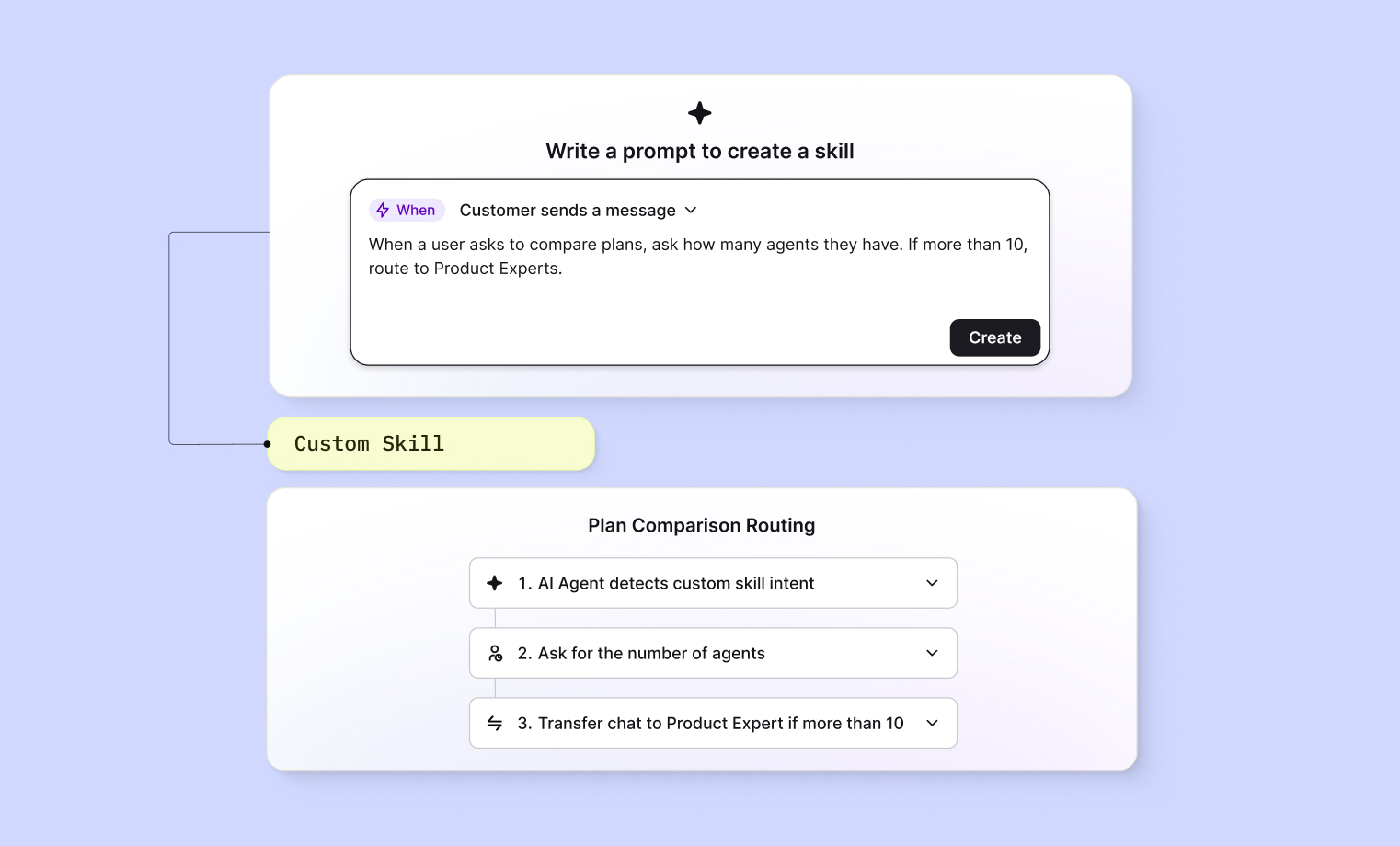
Custom skills gave the agent the ability to act on what it learned.
The solution
Kosnik built three skills that addressed the biggest gaps.
A language detection skill filtered the noise. Non-English traffic, overwhelmingly spam on Text's license, got a polite redirect. It fired 17,000 times in two weeks. Agents never saw any of it.
A context-aware transfer skill replaced the blind handoff. Instead of generic intake questions, the agent used what it already knew from the conversation, collected the customer's email with a reason, and routed the chat with full context attached.
A sales qualification skill caught visitors who wanted to buy. The agent ran a qualification flow, collected details, and either closed the sale in the conversation or sent a demo booking link with a ticket for the sales team.
It took me thirty seconds to build the language skill. The sales qualification skill took a week. Start simple.
The result
Before custom skills, the AI Agent handled repetitive questions but everything else landed on the team. After, it started operating: filtering, routing, qualifying, collecting data. The resolution rate climbed to 74%, well above the 59% industry average. Out of 122,000 monthly chats, only about 32,000 reach a human now.
The team restructured around it. Agents who used to sit in a queue picking up chats one by one now supervise the AI, stepping in only for billing disputes, account cancellations, and complex technical problems. Every month, the share of conversations handled entirely by the agent grows.
My goal is to get the AI Agent to a place where our human agents only step in when something truly requires their expertise. We're getting there.
Talk to our Product Experts
