

AI bots, also known as chatbots, are computer programs that use artificial intelligence to simulate human-like conversations with customers. Conversational AI chatbots utilize advanced natural language processing to facilitate seamless, human-like interactions, thereby significantly enhancing the customer experience.
In addition to chatbots, virtual assistants and intelligent virtual assistants represent more advanced forms of AI bots that can automate a wide range of tasks and understand complex human interactions. AI agents can handle routine conversations and tasks, and route complex requests to human agents when needed.
They can be used to provide instant customer service, answer customer questions, and help customers with their queries.
- How natural language processing (NLP), machine learning, and large language models (LLMs) power modern bots
- Why AI bots matter now: customer expectations for speed, availability, and personalization
- How AI bots support both customers and business teams
- Why businesses adopt them for scalability, efficiency, and better experiences
Let’s take a closer look at how AI bots work, where they deliver the most value, and why they’ve become a core part of modern customer service and business operations.
Benefits of AI bots for customers
Always-on, instant support
Customers expect help the moment a question comes up, not hours later when a support team is back online. AI bots meet that expectation by staying available around the clock.
With 24/7 coverage, customers can get answers whenever they need them, without waiting in a queue or checking business hours. AI bots provide support outside regular business hours, ensuring continuous assistance even when your team is offline. This is especially valuable for global audiences across different time zones and for users who prefer to resolve issues immediately rather than return later.
AI bots also respond instantly during peak demand. Product launches, sales, or unexpected outages often overwhelm human teams. Bots handle these traffic spikes smoothly, delivering quick replies even when thousands of people reach out simultaneously.
AI chatbots offer omnichannel support by integrating with messaging apps and social media platforms, as well as being accessible through websites and mobile apps. This means customers can connect with your business through their preferred channels, enhancing convenience and engagement.
The result is less frustration. Customers aren’t left staring at a loading message or wondering if their request was received. Immediate acknowledgment and fast answers set a positive tone for the entire interaction.
Better self-service experiences
Many customers prefer to solve issues on their own, as long as the process is simple and intuitive. AI bots make self-service easier by acting as a guide instead of a barrier.
They can direct users to relevant FAQs, help center articles, or step-by-step troubleshooting instructions based on the customer’s request. AI chatbots can also direct customers to community forums, FAQ pages, or help center articles to facilitate self-service. Instead of searching through long documentation or guessing which article applies, customers get targeted help right away. Chatbots can help customers find or input information quickly by instantly responding to requests that use audio or text input.
This approach reduces handoffs and effort. Customers don’t have to jump between pages, forms, or agents to resolve basic questions. One conversation is often enough to reach a solution.
Consistency also plays a major role here. AI bots pull answers from a single, maintained source of truth. Analyzing customer interactions enables businesses to identify common customer questions and most frequently asked queries, which helps improve the self-service experience and better understand customer preferences. That means customers receive the same information every time, regardless of channel or timing. Fewer contradictions lead to more trust and fewer repeated questions.
Personalized and proactive interactions
Modern AI bots go beyond generic replies. Powered by artificial intelligence, they utilize advanced technologies, including natural language processing and machine learning, to tailor conversations to each individual.
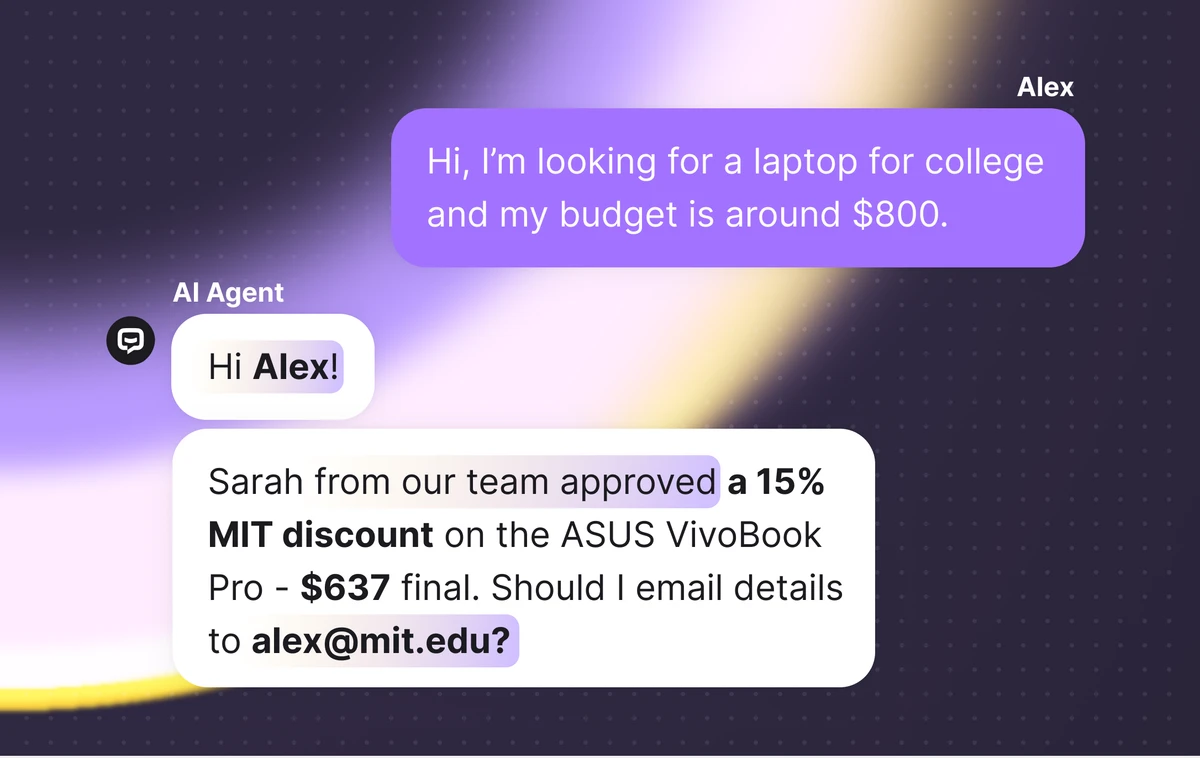
Bots can adapt their responses based on a customer’s history, account details, or previous interactions. A returning customer doesn’t need to explain their situation from scratch, and recommendations feel more relevant to their context.
Proactive messaging adds another layer of value. Instead of waiting for customers to ask, AI bots can send timely updates about order status, payment confirmations, delivery delays, or account issues. Intelligent virtual assistants and virtual agents can also proactively engage potential customers with relevant information or offers, helping to nurture leads and guide them through the sales funnel. These messages reduce uncertainty and prevent unnecessary follow-up questions.
Multilingual support further improves accessibility. AI bots can communicate in multiple languages without incurring additional staffing costs, enabling customers to interact in the language they’re most comfortable with. This removes language barriers and creates a more inclusive support experience for global audiences.
Together, personalization and proactive communication make support feel thoughtful rather than reactive. When implemented well, such as in platforms like Text® App that combine AI automation with customer context, bots help customers feel understood, informed, and supported at every step.
AI bots and virtual assistants support various industries, including healthcare, finance, retail, marketing, and manufacturing, by automating specific processes and tasks.
Brand loyalty and retention
AI chatbots are powerful tools for building brand loyalty and driving customer retention. By providing instant, personalized support for customer inquiries around the clock, AI chatbots ensure that customers always feel valued and heard. This level of responsiveness not only improves customer satisfaction but also strengthens the overall customer experience, making it more likely that customers will return and recommend the brand to others.
Beyond just answering questions, AI chatbots can proactively engage loyal customers with exclusive offers, personalized recommendations, and tailored loyalty programs. These targeted interactions help deepen the relationship between the customer and the brand, encouraging repeat business and long-term loyalty.
Additionally, chatbots can collect customer feedback after each interaction, giving businesses direct insight into what’s working and where improvements are needed. By acting on this feedback, companies can continually enhance customer service operations and deliver experiences that keep customers coming back. The result is a virtuous cycle: satisfied customers become loyal advocates, and their input helps businesses further enhance customer service and engagement.
Collecting customer data
AI chatbots excel at collecting valuable customer data during every interaction. As customers engage with chatbots, whether through conversations, surveys, or feedback forms, the system gathers insights into preferences, behaviors, and interaction history. This customer data is essential for creating a more personalized experience and improving overall customer satisfaction.
By integrating this data with other business systems, such as CRM software, businesses can build unified customer profiles that inform both customer service operations and marketing campaigns. This holistic view enables companies to anticipate customer needs, deliver proactive support, and tailor communications to each individual.
Analyzing the collected data also helps businesses identify trends and patterns, allowing them to refine their strategies and offer more relevant products or services. Ultimately, leveraging customer data through AI chatbots leads to more efficient business systems, improved customer satisfaction, and a stronger ability to meet evolving customer needs.
Collect customer feedback
AI chatbots make it easier for businesses to collect customer feedback at scale. After a customer inquiry is resolved or a support interaction ends, chatbots can prompt users to share their thoughts through quick surveys, ratings, or open-ended comments. Because this happens immediately after the conversation, feedback feels relevant and requires minimal effort from the customer.
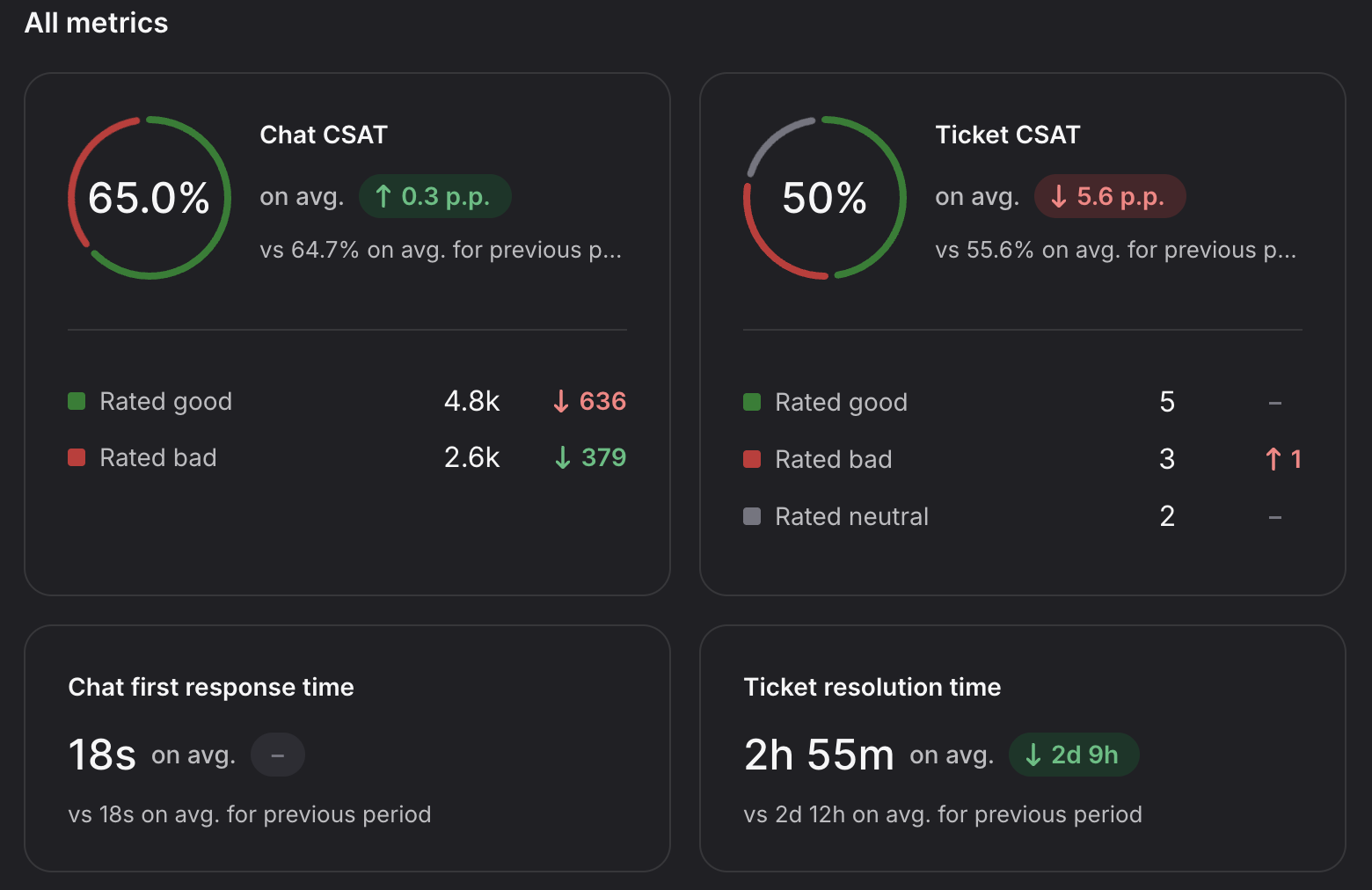
In Text App, many teams use post-chat surveys to capture feedback right after a conversation ends. It can support feedback collection alongside ongoing conversations. Once a chat ends, customers can rate their experience and leave short feedback without being redirected or asked to complete a long form. This helps teams gather consistent, real-time insights while the interaction is still fresh.
The feedback collected through these post-chat surveys helps businesses understand customer satisfaction and spot patterns in support quality. Teams can see which conversations go smoothly, where customers struggle, and when automation meets or falls short of expectations. These insights can then be used to improve responses, refine chatbot flows, and adjust when conversations should be handed over to human agents.
Over time, analyzing post-chat feedback supports better, data-driven decisions across customer service operations. By acting on real customer input, businesses can enhance the overall support experience, refine AI automation, and maintain higher levels of customer satisfaction without adding extra workload to their teams.
Benefits of AI bots for businesses
Operational efficiency and cost reduction
AI bots help businesses accomplish more with fewer resources by automating repetitive, time-consuming tasks, leading to lower business costs. Chatbots can automate repetitive tasks, allowing human agents to focus on more complex issues that require their expertise. Common questions about orders, account access, pricing, or basic troubleshooting no longer require reaching a human agent. Automation handles these inquiries instantly and consistently.
This reduces staffing pressure. AI technology reduces business costs associated with labor and training by streamlining business processes, thereby enhancing operational efficiency. Teams don’t need to scale headcount at the same pace as customer demand, and new hires require less training because bots absorb a large share of routine conversations. Training costs decrease, and agents ramp up more quickly.
Fewer incoming tickets also lead to a measurable reduction in average handling time (AHT). When bots resolve simple requests before they become tickets, agents spend less time per case and close conversations more quickly. Over time, this translates into lower operational costs and more predictable support workloads.
Scalable customer engagement
As a business grows, customer conversations increase in volume and complexity. Conversational AI chatbots and customer chatbots enable businesses to scale customer communication and customer service interactions efficiently, ensuring seamless support as demand rises. AI bots scale without friction.
Bots can handle thousands of simultaneous interactions across chat, email, and messaging platforms without slowing down. There’s no concept of a “full inbox” or peak-hour bottleneck. Every customer gets an immediate response, regardless of demand.
Consistency is another key advantage. AI bots deliver the same tone, information, and brand voice across every channel. Whether a customer reaches out via a website, an app, or messaging platforms, the experience feels cohesive and reliable.
Multilingual capabilities make expansion easier. Businesses can support new regions and audiences without hiring language-specific teams. AI bots respond in multiple languages from day one, enabling companies to enter new markets faster while maintaining high service quality.
Higher agent productivity
AI bots don’t replace customer service agents. They protect their time by supporting both customer service agents and the customer service team, handling routine inquiries before they reach the team.
By deflecting simple issues before they reach the team, bots reduce noise in the support queue, allowing for more efficient support. Agents no longer spend hours answering the same questions or copying links to direct users to help articles. Instead, they focus on complex, sensitive, or high-impact conversations that require judgment and empathy.
When a handoff is necessary, well-designed bots pass full context to the agent. The customer’s history, previous messages, and attempted solutions are already there. This eliminates repetition and shortens resolution time.
Platforms like Text App are built around this blended model. AI handles routine work in the background, while agents operate in the same workspace with full visibility into bot conversations. The result is smoother collaboration between automation and humans, higher agent satisfaction, and better outcomes for customers and the business. The service team benefits from chatbots streamlining conversations and reducing workload, enabling them to focus on more complex support issues.
Business systems integration
Integrating AI chatbots with other business systems is key to delivering seamless and efficient customer service. When chatbots are connected to CRM software, marketing automation tools, and customer service platforms, they gain access to comprehensive customer data, interaction history, and preferences. This integration enables chatbots to deliver more personalized and effective support, thereby enhancing customer satisfaction at every touchpoint.
AI chatbots can also work in conjunction with AI agents and other AI-powered tools to further streamline customer service operations. When automating routine customer service processes and reducing operational costs, businesses can allocate resources more strategically and focus on delivering high-value interactions.
Ultimately, integrating chatbots with business systems not only improves customer satisfaction but also drives more efficient operations, reduces costs, and ensures that every customer receives timely, relevant support.
Customer data analysis
AI chatbots do more than just collect customer data; they analyze it to unlock valuable insights into customer behavior, preferences, and needs. Using advanced machine learning algorithms, AI-powered chatbots can identify patterns and trends in customer interactions, helping businesses understand what drives customer satisfaction and loyalty.
This data-driven approach enables companies to create highly personalized experiences, launch targeted marketing campaigns, and continuously improve customer service operations. By pinpointing areas for improvement, businesses can make informed decisions that enhance the overall customer experience and foster stronger customer loyalty.
Leveraging customer data analysis through AI chatbots not only improves customer satisfaction but also provides a strategic advantage. Businesses can anticipate customer needs, adapt quickly to changing preferences, and drive revenue growth by delivering the right message at the right time, every time.
AI bot features that drive these benefits
AI bot features are what turn automation into real, measurable value. Behind every fast response or smooth interaction, there’s a set of capabilities working quietly in the background to improve how businesses understand and serve their customers.
One of the most important features is data collection and customer insight. Every conversation becomes a structured data point. AI bots capture what customers ask, how often issues repeat, and where friction appears. By analyzing customer interactions, businesses gain actionable insights that help them understand behaviors, identify pain points, and improve the overall self-service experience through a data-driven approach.
Over time, analytics surface clear patterns, such as recurring problems, shifts in customer sentiment, or gaps in documentation. These insights enable teams to make more informed product decisions, refine service workflows, and tailor messaging based on actual customer behavior rather than assumptions.
Another driver is advanced AI capability. Modern AI bots rely on generative AI to produce responses that sound natural and adapt to context, rather than repeating rigid scripts. Machine learning enables bots to continually improve as they interact with an increasing number of customers. These advanced features deliver significant benefits and power comprehensive customer service solutions, including deep semantic search, proactive engagement, and smart knowledge management. AI chatbots can also direct customers to community forums, FAQ pages, or help center articles to facilitate self-service.
Integrations with CRM systems and knowledge bases add context, so answers reflect account details, previous interactions, and up-to-date information. Omnichannel support ties everything together, letting customers move seamlessly between chat, email, and messaging platforms without losing continuity.
Key features that make this possible include:
- Structured data capture from every customer conversation
- Built-in analytics for trends, sentiment, and performance tracking
- Generative AI for flexible, human-like responses
- Machine learning that improves accuracy over time
- CRM and knowledge base integrations for context-aware answers
- Omnichannel engagement across chat, email, and messaging platforms
Together, these capabilities ensure AI bots don’t just respond quickly. They learn, adapt, and help businesses deliver better experiences with every interaction, resulting in improved customer service.
Implementing AI bots
AI chatbots are most powerful when seamlessly integrated with a company’s existing business systems, such as customer relationship management (CRM) software, enterprise resource planning (ERP) platforms, and marketing automation tools. Integrating AI bots streamlines business processes and significantly improves the ability to serve customers by providing immediate, tailored support across multiple channels.
When connecting with these systems, AI chatbots can access up-to-date customer data, enabling them to provide instant customer service and deliver highly personalized recommendations. This integration streamlines customer service operations, enabling businesses to reduce operational costs while ensuring that customers receive fast and relevant support.
For example, when an AI chatbot is integrated with a CRM, it can instantly retrieve a customer’s history, preferences, and previous interactions, enabling it to offer tailored solutions and resolve issues more efficiently. This not only enhances customer satisfaction but also empowers businesses to gain valuable insights into customer behavior and preferences.
These insights can be leveraged to refine marketing campaigns, anticipate customer needs, and improve overall customer engagement. Ultimately, integrating AI chatbots with other business systems leads to more efficient operations, lower costs, and a superior customer experience. AI bots also assist in various industries such as healthcare, finance, retail, marketing, and manufacturing by automating specific processes and tasks.
In Text App, AI bots and live agents share the same workspace and customer context. Bots handle routine questions, such as order status, pricing, account access, or basic troubleshooting, before those conversations ever reach an agent. When a request becomes more complex, the bot passes the full conversation history, customer details, and intent to a human agent for further processing. This prevents customers from repeating themselves and helps agents respond faster and more accurately.
LiveChat’s Chatbot follows a similar philosophy. It’s designed to work alongside live chat, not replace it. The chatbot can greet visitors, qualify inquiries, collect key information, and automatically resolve common questions. If human assistance is needed, the chat is seamlessly transferred to an agent inside LiveChat, with context preserved. From the customer’s perspective, the conversation continues naturally, rather than restarting.
Industry-specific applications of AI bots
AI bots deliver the most value when they’re tailored to real workflows in each industry. Instead of trying to do everything, they focus on high-impact tasks that customers and teams deal with every day. Efficiently handling customer service requests with AI bots leads to higher customer satisfaction, as businesses can provide timely, accurate, and personalized support at scale.
In ecommerce, AI bots support customers before, during, and after a purchase. They handle order tracking, shipping updates, and returns without delay, which reduces “where is my order” inquiries. Bots also send abandoned cart reminders and answer product-related questions in real time, helping shoppers move forward with confidence. Personalized product recommendations, based on browsing or purchase history, further enhance the shopping experience while driving higher conversion rates.
In banking and finance, AI bots offer fast and reliable assistance for time-sensitive requests. They answer account and transaction questions, guide users through payments, and offer instant updates on balances or transfers. Bots can also deliver fraud alerts and security notifications, helping customers act quickly while reducing pressure on support teams. AI chatbots can be used to deliver fast and accurate answers, streamline web searches, and facilitate meaningful customer interactions. Clear, immediate responses are critical in financial services, and AI bots help maintain that standard at scale.
In healthcare, AI bots reduce administrative friction for both patients and staff. They manage appointment scheduling, confirmations, and rescheduling, ensuring fewer missed visits. Medication reminders and follow-up notifications help patients stay on track with treatment plans. Bots can also answer basic care-related questions, allowing healthcare professionals to focus on clinical work rather than routine inquiries.
For HR teams, AI bots serve as the primary point of contact for employees. They guide new hires through onboarding steps, explain company policies, and answer common questions about benefits or payroll. Time-off requests and balance checks can be handled instantly, improving the employee experience while reducing repetitive work for HR staff.
In insurance and real estate, AI bots support customers through complex, decision-heavy processes. They provide quick access to quotes, explain coverage options or property details, and assist with claims or availability checks. Chatbots offer real-time, personalized responses for quotes, claims, and payments, fostering long-term customer relationships. Faster responses help build trust and keep prospects engaged, especially when customers are comparing options or dealing with urgent situations.
In manufacturing, AI can analyze sensor data to predict equipment failures, enabling proactive maintenance and reducing downtime. AI tools can also simulate processes in virtual environments to identify issues early, improving efficiency and product quality.
Across all industries, AI bots create the same outcome: faster responses, fewer manual tasks, and smoother interactions that scale without sacrificing quality.
AI-powered technology
At the core of today’s most effective chatbots is advanced AI-powered technology. Leveraging machine learning and natural language processing (NLP), AI-powered chatbots can understand and interpret customer inquiries in real time, providing instant responses that feel natural and personalized. These chatbots continuously learn from customer interactions, allowing them to improve their accuracy and effectiveness over time.
AI-powered chatbots are capable of handling a high volume of customer queries simultaneously, freeing up human agents to focus on more complex or sensitive issues. This not only enhances the efficiency of customer service operations but also ensures that customers receive immediate support whenever they need it.
Additionally, AI-powered chatbots can collect customer feedback, analyze customer interactions, and identify trends in customer behavior. These valuable insights enable businesses to anticipate customer needs, refine their service offerings, and ultimately enhance customer satisfaction.
Future of AI bots
The future of AI bots is set to transform the customer service landscape even further. As advancements in AI technology, machine learning, and generative AI models continue to accelerate, chatbots will become increasingly sophisticated in handling complex customer inquiries and providing instant responses.
The adoption of advanced generative AI models will enable chatbots to understand and process natural language with greater nuance, resulting in more accurate and human-like interactions.
Looking ahead, the integration of AI bots with other business systems, such as CRM and ERP platforms, will further streamline customer service operations, reduce operational costs, and enable more efficient operations across the board.
Businesses can expect AI bots to deliver instant support, proactively address customer needs, and offer highly personalized experiences at every stage of the customer journey. As these technologies evolve, companies that leverage AI bots will benefit from more efficient operations, reduced costs, and higher levels of customer satisfaction.
Try AI-powered chatbots with Text App now
In summary, AI chatbots have fundamentally transformed how businesses approach customer service. They deliver instant responses, support personalization at scale, and help teams improve customer satisfaction without increasing workload. The benefits are clear: lower operational costs, smoother support operations, and more engaged customers.
When chatbots connect with your existing business systems, they also unlock better insight into customer behavior. That makes it easier to tailor support, refine marketing efforts, and respond to real customer needs with more accuracy.
As AI technology continues to evolve, chatbots will increasingly handle more complex inquiries, provide proactive assistance, and deliver more relevant, human-like experiences. Businesses that adopt these capabilities now are better positioned to build trust, improve responsiveness, and strengthen long-term customer relationships.
If you’re ready to put these ideas into practice, Text App gives you one workspace for AI-powered chatbots, live chat, and customer conversations, designed to scale with your team and stay practical from day one.
Try Text App and see how AI chatbots can support your customers while keeping your service human where it matters most.
FAQ
What are the main benefits of AI bots?
AI bots deliver instant support, reduce operational costs, scale customer engagement, and free human agents to focus on complex issues.
How do AI bots improve customer satisfaction?
They reduce wait times, offer self-service options, personalize responses, and provide consistent support across channels.
Can AI bots replace human agents?
No. The most effective setups combine AI automation with human expertise for nuanced or sensitive conversations.
Are AI bots suitable for small businesses?
Yes. AI bots help small teams handle higher volumes without increasing headcount or costs.
How does Text App use AI bots?
Text App utilizes AI bots to resolve common issues automatically, route complex cases to agents, and consolidate all conversations in a single workspace.
Get a summary with