
Sylwia Kocur
Content Marketing Specialist
I joined Text to help introduce our products to companies looking for a reliable and forward-thinking partner in global communication. With experience as both a Product Expert and now a Content Writer, I understand what businesses need and help them discover how Text can support their goals.
SKlabs is a two-person developer team that joined the Text Developer program (now Technology program) to build integrations with tools they used daily — Zoom, Trello, GitHub and others. By creating a shared backend framework that could be reused across every new app, they scaled to seven published integrations and hit $1,000 MRR, all as a side project alongside full-time jobs.
Key metrics at a glance:
Seven apps live on the Text Marketplace.
$1,000 MRR milestone reached.
360+ installations on their flagship Zoom integration.
Team size of two, both working remotely part-time.
Products included in the implementation: LiveChat Accounts SDK, Text Design System, In-App Upgrades feature, LiveChat Webhook handling, LiveChat Agent App infrastructure.
Partner introduction
SKlabs is a small independent development studio specializing in building integrations for the Text Marketplace. Operating as a side business, the two-person remote team focuses on connecting the LiveChat app with widely-used workplace tools — turning everyday software gaps into recurring revenue.
Company: SKlabs
Industry: SaaS Integration Development
Specialization: Text Marketplace app development, third-party tool integrations
Team size: Two developers, fully remote, part-time
Challenge introduction
Independent developers entering established app marketplaces face a familiar set of obstacles:
Oversaturated platforms
Weak discoverability
Building sustainably with limited time and resources
SKlabs explored several major marketplace ecosystems before committing, and found most of them too crowded to gain meaningful traction.
Even after choosing Text, the early technical challenges were significant. Understanding Text’s domain model — how licenses work, how agents are authenticated, how installations are handled — took time and iteration.
A critical bug emerged just before their first app launch when they discovered that Safari's strict third-party cookie policies broke authentication entirely for users within the iFrame environment. Fixing it required rethinking core parts of their backend architecture at the worst possible moment.
On top of the technical complexity, external dependencies created their own delays. Zoom's OAuth app review and approval process took far longer than anticipated, stalling the launch timeline and testing the team's resolve.
How SKlabs mapped problems to LiveChat app features
SKlabs approached the Technology program not just as a distribution channel, but as a platform to build a scalable, repeatable development business.
Their core insight was that the similarities between apps — authentication, webhook handling, installation flows — could be abstracted into a shared framework, reducing the cost of every subsequent build.
They deliberately targeted integration gaps in the Text Marketplace by scouting tools they already used daily and checking whether a native integration existed. This kept project scope tight and market demand predictable.
By using Text’s own Design System, they ensured every app felt native to the platform — reducing friction for end users and making it easier to meet Text’s Marketplace quality standards.
Core challenge | Text feature used | Benefit |
High cost of building each new app from scratch | Reusable framework built on Accounts SDK and webhook infrastructure | Faster time-to-market for every subsequent integration |
Safari third-party cookie blocking authentication in iFrame | Accounts SDK with reworked backend auth mechanism | Stable authentication across all browsers |
Apps feeling disconnected from the LiveChat UI | LiveChat Design System | Consistent, first-party look and feel across all seven apps |
Monetising beyond flat-fee installs | In-App Upgrades feature | Package-based pricing introduced optional premium tiers |
Limited marketing resources as a two-person team | LiveChat Marketplace SEO and Marketplace campaigns | Organic discoverability and featured placement without dedicated marketing spend |

Rollout strategy
SKlabs followed a deliberate, incremental approach — shipping one app, learning from it, and using those learnings to build faster and smarter with every release.
Step 1 — Platform selection and opportunity mapping
SKlabs evaluated multiple marketplace ecosystems and chose Text for its relative openness and the closer relationship available with the internal team. They identified integration gaps by cross-referencing tools they used daily with what was already listed on the Marketplace, selecting Zoom as their first target for its broad adoption and clear demand signal.
Step 2 — Building a reusable framework
Rather than treating each app as a standalone project, SKlabs invested upfront in a shared backend framework using Laravel and React — abstracting installation flows, webhook handling, authentication, and authorization so these components could be dropped into every subsequent app. This decision compounded in value as the portfolio grew.
Step 3 — Iterative app development and Marketplace scaling
With the framework in place, SKlabs shipped six more integrations — GoToMeeting, Trello, GitHub, Discord, MS Teams, and Ping — each built faster than the last. They used the In-App Upgrades feature to introduce tiered pricing in select apps, unlocking premium revenue beyond base subscription fees.
Step 4 — Marketing through Marketplace leverage
Rather than building a standalone marketing operation, SKlabs leaned into Text’s Marketplace infrastructure, benefiting from Text’s SEO, featured Marketplace campaigns, and direct outreach to churned users with discount offers. They recognized early that integrations with well-known tools are inherently easier to market than custom, unknown products.
Results
Metric | Result |
MRR milestone reached | $1,000 MRR achieved within the first year |
Apps published | 7 integrations live on the Text Marketplace |
Flagship app installations | 360+ installations on Zoom integration |
Time-to-build per app | Reduced significantly after shared framework established |
Browser compatibility blocker | Resolved — Safari auth issue fixed via backend rework |
Marketing overhead | Minimized — Text SEO and campaigns drive organic installs |
App UI consistency | All apps built with Text Design System for a native look and feel |
Monetisation flexibility | In-App Upgrades enabled optional premium packages for users |
Partner support quality | Shared Slack channel provided direct access to Text team for fast issue resolution |
Revenue and growth
SKlabs reached their primary milestone — $1,000 MRR — within their first year of publishing on the Text Marketplace, driven primarily by their Zoom integration which has accumulated 360+ installations.
Although a major client churning temporarily reduced revenue, the portfolio's breadth across seven apps provided resilience, and new releases have put them on track to recover the milestone.
The decision to build integrations with well-known tools — rather than novel, unproven concepts — proved to be the right commercial strategy: discoverability was higher, sales cycles were shorter, and user trust came built-in.
Operational efficiency and speed
The single most impactful operational decision SKlabs made was building a reusable backend framework from the start.
By abstracting the common components of every LiveChat app — installations, authentication, webhook handling — into shared infrastructure, each subsequent app costs progressively less to build.
The Safari authentication issue, which required a fundamental rework of their backend auth mechanism, was painful in the short term but ultimately produced a more robust system that has served every app since.
Customer experience and quality
By using Text’s Design System across all seven apps, SKlabs ensured that every integration felt like a natural extension of the LiveChat agent interface rather than a third-party add-on — reducing friction for end users and meeting the platform's quality bar consistently.
The In-App Upgrades feature allowed them to offer users genuine choice through package-based pricing, rather than forcing a one-size-fits-all model. And the direct Slack channel with Text’s internal team meant that bugs and blockers were surfaced and resolved quickly, rather than sitting in a support queue — a material advantage for a two-person team with limited bandwidth.
Conclusion
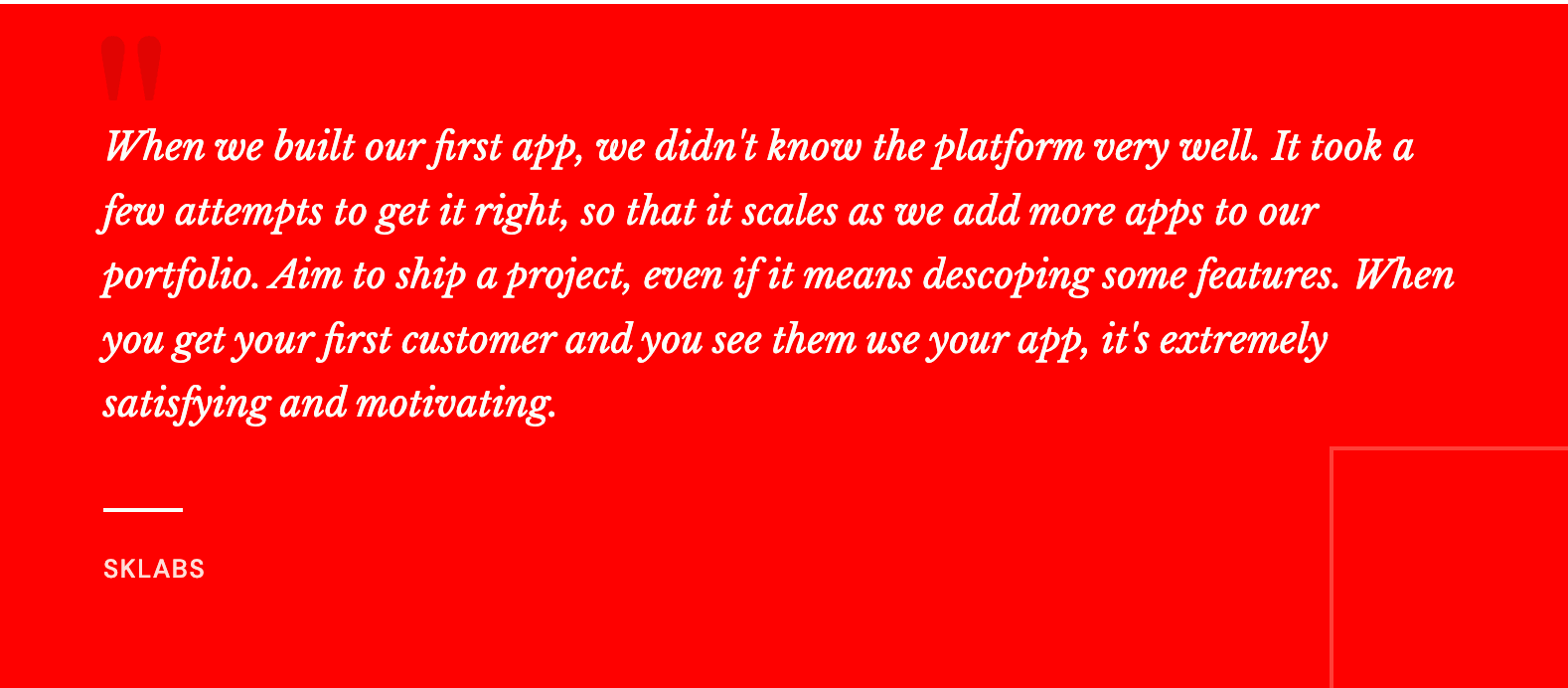
SKlabs demonstrates that the Text Technology program is a viable path to meaningful recurring revenue even for a small, part-time team — provided the approach is deliberate.
By choosing the right platform, building reusable infrastructure, targeting proven demand, and leaning on Text’s Marketplace for distribution, they turned a side project into a seven-app portfolio generating four-figure monthly revenue.
Join the Text Partner Program
If you are a developer or a small team looking to build scalable integrations and generate passive income, the Text Technology Program provides the infrastructure, documentation, and direct support to get there.