

Communication shapes how we connect, collaborate, and build trust. It’s how ideas move from one person to another, how emotions are expressed, and how decisions get made. Whether you’re talking to a colleague, leading a meeting, sending a message, or supporting customers online, communication sits underneath every interaction.
What’s changed is not whether communication matters, but how it works. Today, conversations move across channels, cultures, and devices. Messages are shorter, expectations are faster, and misunderstandings travel further.
Understanding the different types of communication and how they interact helps you communicate with greater clarity, empathy, and impact.
In this article, you’ll learn:
- What communication really means beyond words and messages
- How communication styles, emotions, and culture influence interactions
- Why listening and nonverbal cues matter as much as speaking
- How technology and AI are changing communication at work and online
Let's explore together how communication sits underneath every interaction.
The main types of communication
Most communication falls into a few core categories, including intrapersonal communication, which refers to internal dialogue, self-reflection, and mental planning that occurs within an individual’s mind. In practice, these types often overlap, but breaking them down makes it easier to see how meaning is created and lost.
Verbal communication is the most common form, used extensively in both personal and group interactions.
Each type of communication plays a crucial role in shaping our everyday life and professional lives, influencing how we understand, connect, and succeed in various settings.
Verbal communication
Verbal communication is the use of spoken words in real time, the most common form of communication. It includes conversations, presentations, meetings, phone calls, and live discussions.
What makes verbal communication powerful is immediacy. Oral communication is especially effective for conveying emotional or sensitive messages due to its immediacy and nonverbal cues. You can adjust your words, clarify your point, and respond to feedback in real time. Tone conveys a great deal of information beyond the actual words spoken, adding emotional nuance and meaning. Tone, pacing, and confidence shape how your message lands just as much as the words themselves.
Verbal communication works best when it’s structured, intentional, and adapted to the audience. Expressing ideas concisely in verbal exchanges helps ensure clarity and understanding. Clear language beats complexity, especially in high-stakes or emotional conversations.
Public speaking and team meetings are key contexts where strong verbal communication skills are essential for engaging audiences and facilitating effective group interactions. People who speak with confidence are effective communicators because others are more inclined to believe them.
Nonverbal communication
Nonverbal communication, also called 'nonverbal' communication, includes everything that isn’t spoken or written: facial expressions, gestures, posture, eye contact, and tone of voice. Research indicates that up to 55% of face-to-face communication is conveyed nonverbally, and non-verbal communication is processed up to 60,000 times faster than text. Sign language is a form of nonverbal communication closely related to spoken language, highlighting the diverse ways people convey messages.
Eye contact is an important aspect of nonverbal communication that helps build connections and convey attentiveness during conversations.
Nonverbal cues often reveal emotion and intent faster than words. A pause, a raised eyebrow, or a shift in posture can reinforce a message or quietly contradict it. That’s why mismatches between words and body language tend to create distrust.
Even in digital environments, nonverbal signals still exist. Timing, punctuation, emojis, and response speed all function as nonverbal cues in modern communication.
Written communication
Written communication includes emails, messages, documents, reports, and any information expressed through text. It relies on written words and is often chosen in professional settings where clarity and formality matter.
Its strength lies in precision and permanence. Written communication creates a record that can be referenced later for accountability, legal compliance, or follow-up. A written message can be reviewed, forwarded, archived, and revisited long after the original exchange.
Unlike oral communication, which can be spontaneous and influenced by tone or body language, written communication is better suited for conveying detailed facts and structured information. But it comes with a challenge: tone.
Without facial expressions or vocal cues, written messages are more easily misinterpreted. A short reply can feel efficient to one person and abrupt to another. Clarity, structure, and simplicity matter more than ever, especially in professional or cross-cultural settings.
That’s why modern customer communication platforms put strong emphasis on written clarity. In tools like the Text® App, teams manage live chat conversations and support tickets in one place, with full conversation history visible. This context helps agents respond with precision instead of guesswork. AI-assisted drafting can also suggest structured, accurate replies, while still leaving room for human tone and judgment.
Visual communication
Visual communication uses images, graphics, charts, video, and design to convey information. It’s especially effective for explaining complex ideas quickly or evoking emotion.
A well-designed visual can communicate in seconds what might take paragraphs to explain. By integrating images, graphics, and design elements with verbal and written communication, visuals help reinforce the overall message, making it clearer and more impactful. That’s why visuals dominate presentations, marketing, interfaces, and product education.
The key is relevance. Visuals should clarify meaning, not decorate it.
Listening as communication
Listening is often overlooked, but it’s one of the most important forms of communication. Strong listening skills are a core component of effective communication, as they involve not only hearing but also actively engaging with the speaker. Active listening includes focusing fully on the speaker, understanding their intent, and responding thoughtfully.
Good listening builds trust. It signals respect and reduces misunderstandings. Summarizing what you heard in your own words demonstrates understanding and engagement, while asking clarifying questions and acknowledging emotions make listening a visible part of the conversation.
Improving your active listening skills helps you communicate better in meetings, presentations, and one-on-one conversations. Active listening is increasingly classified as a core communication form important for building trust in negotiations.
In negotiations, leadership, and customer interactions, listening is often what determines whether communication succeeds.
Communication styles and how to recognize them
Beyond types of communication, people differ in how they communicate. Communication style shapes tone, pacing, and emotional impact. For example, aggressive communication can be perceived as hostile or authoritarian, which may negatively affect team dynamics but can sometimes drive efficiency in certain workplace situations.
Being an effective communicator is crucial for building strong personal relationships and achieving success in both personal and professional contexts, as it enhances understanding, trust, and conflict resolution.
Common communication styles
Some people communicate passively, avoiding conflict and withholding opinions. Others communicate aggressively, prioritizing dominance over understanding. Assertive communicators balance clarity with respect, while passive-aggressive styles often express frustration indirectly.
Recognizing these patterns helps you adapt your response rather than escalate tension. Effective communication doesn’t require changing who you are, but it does require awareness of how your style affects others.
Emotional intelligence in communication
Emotional intelligence plays a major role in communication effectiveness. It includes emotional awareness, self-regulation, empathy, and social skills.
People with higher emotional intelligence tend to communicate more successfully because they can read situations, manage reactions, and respond with intention rather than impulse. Emotional awareness helps you notice not just what is being said, but how it’s being felt.
This becomes especially important in sensitive conversations, feedback, and conflict resolution.
Cultural context and implicit bias
Culture shapes communication norms. Directness, silence, eye contact, and even response timing can mean different things across cultures. What feels clear in one context may feel abrupt or vague in another.
Implicit biases can also affect how we interpret tone, confidence, or intent. Being aware of cultural differences and questioning assumptions reduces misunderstandings and strengthens collaboration.
Effective communicators adapt without losing authenticity.
Communication in different contexts
Communication changes depending on where and why it happens. In different contexts, communication flows describe how information moves in various directions, such as upward, downward, or horizontally, depending on the needs and structure of the organization or group.
Interpersonal and group communication
Interpersonal communication involves direct exchanges between individuals. It allows immediate feedback and emotional nuance. In group communication, members interact face-to-face and typically work toward a shared goal, making it more intentional than casual conversation. Group communication introduces dynamics like power, alignment, and shared goals.
Clear roles, active facilitation, and psychological safety make group communication more productive.
Public and mass communication
Public communication typically flows one way, from a speaker or organization to a larger audience. It often involves delivering a specific message tailored to the intended audience to ensure clarity and impact.
Public relations is a key field in this context, focusing on shaping public perception and delivering messages to large audiences through channels like press releases, media outreach, and online content. Clarity and structure matter more because feedback is limited or delayed.
Mass communication scales messages across large, diverse audiences. Consistency and accessibility become critical.
Professional and organizational communication
In organizations, communication connects people, processes, and decisions. Managing diverse communication channels, such as e-mail, videoconferencing, and written media, is an important skill for professionals to ensure clarity and efficiency in the information conveyed. Formal communication relies on structure and documentation. Informal communication fills gaps and builds relationships.
Modern teams increasingly favor two-way, conversational communication over static announcements. This is where platforms like Text App quietly support better interaction by enabling real-time, contextual conversations instead of fragmented messages across tools.
Online communication
Online communication has become a cornerstone of how we connect, collaborate, and share information in the digital age. With the widespread use of social media platforms, instant messaging, and video conferencing, our ability to communicate now extends far beyond face-to-face interactions.
This shift brings both opportunities and challenges. While online communication allows us to reach a global audience and maintain relationships across distances, it also increases the risk of misunderstandings because it lacks nonverbal cues such as tone of voice and body language.
To communicate effectively online, it’s essential to use clear and concise written communication, choose your words thoughtfully, and be mindful of how your message might be interpreted. Visual communication, such as images, infographics, and video, can help clarify complex ideas and engage your intended audience.
Practicing active listening, even in digital conversations, means paying attention to the context, responding thoughtfully, and acknowledging others’ perspectives.
When combining strong verbal, written, and visual communication skills and being aware of nonverbal cues conveyed through timing, emojis, or formatting, we can navigate online communication more successfully. Ultimately, developing these communication skills is vital for building strong connections and achieving professional success in our increasingly digital world.
Technology’s role in modern communication
Technology has reshaped how we communicate, not just where. Messaging apps, video calls, and collaborative tools have compressed time and distance. Conversations that once took days now happen in minutes. Expectations have shifted accordingly.
Customers no longer compare you to direct competitors. They compare you to the fastest, smoothest experience they’ve ever had.
AI-powered tools now assist with routing, summarizing, translating, and responding to messages. When used thoughtfully, they reduce friction without removing the human element. The goal isn’t automation for its own sake. It’s clarity at scale.
This is where platforms like the Text App make a difference. It brings live chat, ticketing, and AI-driven conversations into one unified workspace. Instead of switching between tools or losing context across channels, teams manage website chats, emails, and AI-assisted conversations in one place.
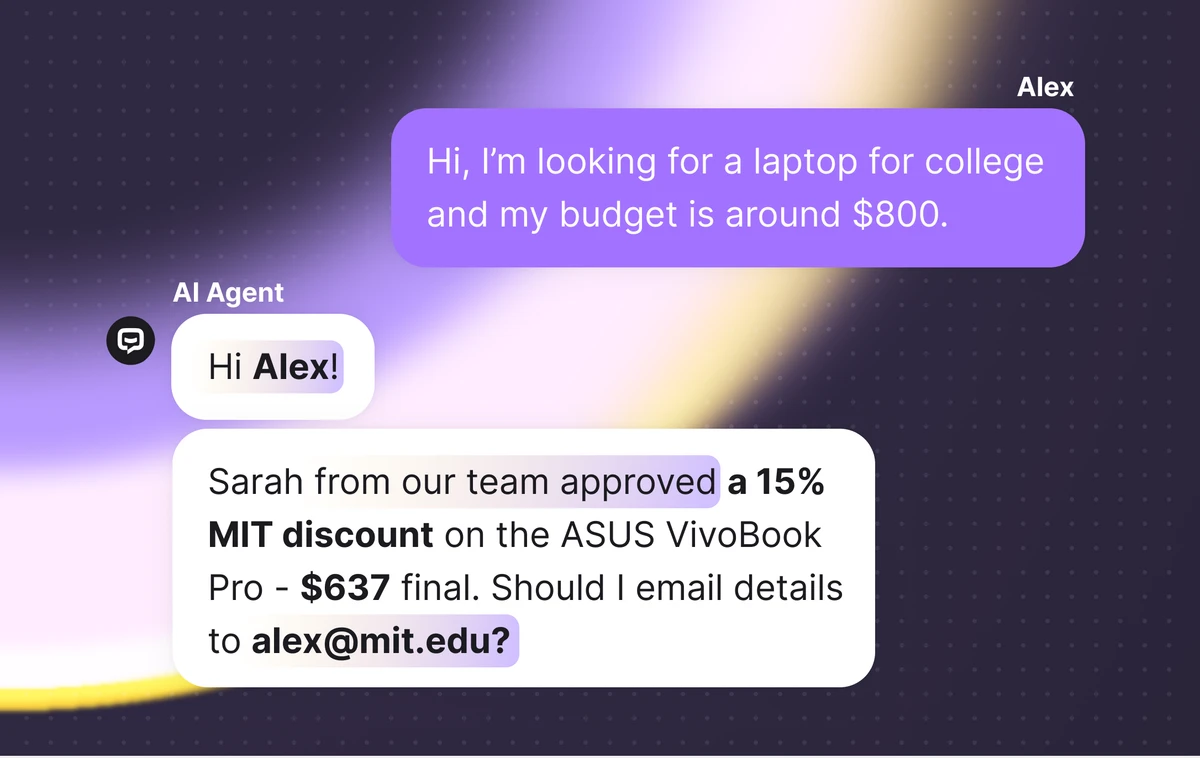
Our AI agents handle routine questions instantly, pulling answers from your knowledge base and past interactions. When a situation requires empathy, negotiation, or deeper problem-solving, the system routes the conversation to a human with full context intact.
Conflict resolution
Conflict resolution is an essential part of effective communication, especially when disagreements or misunderstandings arise. Navigating conflict requires a blend of communication skills, including the ability to express yourself clearly and listen actively to others.
Using thoughtful verbal communication, such as speaking in a calm, respectful tone and using “I” statements, helps you express your own emotions without assigning blame. Written communication can also be useful for clarifying points and documenting agreements, especially in professional settings.
Nonverbal communication plays a significant role in conflict resolution. Facial expressions, body language, and eye contact can all signal openness or defensiveness, often revealing more than actual words.
Being aware of these nonverbal cues, both in yourself and others, can help you better understand underlying emotions and intentions. Practicing active listening, focusing on the speaker, asking clarifying questions, and summarizing what you’ve heard, shows respect and helps uncover common ground.
Self-awareness is key during conflict. Recognizing your own emotions and biases allows you to communicate more effectively and avoid escalating tensions. By combining verbal, nonverbal, and written communication skills and approaching conflict with empathy and a willingness to understand, you can resolve disagreements constructively and respectfully.
How to improve communication skills in practice?
Improving communication is less about learning scripts and more about building habits.
Start by observing how you currently communicate. Notice where misunderstandings happen and how others respond to your tone and timing. Practice active listening and resist the urge to respond until you fully understand.
Pay attention to nonverbal signals, both yours and others’. Adapt your communication style to the context rather than relying on one default approach.
Feedback helps. So does reflection. Communication improves through awareness and repetition, not perfection.
The future of communication
Communication in 2026 and beyond is increasingly interactive, mobile-first, and conversational. People expect faster responses, clearer context, and more empathy across every channel.
AI will continue to support communication by handling routine exchanges and removing friction. Human judgment, emotional intelligence, and clarity will matter even more.
The future of communication isn’t about saying more. It’s about understanding better.

Turn communication into action
Communication isn’t just a skill. It’s infrastructure.
It shapes how teams collaborate, how leaders inspire, how conflicts get resolved, and how customers decide whether to stay loyal or walk away. The tools may change. The channels may multiply. AI may assist with speed and scale. But clarity, empathy, and intention will always be what make communication work.
The real advantage in 2026 isn’t talking more. It’s understanding better. Listening more closely. Responding with context. Choosing the right format, tone, and timing for the moment.
And when communication moves into customer support, those small details matter even more. Response time. Conversation history. Smart routing. Clear handoffs between AI and humans.
That’s where technology should support communication, not complicate it.
If you want your team to communicate with customers in one unified space, blend AI assistance with real human conversations, and remove friction from every interaction, explore the Text App. It brings live chat, ticketing, and AI-powered support into a single workspace so your communication stays fast, clear, and human.
Better communication doesn’t happen by accident. It happens by design.
If you’re ready to communicate with more clarity, speed, and confidence, explore the Text App and see how modern customer conversations should feel.
FAQ
What are the main types of communication?
The core types include verbal, nonverbal, written, visual, and listening-based communication. Most interactions combine several of these at once.
Why is nonverbal communication so influential?
Nonverbal cues often convey emotion and intent faster than words, shaping how messages are perceived and trusted.
How does culture affect communication?
Cultural norms influence tone, directness, silence, and interpretation. Awareness helps prevent misunderstandings and bias.
Can technology improve communication without harming it?
Yes, when it supports clarity, context, and responsiveness while preserving human judgment and empathy.
How can I improve my communication skills in the long term?
Focus on self-awareness, active listening, emotional intelligence, and adapting your approach to different people and situations.
Get a summary with