
Sylwia Kocur
Content Marketing Specialist
I joined Text to help introduce our products to companies looking for a reliable and forward-thinking partner in global communication. With experience as both a Product Expert and now a Content Writer, I understand what businesses need and help them discover how Text can support their goals.
Your ecommerce clients are running into the same wall. Orders come in through one system. Customer data lives in another. The support team works out of a third. And somewhere in between, someone is manually copying data between platforms, hoping nothing breaks.
That wall has a name: poor ecommerce integration. And it's costing your clients time, money, and customers.
Here's what that means for you as a Text partner. Every ecommerce business dealing with disconnected systems is a service opportunity. You have the tools to fix it, the partner program to back you up, and a product suite built for exactly this kind of work. The question isn't whether there's demand. It's whether you're ready to meet it.
What does an ecommerce integration mean
Ecommerce integration is the process of connecting an online storefront to the internal business systems that keep it running, such as inventory management, customer relationship management (CRM), accounting software, and enterprise resource planning (ERP) software, so all of that data flows into one place.
When they don't talk to each other? You get manual data entry, errors, delayed responses, and frustrated customers who feel like your client has no idea who they are.
Successful ecommerce integration supports consistent data flow between front- and back-end platforms, which eliminates the need to update multiple systems manually and reduces the risk of errors. For your clients, that's the difference between spending their day putting out fires and actually growing their business.
Why your clients can't ignore this anymore
The ecommerce landscape has changed. Customers now expect a seamless experience whether they're browsing on mobile, checking out on desktop, or following up via chat. They expect the person on the other end of a support conversation to know their order history. They expect shipping updates to be accurate. They don't expect to repeat themselves three times across three different channels.
Meeting those customer expectations requires integrated systems. It's not optional anymore.
Think about what happens without integration. A customer places an order. The inventory system doesn't update in real time. A second customer orders the same item. Now your client has an oversell situation, an angry customer, and a support team scrambling to fix something that a basic integration would have prevented entirely.
Integrating ecommerce systems creates a seamless omnichannel customer experience by connecting various customer touchpoints, which leads to measurably higher customer satisfaction and loyalty. For businesses selling across multiple channels, that kind of real-time data synchronization isn't a luxury. It's what keeps operations from falling apart.
For your clients who are running WordPress sites with WooCommerce, high-volume operations on BigCommerce, or growing brands on Shopify, the needs are similar. Each of those platforms has its own integration ecosystem. Your job as a partner is to know that ecosystem well enough to build the right solution for each client.
The platforms your clients are already on
Before building any integration stack, you need to understand where your clients are starting. The three platforms you'll encounter most often are Shopify, WooCommerce, and BigCommerce. Each has its strengths and its quirks.
Shopify is one of the most popular ecommerce platforms around, and its reputation is well-earned. It's known for ease of use and an extensive app ecosystem that makes connecting third-party services straightforward. Most of your small to mid-size ecommerce clients are probably here, and they're likely already using at least a handful of apps. The integration opportunity is in connecting those apps into a coherent data flow rather than leaving them as isolated tools.
WooCommerce takes a different approach. It's an open-source plugin built for WordPress sites, which gives it enormous flexibility and a wide variety of extensions for customization. That flexibility is also why WooCommerce clients often need more hands-on integration work. The platform doesn't enforce structure the way Shopify does, so the gap between a well-integrated WooCommerce store and a poorly integrated one can be significant.
BigCommerce sits at the more enterprise end of the spectrum. Its open application programming interface (API) architecture makes it especially suited to businesses managing large numbers of orders and products. It's built for scale, and so are the integration requirements that come with it. Clients on BigCommerce are often the ones looking for ERP integration, multi-channel inventory synchronization, and custom development work that goes beyond plug-and-play solutions.
When you're assessing a new client's needs, the first question is compatibility. Does the tool you're recommending actually work with their ecommerce platform? What version are they running? Is the integration maintained and up to date? These aren't glamorous questions, but skipping them is how projects go sideways. Businesses should check the compatibility of each tool with their existing systems and confirm they're running current versions of all software before any integration work begins.
The integrations that move the needle
Not all ecommerce integrations deliver the same impact. Some fix operational problems. Some drive revenue directly. The best ones do both. Here's where to focus your energy as a partner.
Integration type | Primary benefit for your client | Systems it connects | Revenue potential for you |
|---|---|---|---|
CRM integration | Centralized customer data: purchase history, location, and interaction history in one place | Ecommerce platform, CRM, customer support software | High — ongoing retainer work |
Customer support software | Faster, more personal support across live chat, ticketing, and automated workflows | LiveChat, ChatBot, HelpDesk, ecommerce store | High — recurring licenses + setup fees |
Inventory & order management | Real-time data synchronization eliminates oversells and manual data entry errors | Inventory system, order management system, ecommerce platform | Medium–high — complex setup, high client value |
ERP integration | Connects finance, supply chain management, and operations into a single data flow | ERP system, ecommerce platform, other business systems | Highest — enterprise-level engagements |
Payment gateway | Supports multiple payment methods, reduces cart abandonment, improves conversion | Payment gateway solutions, ecommerce platform, accounting tools | Medium — strong entry-point project |
Marketing tools | Smarter campaigns using real customer behaviors and purchase data | Email marketing, CRM, ecommerce platform | Medium — often bundled with CRM work |
Shipping solutions | Automated order updates reduce customer frustration and support ticket volume | Shipping systems, order management, ecommerce store | Moderate — quick win, builds trust |
Customer relationship management and CRM integration
Your clients' most valuable asset is their customer data, and most of them aren't using it well. CRM integration connects the ecommerce store to the system that tracks customer location, purchase history, and interaction history, so everyone in the business has a complete picture.
When a support agent can see that a customer made three purchases in the last 90 days and reached out about a shipping issue last month, that conversation goes differently. It's faster, more personal, and far more likely to end with the customer feeling valued. CRM integration makes that possible at scale.
For you as a partner, CRM integration is also an entry point into a longer conversation about the full customer support stack, and that's where LiveChat fits in naturally.
Customer support software integrations
This is where you bring Text products directly into the integration picture. LiveChat connects with ecommerce platforms to pull customer data into every chat conversation, so agents aren't starting from zero. When a customer opens a chat on a Shopify store, an agent with LiveChat can see what's in their cart, what they've ordered before, and how they've interacted with support previously.
That's not just a better experience for the customer. It's a faster resolution for the agent, which means more chats handled per hour and lower support costs for your client.
Sephora, the global beauty retailer, built exactly this kind of connected support experience using LiveChat — read about it here.
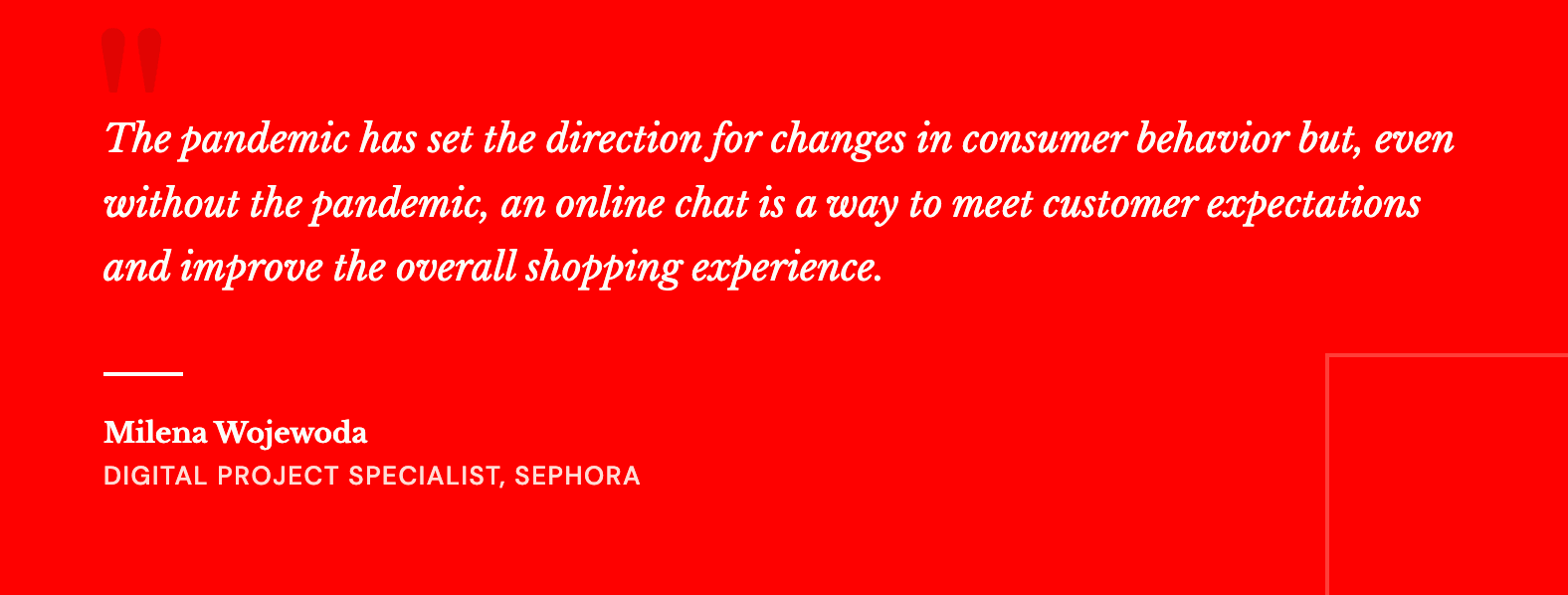
The result? Average order value increased by 25%, and sales made through chat consultations became a measurable part of the company's digital revenue.
That's the story you can tell your prospects. Customer support software integrations aren't a cost center. They're a revenue driver.
Inventory management and order management systems
Inventory levels that don't sync in real time create a cascade of problems. Oversells, backorders, inaccurate shipping estimates, and customer frustration. Integrating inventory management with the ecommerce platform means those systems share a single source of truth.
Order management integrations go hand in hand with inventory work. When an order is placed, the inventory updates. When an order is shipped, the customer gets notified. When an order is returned, the inventory reflects that too. The whole order lifecycle flows automatically, which frees up the team to focus on work that actually needs a human.
ERP integration and supply chain management
For larger ecommerce clients, the conversation eventually gets to ERP integration. Connecting an ecommerce platform to an ERP system brings finance, procurement, supply chain management, and operations into the same data environment as sales. It's the most complex type of integration work you'll take on, and it's also where the highest-value projects live.
ERP integration projects require more technical expertise and more careful planning, but they also command higher fees and tend to create longer client relationships. Once you're embedded in a client's core business systems, you become hard to replace.
Payment gateway integrations
Integrating payment gateways with ecommerce platforms allows businesses to securely handle transactions and support multiple payment methods, which directly affects conversion rates and cart abandonment. Clients who limit their payment options are leaving money on the table.
Payment gateway integration is often one of the first projects a new ecommerce client needs, which makes it a strong starting point for a longer engagement. You solve a clear, measurable problem. You demonstrate results. You build the trust for the next project.
Marketing tools and automated workflows
Email marketing platforms, marketing campaign tools, and automation systems all become more powerful when they're connected to ecommerce data. A client who can segment their email list by purchase history, cart abandonment behavior, or product affinity will run significantly better marketing campaigns than one sending the same message to everyone.
Marketing integrations also tie into customer journey work. When you know which products a customer viewed, what they bought, and how long ago, you can build automated workflows that engage them at exactly the right moment. That's the kind of customer communication that builds loyalty rather than just adding to the noise.
Where Text products fit into the integration picture
Here's something worth saying plainly: the Text® product suite isn't just a set of customer support tools. It's a foundation for the kind of integrated customer experience that ecommerce businesses need to compete.
LiveChat integrates with Shopify, WooCommerce, and other major ecommerce platforms. It pulls customer data into conversations in real time, connects with CRM systems, and gives agents visibility into the full customer relationship. For ecommerce clients dealing with high chat volumes, the combination of live agent support and ChatBot automation means they can scale without proportionally scaling headcount.
ChatBot handles the routine queries automatically: order status, shipping timelines, return policies, frequently asked questions. It runs 24/7 without any additional cost per conversation, which matters for clients selling to customers worldwide across multiple time zones. When a query needs a human, ChatBot routes it to the right agent with context attached.
HelpDesk closes the loop on customer communications by managing everything that doesn't get resolved in a live chat. Tickets, email inquiries, form submissions, all of it lands in one place, gets assigned, tracked, and resolved with full conversation history visible to every agent. For ecommerce clients managing support across multiple channels, HelpDesk is the system that makes sure nothing gets lost.
How to talk about total cost of ownership
Cost area | Visible cost | Hidden cost if ignored | Type | Ask your client |
|---|---|---|---|---|
Integration setup | Initial build or configuration fee | Rebuilding from scratch when the solution can't scale — cheaper architecture now saves this later | Upfront | Does this handle double your current volume? |
Manual data entry | Staff time spent copying data between systems | Errors from manual processes: wrong inventory levels, mis-routed tickets, delayed orders | Ongoing | How many hours a week does your team spend on this? |
Subscriptions | Monthly or annual platform fees | Redundant tool overlap — paying for features that already exist in another system | Recurring | Which tools are doing the same job twice? |
Maintenance and upgrades | Developer time to keep integrations current | Broken integrations after a platform update that nobody caught in time | Variable | Who owns integration health after launch? |
Customer support failures | Support team salaries and tooling | Lost revenue from cart abandonment, churn, and negative reviews caused by slow or inaccurate support | Invisible | What's your current cart abandonment rate? |
Legacy system debt | Cost to maintain older systems | Incompatibility with new tools forces workarounds or full replacement — both are expensive | Deferred | When was the last time this system was updated? |
Scalability gap | None — until growth hits the ceiling | A solution built for current volume that breaks at 2x — rebuilding mid-growth is far costlier than building right the first time | Future | What does your growth look like in 18 months? |
One of the most common objections you'll face is price. A client sees the upfront cost of an integration project and compares it to the status quo. But the status quo has its own cost, and it's often invisible.
Manual data entry isn't free. Every hour an employee spends copying order data between systems is an hour not spent on something that grows the business. Errors from manual processes aren't free either. Incorrect inventory data, delayed shipments, and misrouted support tickets all have a cost that shows up in customer satisfaction scores, return rates, and churn.
When you're making the case for ecommerce integration services, compare the total cost of ownership across the options. That means upfront costs, yes, but also subscription fees, maintenance, upgrade requirements, and the cost of the problems you're solving. Scalability matters here too. An integration built to handle current volume that falls apart at two times current volume isn't actually a solution. It's a deferred problem.
Cost-conscious businesses especially benefit from starting with the right architecture. It's cheaper to build something scalable from the start than to rebuild it when growth makes the original solution obsolete.
The API opportunity that most partners overlook
Here's where the revenue picture gets interesting for partners who want to go beyond standard integration work.
The Text® platform's API infrastructure is one of the most underused assets in the partner ecosystem. The APIs cover messaging, management, reporting, and customer data, and they're accessible to Solution partners for building custom integrations that connect LiveChat, ChatBot, and HelpDesk with virtually any ecommerce tool a client is running.
That opens up a category of work that goes beyond configuring existing integrations. Custom development using the Text platform API means you can build exactly the integration a client needs, whether that's a direct connection between LiveChat and a legacy system, a custom data flow between HelpDesk and an ERP, or automated workflows that trigger based on ecommerce events in real time.
Custom integrations built on the Text® platform become an extension of your service offering that competitors can't easily replicate. You're not just recommending a tool. You're building something that delivers exactly what the client needs, backed by a platform trusted by 35,000+ businesses worldwide.
This is where technical expertise translates directly into higher-value engagements. Clients with legacy systems, unusual tech stacks, or specific operational requirements need partners who can build rather than just configure. If that's you, the API opportunity is worth exploring seriously.
Getting discovered as an integration partner
You can be excellent at ecommerce integration services and still not have enough clients to show for it, if no one knows you exist. That's where visibility matters.
Text Solution partners are listed in the partner directory, where businesses searching for implementation experts and integration specialists can find them. Your profile appears to clients who are actively looking for help. Combined with co-marketing opportunities and the credibility of being a certified partner, that directory listing is a meaningful source of inbound leads.
The other side of visibility is content. Clients searching for ecommerce integration services online are asking questions before they're ready to talk to anyone. They want to know which platforms are compatible, how to think about total cost of ownership, what a real integration project looks like, and what results they can realistically expect.
If you're creating content that answers those questions, drawing on your real project experience and the results your clients have seen, you build authority in the space over time. That's an SEO strategy that pays off well past the initial effort. Long-tail keyword content ("how to integrate Shopify with HelpDesk," "WooCommerce CRM integration for ecommerce") tends to attract exactly the kind of high-intent traffic that converts into actual client conversations.

The program is designed to make it easier for partners to succeed, not harder.
Building a repeatable service offering
The best integration work doesn't end at launch. It evolves.
A client whose systems you've connected still has ongoing needs:
Software updates
New tools to integrate
Growing data volumes that require optimization
Business changes that mean the original integration needs to adapt
The way to make that happen reliably is to build a repeatable process:
A discovery phase that maps the client's current systems and data flows.
An assessment of compatibility and scalability requirements.
A proposal that shows both the integration architecture and the business case.
An implementation phase with clear milestones.
A post-launch review that identifies the next opportunity.
That process, repeated across clients, becomes a practice. A practice is what you put on your website, in your pitch deck, and in the discovery call you have with every new ecommerce prospect.
The ecommerce integration space is large, growing, and full of businesses that need what you can offer. Text gives you the products, the platform, the partner support, and the directory listing to compete for that business seriously.
Everyone has AI now. The question is whether the AI your clients are using actually does something. LiveChat, ChatBot, and HelpDesk integrated into a well-built ecommerce stack? That does something.
FAQs
What is ecommerce integration and why does it matter for my online store?
Ecommerce integration connects your online store to your other business systems, creating a single data flow across your entire business. It eliminates manual data entry, syncs inventory levels automatically, and gives your team accurate, centralized reporting — so you spend less time fixing errors and more time selling.
How do ecommerce integrations help manage customer data across multiple channels?
When your systems are integrated, customer details like purchase history, location, and interaction history all live in one place. That means your team can engage customers personally across multiple channels, run smarter marketing campaigns, and spot customer behaviors that would otherwise stay buried in disconnected data.
Can ecommerce integrations work with legacy systems and existing business processes?
Yes. Modern integration platforms and custom development work can connect legacy systems to your current ecommerce platform without a full overhaul. The key is assessing compatibility early and building with scalability in mind, so your integrated systems can grow with your business needs rather than hold them back.
What role do shipping solutions and order management systems play in ecommerce integration?
Shipping solutions and order management systems sit at the heart of ecommerce operations. When integrated, they sync with your online store in real time, reducing customer frustration from delayed updates and keeping your data flow accurate from the moment an order is placed to the moment it arrives.
How do I choose the right integration services for my ecommerce business?
Start by mapping your current business operations and identifying where data breaks down. Prioritize integrations that directly affect customer experience and operational efficiency, such as CRM, payments, and support software. Then evaluate total cost of ownership, compatibility with your ecommerce site, and whether the solution scales with your growth.