

Tomasz Ziętek
Content Creator
Experienced content and SEO specialist working with SaaS businesses since 2016. After hours, he's cycling, cooking, traveling, or digging through record crates.
Connecting a help center to an AI chatbot takes about ten minutes. Watching it answer a refund question with a policy you retired last spring takes about ten seconds.
I've been on the wrong end of that as the person who wrote the article. Writing support content left me with a habit I had to unlearn: I wrote for a reader who already had context, who knew which plan they were on and which of the two pages called "Billing" was current. A person fills those gaps without noticing. A retrieval system doesn't. It finds the closest matching paragraph and lets the customer sort out the rest.
That gap has two names.
Coverage asks: do we have the answer somewhere? Retrievability asks: can the system find that answer, read it in isolation, and use it at the moment a customer needs it? Most support teams measure the first and get judged on the second.
Quick answer: a chatbot knowledge base is the set of sources an AI agent is allowed to answer from: help center articles, product documentation, policy pages, internal wikis, and structured data like order records – or any other useful piece of information. The bot memorizes none of it. When a user sends a message, the system searches those sources, pulls the most relevant content into the model's context, and the model answers from what came back.
Disclosure up front: we build an AI Agent and a Knowledge Base product at Text, and there's a short section near the end about where ours fits. Everything before it is method, the same whoever you buy from.
What a chatbot knowledge base is
A knowledge base is a curated collection of content explaining how your product and your policies work, and it predates AI by decades. Help center content used to have one main audience: a customer who landed after a search, scanned for the part that applied, and left. Now the same library has to support customers across multiple channels, carry the customer experience on each, and satisfy an AI chatbot reading it cold, with no judgment about whether an article covers a plan you stopped selling.
So a chatbot knowledge base is that library under a different contract: every article stands alone, every policy states its own conditions, and every piece of company information the bot can reach is meant to be either correct or disconnected — that's the design goal, not an automatic guarantee. A poorly built system can still blend retrieved facts with the model's own assumptions, or guess when nothing relevant comes back, so the "correct or disconnected" promise only holds if the system is built to stay strictly grounded in what it retrieves and to admit when it's found nothing. Teams call this a custom knowledge base, to separate it from the model's general training.
The artificial intelligence supplies the language. Your own data supplies the facts, on the condition that those facts are kept current — an outdated policy in the knowledge base gets repeated just as confidently as a correct one. The job: answer customer questions correctly, in your voice, at whatever hour they arrive.
How AI agents use knowledge sources
The mechanism has a name: retrieval-augmented generation (RAG). The paper that introduced it pairs a retriever that searches a document index with a generator that writes the answer, so the model replies from documents it just looked up rather than from memory. Most knowledge base chatbots run some version of that loop, and four steps decide what your customer gets.
Chunking. Your help center website, PDFs, internal wikis, and any external knowledge bases you index get split into sections, because a 4,000-word troubleshooting guide is mostly irrelevant to one question. The split follows your headings, so a wall of text chunks badly and a well-sectioned article chunks cleanly.
Embedding. Each chunk becomes a vector, a numerical representation of its meaning. That's why a customer can type "my package hasn't moved in a week" and reach "Tracking a delayed shipment." The words don't match, the meaning does. Keyword search can't make that jump; natural language processing can, and that's the entire reason this step exists.
Retrieval. The user's query gets embedded the same way, and the closest chunks come back — all the relevant information the model will ever see. Metadata filters narrow the field first: product, locale, plan tier, date.
Generation. The chunks go into the model's context with the question and your instructions on the bot's tone, and the model writes an answer out of them in ordinary human language rather than quoting them back. All of that rewriting happens at this step and nowhere else, which is the trap: human-like answers are a property of the phrasing, not of the retrieval underneath it, so a reply can read perfectly and still be built on the wrong chunk.
Two failures follow. Content that doesn't exist sends retrieval to the nearest adjacent page: a coverage failure. Content that exists but chunks badly gives the same wrong answer from better material: a retrievability failure. Only the first shows up when somebody counts connected articles.
Knowledge base vs scripted chatbot
A scripted bot is a decision tree: someone wrote the branches and the predefined responses, and the conversation follows them or dies. It can't answer questions nobody scripted. An AI agent works from meaning instead of matching, and because knowledge base chatbots answer from a library rather than a script, one article handles a question asked eleven ways and covers the long tail of customer queries nobody would script.
Scripted chatbot | Knowledge base chatbot | |
|---|---|---|
How it answers | Predefined responses on a fixed path | Generative AI writing from retrieved content |
Coverage | What someone built | What you documented |
Fails by | Dead-ending the conversation | Answering confidently from the wrong page |
Maintenance | Editing flows | Editing knowledge base content |
The failure modes tell you more than the feature lists do. A bad chatbot built on scripts frustrates people by refusing to understand them, which you find out immediately. A bad chatbot built on a knowledge base sounds certain and is wrong, and that customer frustration surfaces later, after someone acted on the answer. Lower operational costs are one of the main reasons support teams move anyway, and the saving is real, on the far side of the content work.
What content to connect
This is the coverage question: do we have the answer somewhere, and is it the version we'd stand behind?
Start with what you already answer. Your self-service resources are the raw material, and not all of it belongs in the index. Pull your last few thousand customer inquiries, rank the topics by volume, connect them in that order. That ranking is also how you identify knowledge gaps: a high-volume topic with no article behind it is a gap no AI tools can paper over.
Help center articles and FAQs cover the common questions and are the obvious core. Product documentation and troubleshooting guides are where complex issues get resolved, written by specialists with deep technical expertise for readers who have some, so they need the most editing. Policy pages are high stakes, low volume, and first to go stale. Internal wikis and macros hold the answers your support teams actually give, in shorthand that needs a pass first. Leave out marketing pages and superseded versions of anything.
How to structure support content
And this is the retrievability question, which is where the article I mentioned at the top went wrong. The fix wasn't better prose.
Write each article so it stands alone. Retrieval may hand a customer one section of one page with nothing around it, so a detail the answer depends on gets restated rather than referenced, and conditions come before instructions. "This applies to stores on Shopify Plus" belongs at the top, not in a closing note.
Use intent-driven titles. Name the article after the question a user actually types: "Why was I charged twice?" beats "Billing cycle overview." One question per article, too — a page answering six retrieves as a compromise for all six.
Keep headings descriptive. They're the split points for chunking. "Step 3" tells the retriever nothing; "Step 3: Connect your domain" tells it plenty, and step-by-step instructions chunk better than walkthroughs.
None of this makes the writing worse for humans. It makes the cost of skipping it visible, because a machine reads your work in isolation and can't be charitable about it.
Handling product, policy and order information
Three categories break the "just connect your articles" model, because the answer shouldn't be in an article at all.
Product information changes constantly and lives in a system. Pricing, specs, and stock belong in an API or a catalog feed, because the hand-written version goes wrong within a month, usually unnoticed.
Policy information is where a confident wrong answer costs real money. Return windows, warranty terms, and refund eligibility need one canonical page each, dated, with superseded versions deleted rather than archived. A second live refund policy is how an AI agent ends up making a promise your team has to honor — and duplicates are invisible to a coverage count: on paper you just have two articles about refunds.
Order information isn't knowledge at all. It's a lookup, and it needs authentication before anything gets disclosed. The knowledge base explains how shipping works; the order system says where this package is, which is what makes personalized responses possible.
Freshness and governance
A stale article in a chatbot knowledge base is coverage that has quietly turned negative: it still counts as an answer, and it's now producing wrong ones. A stale help article at least looks old. A generated answer arrives as a confident sentence with no date and no source, so the staleness is invisible and the defense has to be upstream.
Governance is three decisions you make once and enforce forever. Who can publish to the index. What happens at a product release, where affected articles belong in the shipping checklist. And who deletes, because removing content is the hardest habit to build.
Accurate responses have an upkeep cost, and this cadence covers it: policy pages quarterly, high-volume articles at every release, everything else once a year. Anything unreviewed past its window drops out of retrieval automatically.
Hallucination prevention and guardrails
Grounding answers in retrieved content reduces fabrication. By how much is a harder question than vendors admit, and it never reaches zero.
The best public evidence comes from an adjacent field. In 2024, researchers at Stanford University's RegLab and HAI, with a co-author at Yale, benchmarked professional legal research tools built on this architecture — retrieve from a curated source, then answer — and found them hallucinating on one in six queries or more. Legal research isn't customer support, so don't read the number across. Read what's inside it instead: the count covers answers that state the law incorrectly and answers that state it correctly while citing a source that doesn't support the claim. So retrieval didn't end invention, and it added a failure of its own — a real document, confidently misapplied. Both will happen to your refund policy.
So the guardrails have to be structural.
Restrict the answer to retrieved content. The agent answers from your sources or not at all, with no gap-filling from general training.
Set a confidence floor. When retrieval returns nothing close enough, the bot says it doesn't know and escalates. Admitting a gap keeps more trust than improvising.
Cite the source. Link the article each answer came from. It doubles as a diagnostic: a wrong page cited is a retrievability problem, nothing cited is a coverage problem.
Fence the sensitive topics. Refunds past a threshold, legal terms, financial advice, any exception to policy. These route to a human by rule, not by the model's judgment.
Constrain the persona. Your brand's tone belongs in the system instructions, with a list of what the bot won't discuss. A platform that offers customization options for the first and nothing for the second has solved half the problem.
Human escalation
Most teams measure a bot by how few conversations reach a person. I think that's backwards. The number that matters is how few reach a person badly: after four failed attempts, with no context, from a customer who has to start over.
Escalate on low retrieval confidence, on explicit request, and on repetition — two identical questions in a row means the first answer failed. Then hand over the whole conversation: the transcript, what the bot retrieved and answered, the account context. A human agent who opens the chat with "can you explain the issue again?" has just told the customer those five minutes were wasted, which costs more customer satisfaction than any tuning on the answers.
Human agents aren't the fallback for a broken bot. They handle the complex problems: a policy exception, anything needing authority the model doesn't have. Design for human intervention there, and the AI agent is left to provide answers to the repeatable questions that fill the rest of the queue.
It's worth being precise about which half of that stack the research actually covers. The most cited field study of generative AI in support — Brynjolfsson, Li and Raymond's Generative AI at Work, an NBER working paper from 2023 published in the Quarterly Journal of Economics in 2025 — followed 5,179 agents using an assistant that suggested replies while they worked, not a bot answering customers on its own. Issues resolved per hour rose about 14%, and the gain sat almost entirely with novices; the most experienced agents saw little or none. Read it as evidence about tooling the people on the other side of the escalation, not about how well a chatbot answers. AI raises the floor of a support team, not the ceiling.
Testing answer quality
Testing separates an AI-powered tool you trust from one you babysit. Build a test set of 100 to 200 real customer questions pulled from transcripts rather than invented in a meeting, covering the high-volume topics, the policy questions, and a few things the bot should refuse. Run it before launch and after every change to the chatbot knowledge base.
Score each answer on accuracy against the source, whether it retrieved the right document, whether it resolved the question, and tone. Log every failure with its cause, because the causes sort into the two halves of this piece: missing content is a coverage problem and a writing task, wrong retrieval on content that exists is a retrievability problem and a structure task.
In production, watch resolution rather than deflection. Deflection counts customer interactions no human touched, and a fast wrong answer deflects beautifully before coming back two days later as a worse ticket.
Maintenance workflow
An AI chatbot is a product rather than a project, and the loop is one question on a schedule: what did we get wrong this week, and was it coverage or retrievability?
Weekly: review escalations, low-confidence conversations, and the unanswered question log, sorting each into a missing article or a findability problem.
Monthly: re-run the test set, fine-tune the instructions wherever the tone drifted, and audit the index for duplicates. Continuous improvement means a number that moves.
One person owns this loop. Split it across a team and it becomes nobody's.
Where the Text AI Agent fits
I promised at the top to say where ours sits, so: at Text we build an AI Agent that answers customers, and a Knowledge Hub that holds what it's allowed to answer from. The split is the only part worth your attention. The agent is step four from the list above. The hub is steps one to three, and it's the one that decides whether any of it works.
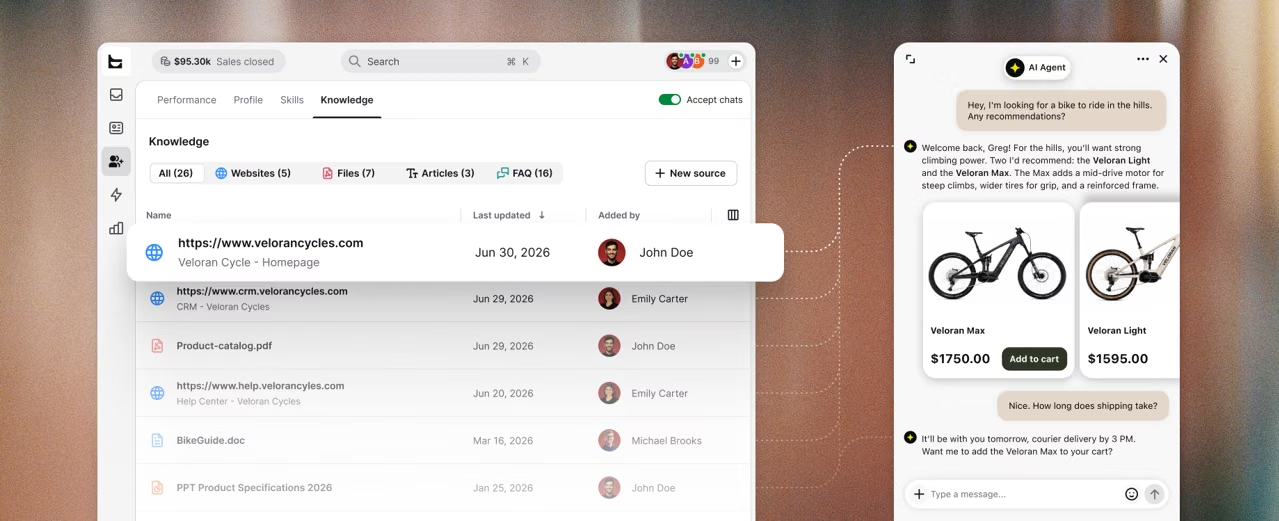 Which puts our own product under the argument in this piece: reliable answers come from maintained sources rather than a better model, so the agent is only ever as good as what your business has written down. Connect a thin help center and you get a thin agent. Connect two live refund policies and something will quote one of them at a customer, and no vendor here, us included, can tell you which one. What a tool can control is the moment retrieval comes back empty: ours stops and routes to a person rather than filling the gap from training data. That's the "correct or disconnected" line from the top of this piece, and the disconnection is the escalation.
Before you buy anything, ours included, I'd make someone show you three things on your own content, not the demo data: what it does with a question it has no source for, whether it tells you which article an answer came from, and how much of your existing library needs rewriting before it retrieves cleanly. Budget for the third. It's most of the work and none of the demos show it.
If you field twenty questions a month, you don't need any of this.
The real knowledge base problem
An AI support agent is only as reliable as the knowledge it can retrieve and the rules around what happens when it can't.
That makes the work less about feeding a model more content and more about maintaining a system: knowing what should exist, making each answer retrievable on its own, removing what is no longer true, and measuring where the agent goes wrong.
The useful distinction is simple. Coverage is a content problem. Retrievability is a structure problem. When an answer is wrong, start there. Did you fail to document the answer, or did you document it and fail to make it findable? The model is the last step in that chain. The knowledge base is everything that makes the answer worth trusting.