

Most of your clients are running customer support out of four or five tools that were never built to talk to each other. A website chat here, a WhatsApp number there, an inbox nobody checks on Fridays. Omnichannel customer support software fixes that by pulling every channel into one place and reaching out before a visitor even asks for help. That's the short version. Here's why it's also one of the easiest upgrades you'll ever pitch.
This is the second piece in our series for solution partners, and it picks up where the last one left off: Text unifies website chat, email, SMS, WhatsApp, Messenger, and more into a single conversation view, then layers proactive engagement on top of it. If you sell or promote Text, this is the feature set that turns a support conversation into a business case.
The channel sprawl problem your clients don't know how to name
Ask a support manager how many tools their team uses, and you'll usually get a pause, then an honest answer: more than they'd like. Website chat in one tab. A WhatsApp Business app on someone's phone. An email inbox shared between three people who all think someone else replied to that ticket from Tuesday. Nobody designed it this way. It just grew, one channel at a time, until an agent handling a WhatsApp question and a website chat in the same hour has to switch platforms and lose the thread halfway through.
That's not a support problem. It's an infrastructure problem, and it's the exact gap that omnichannel customer support software was built to close. Once you can name it out loud in a client meeting, most of the pitch writes itself. You're not selling a new tool. You're pointing out something they already feel every day.
Multichannel and omnichannel are not the same pitch
Part of your job is helping a client tell these two apart, because most of them think they already have an omnichannel setup when what they actually have is multichannel.
- Multichannel support means a business offers several ways to get in touch, chat, email, social, phone, but each one runs on its own, with its own history and its own blind spots. A customer who emails, then switches to chat, starts over. Multichannel is what channel sprawl looks like once you give it a name.
- Omnichannel support connects those same channels so the conversation and the customer's full context travel together, no matter which one they pick. It's the difference between a client saying "we support customers on five channels" and a client who can actually say "our customer support software adapts to a customer's needs across five channels without ever making them repeat themselves."
Once a client sees that distinction, the pitch stops being about adding a channel and starts being about connecting the ones they already have.
One inbox, every channel your customers already use
With Text, website chat, email, SMS, WhatsApp, Messenger, and more, all flow into a single conversation view. An agent can pick up a WhatsApp question and a website chat in the same hour and see both in one place, with full history attached, instead of hunting through five different apps to piece together what a customer already told someone else.
That single view matters more than it sounds. A customer who starts on WhatsApp and follows up by email shouldn't have to explain their issue twice. The agent who picks up that thread should already know what was said, what was promised, and what's still open. Because all the data attached to a customer, like message history and past orders, travels with the conversation, the experience stays consistent no matter which channel someone picks. Customers can switch channels without starting over, which is the whole point.
.png)
The website widget that closes the gap between chat and commerce
Talk to any client running an online store and they'll tell you the same thing: most of their site visitors never click the chat button. They browse, they hesitate, they leave. Text's website widget is built around that exact moment. It ships with contact forms, an FAQ template, product cards, and AI-driven recommendations, and none of it requires a developer to set up.
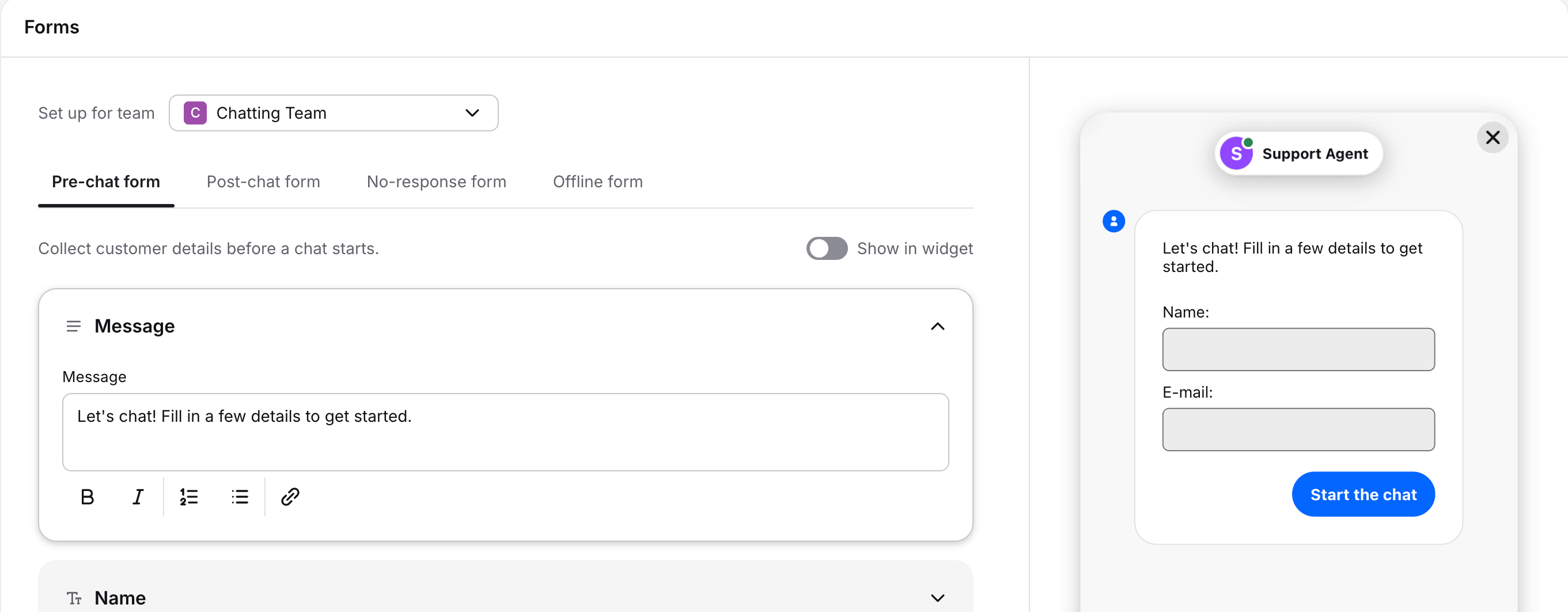
Product cards carry an image, a title, a description, and up to three buttons, and a few of them strung together become a carousel that a customer can scroll through without leaving the chat window.
-(1).png)
No separate tool is needed to manage any of it either. That's the detail worth repeating to a client who's currently juggling a chat plugin, a separate FAQ page, and a product recommendation app from three different vendors. Text folds all three into the same widget your visitors already see.
A trading platform kept its five-star rating through a 15x traffic spike
Numbers are convincing. Real clients are more convincing. Funded Trading Plus, a prop trading platform operating across North America, Europe, and Asia, ran into a stress test most support teams dread: a major industry-wide disruption in 2024 that sent daily inquiries up 1500% overnight. Competitors' public ratings dropped during the same disruption. FT+'s didn't.
Jamie Miller, the company's Chief Strategy Officer, credited the response with helping the firm "save our five-star reputation" during the spike, even as rival platforms saw their TrustPilot scores fall. Behind that result was a support setup that automated 18% of all interactions, taking routine questions off human agents entirely, while still maintaining a 93% customer satisfaction rating across roughly 125,000 chats a year.
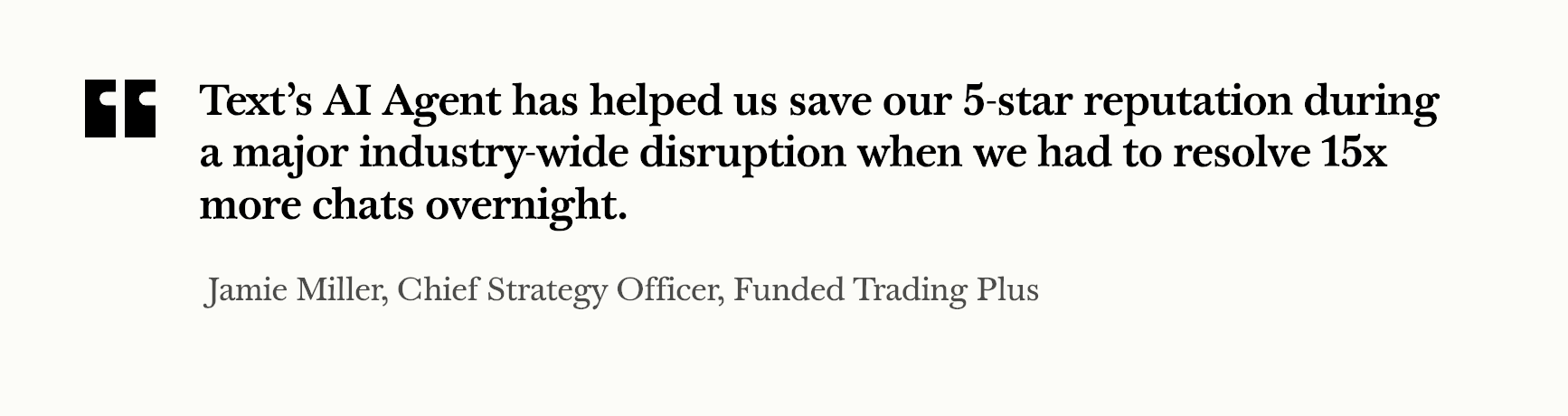
That's not a hypothetical. That's a company measuring what happened to its reputation during the worst week of the year and finding the numbers held. When you're pitching omnichannel customer support software to a client in a fast-moving or high-volume industry, this is the kind of story that turns a features conversation into a risk-management conversation.
Native integrations that plug into what your client already runs
A client's existing stack shouldn't have to be replaced to get any of this working. Text connects directly with the tools most businesses already have running:
- Shopify, for cart previews, order history, and product recommendations right inside the agent panel.
- Facebook Messenger, so social conversations land in the same inbox as everything else.
- WhatsApp, including file and audio uploads.
- Twilio, for SMS and voice, so an agent can text a customer back from the same window they're already chatting in.
- WordPress and Webflow, through a plugin that adds the widget to a site in minutes.
That's a meaningfully different pitch than telling a client they'll need to rebuild their workflow around a new platform.
Turn every conversation into a unified customer timeline
Ask a support agent what slows them down most, and the answer is rarely the customer. It's the five minutes spent digging through past tickets, old emails, and a separate CRM tab just to understand what already happened.
Omnichannel customer support software solves this by attaching a customer's full history, past orders, previous chats, notes from other agents, to the conversation the moment it opens. An agent picking up a new message already has the context another team member built last week, which is most of what first contact resolution actually depends on.
.png)
Text's reporting dashboard tracks the pieces that make this useful in practice: response times, chat duration, missed chats, and satisfaction scores by agent or by team. Internal notes let one agent flag something for the next person without the customer ever seeing it, so a complex issue can move between team members without forcing the customer to repeat themselves.
None of this requires a separate business intelligence tool bolted on afterward. The data a client needs to spot where support is working, and where it isn't, lives inside the same platform their agents already use every day.
For a client comparing this against an all-in-one suite like HubSpot Service Hub, the honest framing is that HubSpot bundles support into a broader CRM, while Text plugs directly into whatever CRM a client already runs. Neither is wrong. It depends on whether a client wants to consolidate their entire stack or keep their existing CRM and add a purpose-built support layer on top of it, which is often the faster and less disruptive path for a mid-size team.
Let customers help themselves before they ever open a chat
Not every customer wants to talk to someone. Some just want the answer, fast, without waiting for an agent to become available. A self-service layer, an FAQ widget synced to a client's most common questions, sitting right inside the same interface as live chat, catches those customers before they ever open a conversation. That matters more than it looks on paper, because every question answered through self-service is one an agent never has to touch, which frees that agent up for the conversations that genuinely need a human.
This is also where the numbers tend to support the pitch on their own. Industry research on AI-assisted support operations puts the cost reduction from combining automation with live support somewhere in the 25% to 45% range, largely because routine questions get answered without ever routing to a live queue. You don't need a client to trust a big, round statistic here. You need them to picture their own FAQ page and realize how many of those questions their agents currently answer over and over by hand.
Agent productivity gains that let a team scale without adding headcount
The most common budget objection you'll hear from a client's finance team is some version of "we'd need more agents to cover more channels." That's backwards. The point of consolidating channels into one inbox is that a single agent can competently handle several conversations at once, because the context for each one is already sitting in front of them instead of scattered across five open tabs.
Research from Emarsys, cited across customer experience benchmarks, found that 52% of customer-focused companies reported that connected, omnichannel programs boosted individual customer engagement and interaction volume per agent, compared to 46% of companies without that focus. That's not a dramatic gap on paper, but it compounds.
A team that can handle a modestly higher volume per agent, quarter after quarter, avoids a hiring conversation that would otherwise show up on next year's budget. That's the argument that resonates with an operations lead who's being asked to do more with the same headcount.
Proactive campaigns that reach out before customers have to
Reactive support waits for someone to click the chat button. Proactive support notices that a visitor has been sitting on a pricing page for ninety seconds, or has viewed four product pages without buying anything, and reaches out first. Text's Campaigns feature lets a client set conditions like browsing time, number of pages viewed, or the path a visitor followed through a site, then trigger a message the moment those conditions are met.
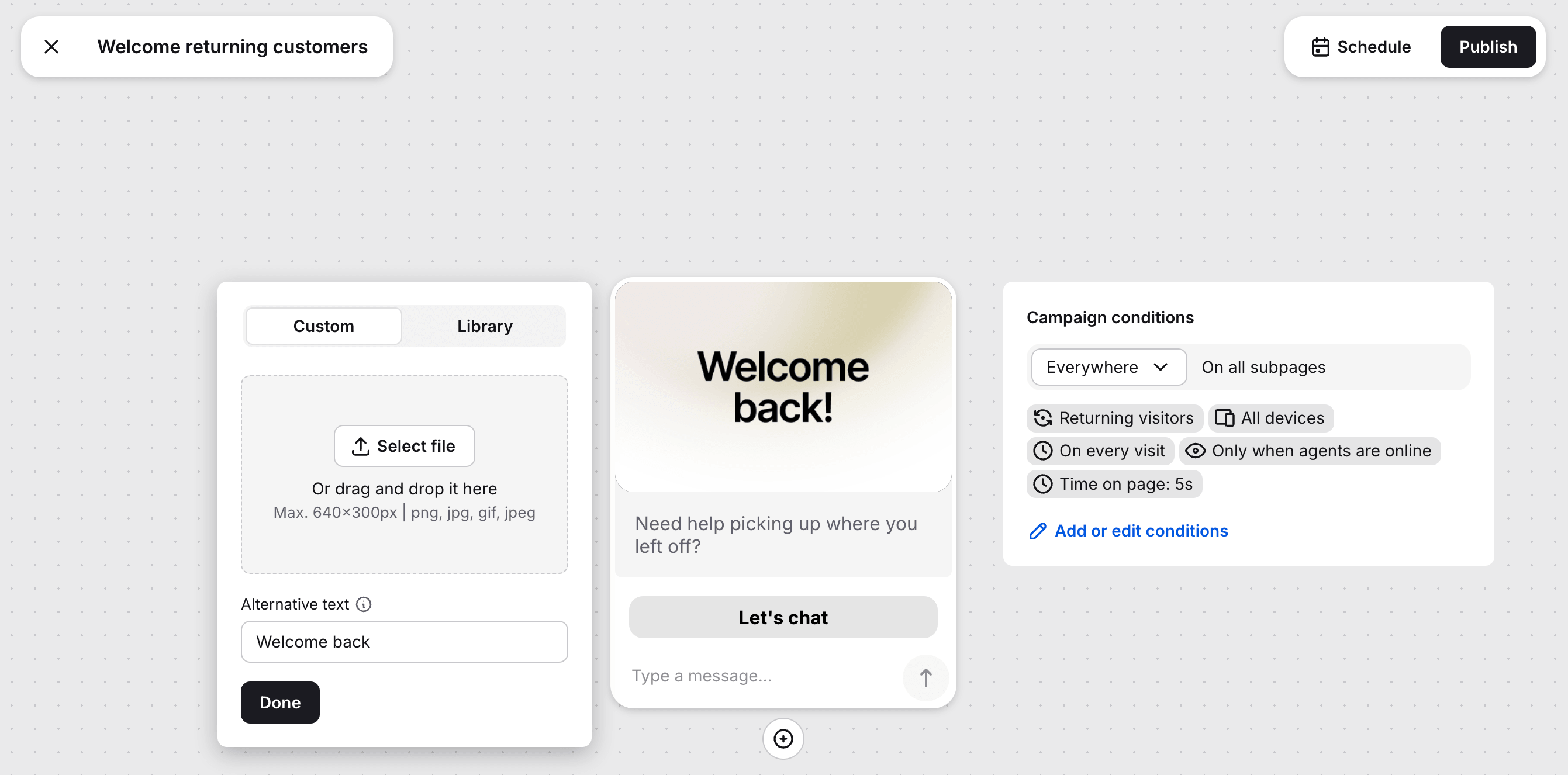
A digital marketing agency ran into this the other way around. Investigator Marketing was facing rising costs per conversion across client campaigns, so it began engaging website visitors proactively instead of waiting for them to click the chat button, then A/B tested different triggers to fine-tune timing and messaging. The reporting built into the platform gave the agency visibility into agent performance and visitor behavior it hadn't had before, which let it keep refining the approach.
The result was close to a 50% reduction in cost per conversion across multiple client verticals, without any increase in ad spend. That's the kind of number that turns a proactive-engagement pitch into a marketing-budget conversation, not just a support one.
Support customers in their own language, everywhere
A client expanding into a new market usually assumes that means hiring local support staff. It doesn't have to. Text's widget and greetings are translated into more than 45 languages, including right-to-left support for Arabic and Hebrew, with a full language list of 48 options a client can assign per group or per page. Real-time translation built into the platform lets a single agent assist a customer in Spanish, French, or dozens of other languages without ever needing a dedicated bilingual hire for each new market. One brand voice, in every market a client serves, without a hiring plan attached to each new language.
Why omnichannel is the retention argument your clients actually care about
Every client cares about growth, but the number that tends to land hardest in a support conversation is retention. Aberdeen Group's research found that companies with strong omnichannel engagement strategies retain 89% of their customers, compared with 33% for those with weak engagement. That's not a small gap. It's the difference between a client who keeps their customer base and one who's constantly replacing it.
Spending habits follow the same pattern. Customers who interact with a business across multiple connected channels tend to spend more than single-channel customers, a pattern documented in Harvard Business Review's cross-channel retail research and cited by customer engagement analysts as roughly a 10% lift in spend. Put those two numbers side by side, and the pitch becomes simple: a unified system keeps more customers, and the ones it keeps spend more while they're around.
It's also worth knowing where Text sits against the tools a client might already be comparing it to. Freshdesk's entry-level paid plan runs $19 per agent per month as of mid-2026, with add-ons for AI features priced separately. Zoho Desk offers a free plan capped at three agents before paid tiers start. Zendesk positions itself for larger teams with heavier automation needs, at a higher price point across the board. None of that makes those tools wrong for every client. It does mean you can walk into a comparison conversation with real numbers instead of a shrug.
A simple way to walk a client through the math
Statistics convince a room. A calculation convinces a budget owner. Here's a rough version you can adapt on a whiteboard in front of a client, using illustrative figures rather than any single company's real numbers.
Say a client's support team currently handles 2,000 contacts a month, split across phone, email, and an unconnected chat widget, at an average cost of $6 per contact, including agent time and tooling. That's $12,000 a month. If moving half of those contacts to a unified, proactive chat experience cuts the average cost per interaction by even a third, a shift well within what automation-driven case studies routinely report, that's a savings of roughly $2,000 a month on that segment alone, before accounting for the additional sales that proactive engagement tends to generate. Multiply that by twelve months and a client is looking at a five-figure annual argument built from numbers they already have sitting in their own support software.
You don't need the client's exact figures to run this exercise. You need their contact volume and their rough cost per contact, both of which most support managers can pull up on the spot. That's what turns "here's a nice feature" into "here's what this is worth to you specifically."
How you earn more from every omnichannel deployment
This is the part of the pitch that's easy to skip and expensive to skip. Every channel a client adds, every integration you configure, every campaign you design, is its own implementation project. Price it as a service, not as a toggle switch a client flips on their own.
A few concrete ways that shows up in practice:
- A client expanding into a new market needs a new language and often a new channel, which is a natural moment to expand the contract rather than chase a brand-new client from scratch
- Behavior-triggered campaigns can be designed and optimized as a paid advisory service, not a one-time technical setup, since the conditions that work well in month one rarely stay optimal by month six
- Consolidating a client's channel sprawl into one inbox is an easy, tangible upgrade to demo, and an easy one to close, because the "before" picture is something every prospect already recognizes from their own inbox
What clients actually push back on
A few objections come up often enough that it helps to have an answer ready before the meeting.
We already have a CRM, why add another tool?
Text isn't replacing the CRM. It's the layer that captures conversations across channels and feeds that context back into the CRM a client already runs, through a native integration rather than a rebuild.
Our team is small, is this overkill?
A client with three agents benefits from the same unified inbox as a client with thirty. The difference isn't headcount, it's how many channels a client's customers are already using without anyone on the team realizing it.
What if our customers don't use WhatsApp or Facebook?
Then those channels simply sit unused at no extra cost, and the client still gets the website widget, product cards, and proactive campaigns on day one. The value doesn't depend on lighting up every channel at once.
How long is the implementation going to take?
A single channel, usually the website widget, can be live within a day. Additional channels, like WhatsApp or a CRM sync, get layered in over the following weeks as each integration is configured and tested, which is exactly why implementation is billed as a project rather than bundled into a flat monthly fee.
Our compliance team is going to have questions.
That's a fair concern for a finance or healthcare client, and it's worth addressing directly rather than waving it off. Point back to what already convinced a trading platform handling sensitive financial data: a support setup with clear escalation paths from automation to a human agent, and enterprise-grade security standards, tends to satisfy compliance reviewers faster than a patchwork of disconnected, unvetted channels ever could.
Check the Text Trust Center for the latest information about compliance and process explanations.
Where to start a client's rollout
Trying to launch every channel on day one is how a good pitch turns into a stalled project. The pattern that tends to work is:
- Start with the channel a client's customers already use the most, usually the website widget, get the team comfortable with the unified inbox and reporting, then add a second channel once that first one is producing visible results.
- A proactive campaign or two comes next, once there's enough traffic data to know which pages and behaviors are worth targeting.
- Language expansion and deeper CRM integration usually come last, timed to whatever market or product launch a client already has planned.
This sequencing does two things for you as a partner. It keeps the first invoice modest enough that a client says yes quickly, and it builds in the natural expansion points described above, so the second, third, and fourth phases of the project are conversations you're already positioned to have.
Position it once, expand the contract forever
The clients who feel channel sprawl the most today are the same clients who'll need a new language, a new integration, or a new proactive campaign strategy in six months. Each of those is a reason to open a conversation, not a reason to wait for the client to ask. A support team that's happy with its unified inbox this quarter is a support team that'll want the same thing extended to their next market, their next product line, their next campaign idea.
That's the shape of a long-term Text partner relationship: not a single sale, but a series of natural expansion points that appear whenever a client grows. Everyone has AI. Sell and promote AI that actually does something, and the renewals tend to take care of themselves.
Get a summary with