
Jacquelyn Dunham
Content Marketing Specialist
Jacquelyn is a content marketing author with over 7 years of experience creating engaging and compelling content for various industries.
A shopper asks whether a jacket runs small. Your bot answers in half a second, confidently and wrongly. She orders a medium, returns it, and never opens your chat window again. You will see the return but will not see the second part.
Gartner surveyed 3,566 customers this spring and found only 27% would try a chatbot again after one bad experience. Eric Keller, the analyst who published the findings in September, called it a leaky bucket and left service teams a line worth taping to your monitor: "Service leaders should prioritize reliability over reach."
That is how this list is sorted. Not by feature count, but by how much of each AI agent is genuinely built for Shopify, and whether you can afford to let its AI touch every conversation rather than a nervous slice.
Nothing here is ranked, because the best AI tools for your store depend entirely on what your queue looks like.
Start with your tickets, not with a demo
Pull your last 200 customer messages and sort them into three buckets. Most Shopify store owners skip this and buy from a feature list instead, then pay monthly for AI features they never switch on. The split decides which of the best AI tools suits you, and sorting takes twenty minutes.
Order questions
"Where is my order?" "Has it shipped?" "Can I still change the address?" On most Shopify stores this is the biggest bucket, and order tracking and shipping alone can run to 40% of everything you receive.
These need a live connection to your Shopify order data and nothing cleverer. Any AI chatbots wired into your orders will answer questions here with instant answers and no training. The ones that only see your knowledge base will guess, and guessing about a parcel is how you earn a one-star review.
Policy questions
Return windows, sizing advice, shipping cut-offs, what happens when a box arrives crushed. Your policies already answer these routine queries, so the work is pointing the AI agent at the right pages and keeping them current.
This is where reliability cracks. An AI assistant trained on a returns page you last touched fourteen months ago will quote the old window with total confidence, and you will honor it or lose the customer.
Judgment calls
The wedding order that missed the date. The chargeback threat. The customer who has emailed four times and is now furious. Route these to a person immediately. They are not repetitive queries and no amount of training will make them behave like ones.
Count the three buckets. If order and policy questions make up 70% of your volume, automation will pay for itself quickly and cut support costs you can actually name. If judgment calls dominate, you are shopping for a better inbox rather than a smarter bot, and no AI customer support tool will fix that.
How AI customer support tools charge you
Every one of these AI chatbots advertises a resolution rate. Almost none put the billing mechanics in the comparison table, and those mechanics decide whether the AI agent can see your whole queue or only the cheap end.
Four pricing models are in play, and they diverge sharply as your volume grows.
Per seat, with AI included
The AI agent's resolutions come with the plan, so support costs stay predictable and a busy month raises usage instead of headcount. Text works this way, Zendesk partly.
Per ticket, plus per resolution
You buy a ticket allowance, then pay again each time the AI agent resolves something. Gorgias's pricing FAQ spells out the catch: "Each AI Agent interaction also counts as a helpdesk ticket and is billed accordingly."
Per AI conversation
You buy AI conversations separately from your human volume. Tidio's Lyro works this way, and a conversation is a gentler unit than a resolution, since a twelve-message exchange counts once.
Per resolution, price on request
The AI agent comes with the plan and you pay for outcomes, except Zendesk does not publish its rate and Intercom does.
One warning before you compare these support tools. Gorgias, Tidio and Zendesk all show the annual price first, and Gorgias folds AI into its headline figure, so find the monthly toggle before you budget.
How much do AI customer service tools for Shopify cost?
Entry prices for the best AI tools here run from free to $29 per seat a month, and four of these six AI chatbots meter the AI separately from seats or tickets. Every figure below comes from the vendor's own pricing page in September 2026.
Tool | How the AI is billed | Entry price | Free plan |
|---|---|---|---|
Text | Per seat, resolutions included | $19 per user/mo yearly, $25 monthly | No, 14-day trial |
Shopify Inbox | Not metered | Free | Yes |
Gorgias | Per ticket, plus $0.90 to $1.50 per AI interaction | $10/mo helpdesk only | No, 7-day trial |
Tidio | Per AI conversation, bought as an add-on | €24.17/mo yearly, €29 monthly | Yes |
Zendesk | Per automated resolution, rate unpublished | $19 per agent/mo yearly | No, 14-day trial |
Intercom | $0.99 per outcome, on top of seats | $19 per seat/mo yearly, $29 monthly | No, 14-day trial |
Two things that table cannot show about these AI chatbots. The marginal cost is what a busy month actually costs you, and past your allowance one more resolution runs $0.99 on Text, $1.50 on Gorgias plus roughly $0.36 for the ticket it also consumes, and $0.99 on Intercom on top of seats. And Zendesk's unpublished rate is the honest answer rather than an omission, because no figure appears anywhere on its public pricing.
Text
Best for: Shopify stores that want the AI agent selling rather than only deflecting, with AI priced per seat instead of per resolution.
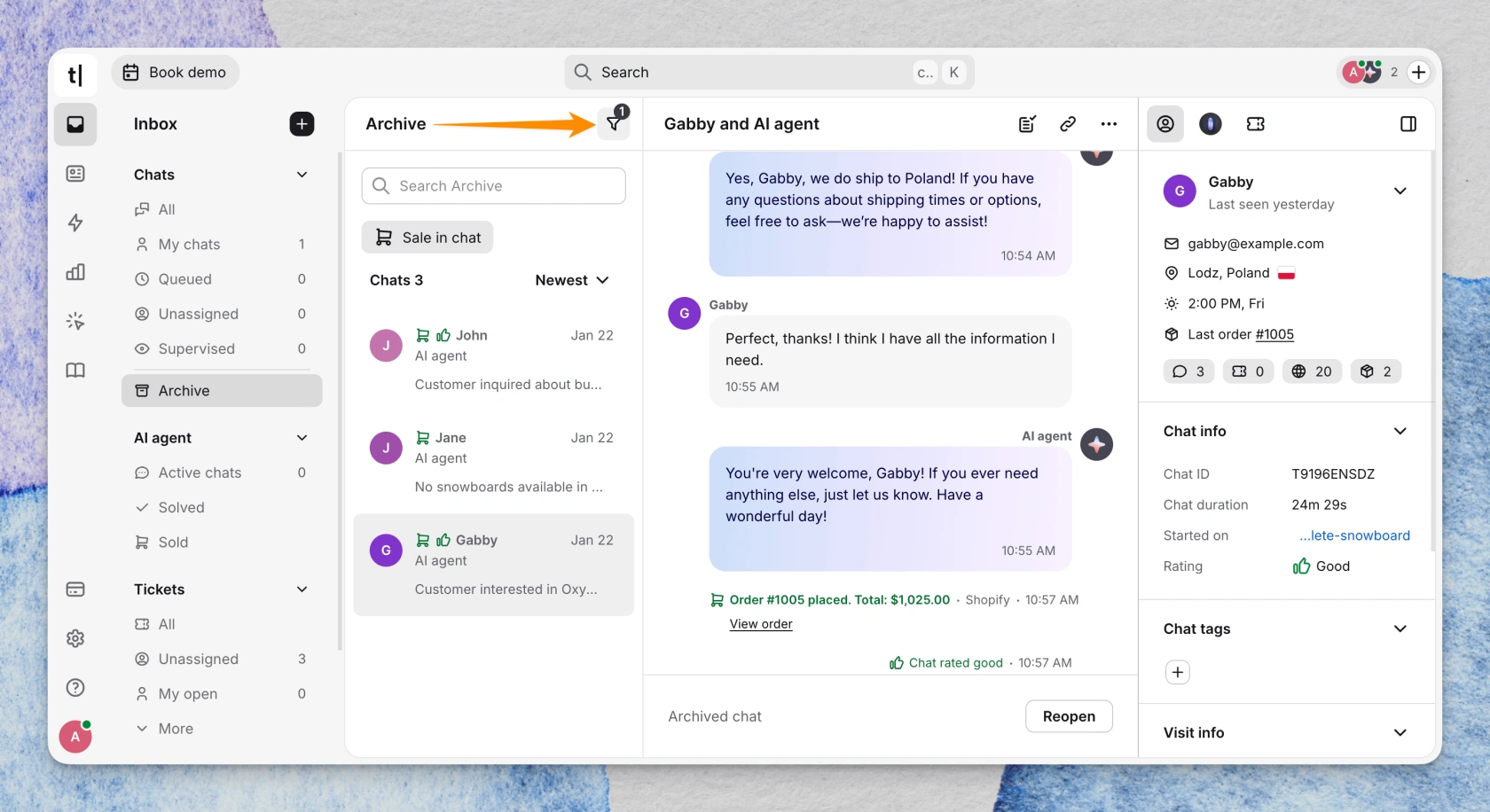 Text is an AI agent platform with live chat and a help desk built around it, and the AI agent is built to act rather than reply. Skills fire on conditions you set, so it pushes a discount code at a shopper stalling in checkout, counters a cancellation with a retention offer, or hands a Spanish conversation to your Spanish-speaking team with the context attached. The Shopify integration depth shows in what it sees: your live catalogue, the shopper's cart, their past orders and their lifetime spend, with your support team reading the same customer data without opening Shopify admin.
The AI capabilities train on what you already publish, your site, help docs and policies, and you can interrogate the agent before it goes live, which given Gartner's 27% matters more than any feature here. You set handoff rules by topic or signal, run separate agents per brand or region, and get revenue attributed per chat, split by AI agent, human agent and assisted. In-chat cart recovery and multilingual support across 46 languages come as standard.
Essential includes one AI agent and 10 AI resolutions. Growth, at $79 per user yearly or $99 monthly, raises that to 10 agents and 200 resolutions. Past your allowance a 50-resolution top-up costs $49.50, or $0.99 each, added automatically so the AI agent keeps working. Resolutions count only when it answers one of the customer questions put to it, and selling through Shopify sits on the entry plan, so Shopify support is not an upgrade.
Where it falls short: There is no free plan, just a 14-day trial. The chat widget covers your storefront and thank-you page on any Shopify plan, but the checkout page needs Shopify Plus, which is Shopify's rule rather than ours. And the 266% conversion lift in our own marketing compares shoppers who started a chat against shoppers who only browsed. Treat it as directional and check your own revenue reports.
Shopify Inbox
Best for: small Shopify stores testing whether chat earns anything before paying for AI chatbots.
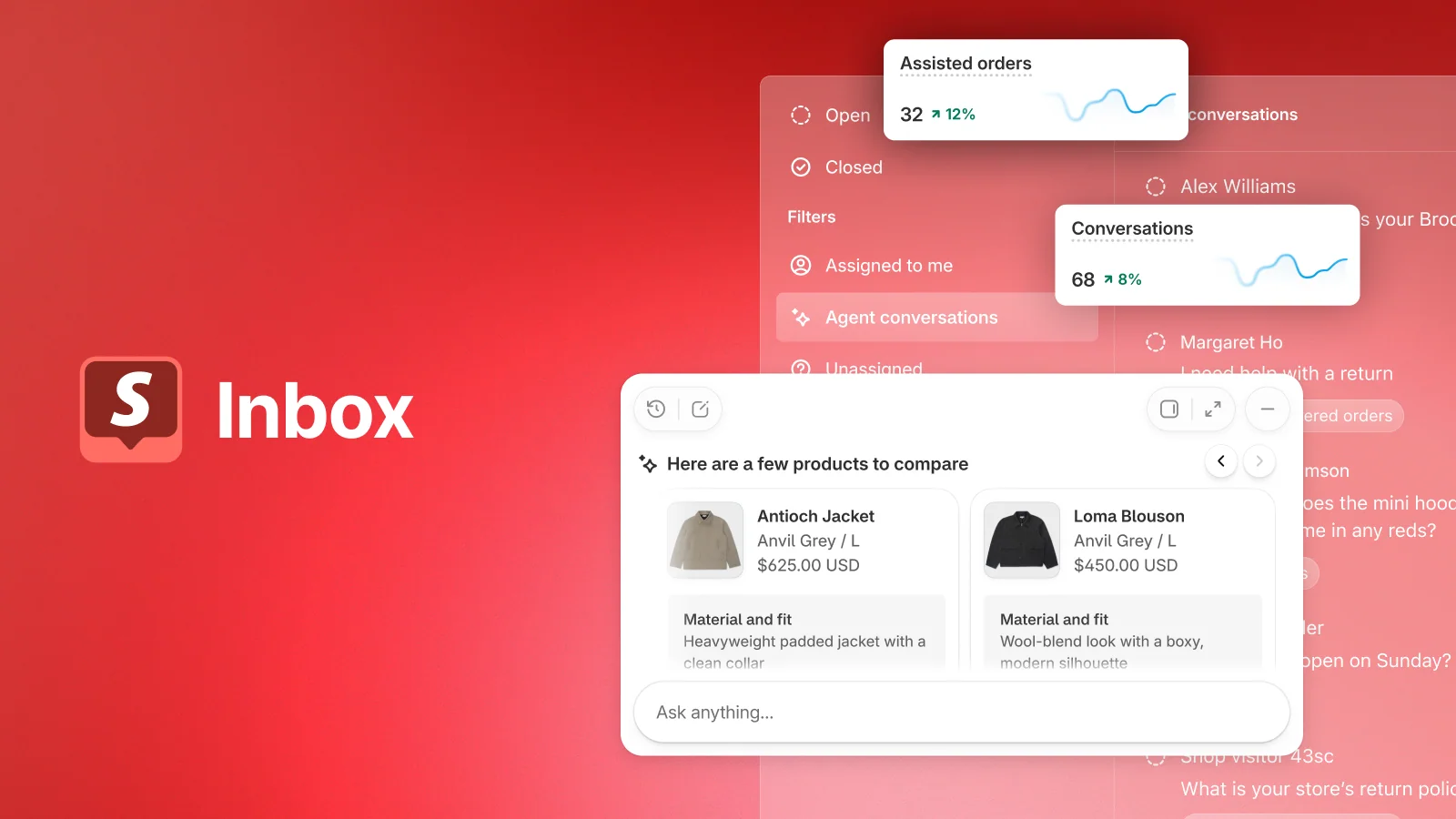 Shopify Inbox is Shopify's own messaging app and it is free, with no conversation quota or seat cap attached. Among free tools, that alone makes Shopify Inbox a solid starting point.
The key Shopify feature is that the Shopify integration needs no setup. Shopify Inbox sits inside your admin, wires itself to your catalogue and inventory, sends automated responses and instant answers on order status, and shows what is in a shopper's cart while you talk. Shopify has been upgrading Shopify Inbox into something more autonomous, and its Shopify App Store listing now promises an "AI-powered sales associate on your storefront" that learns from your catalogue, policies and store content. That is a real AI shopping assistant with access to product details, for nothing.
Where it falls short: Shopify Inbox is a chat app rather than a help desk. Nothing in it follows a return through to a refund, and there is no ticket queue to report on. Social channels are not covered either, whatever the marketing copy implies. Shopify publishes no deflection rate, so you are trusting the AI agent rather than measuring it. Use Shopify Inbox as the baseline you judge the best AI tools against, and move up once refunds start slipping through.
Gorgias
Best for: ecommerce brands that want the AI agent issuing refunds and order edits inside the ticket.
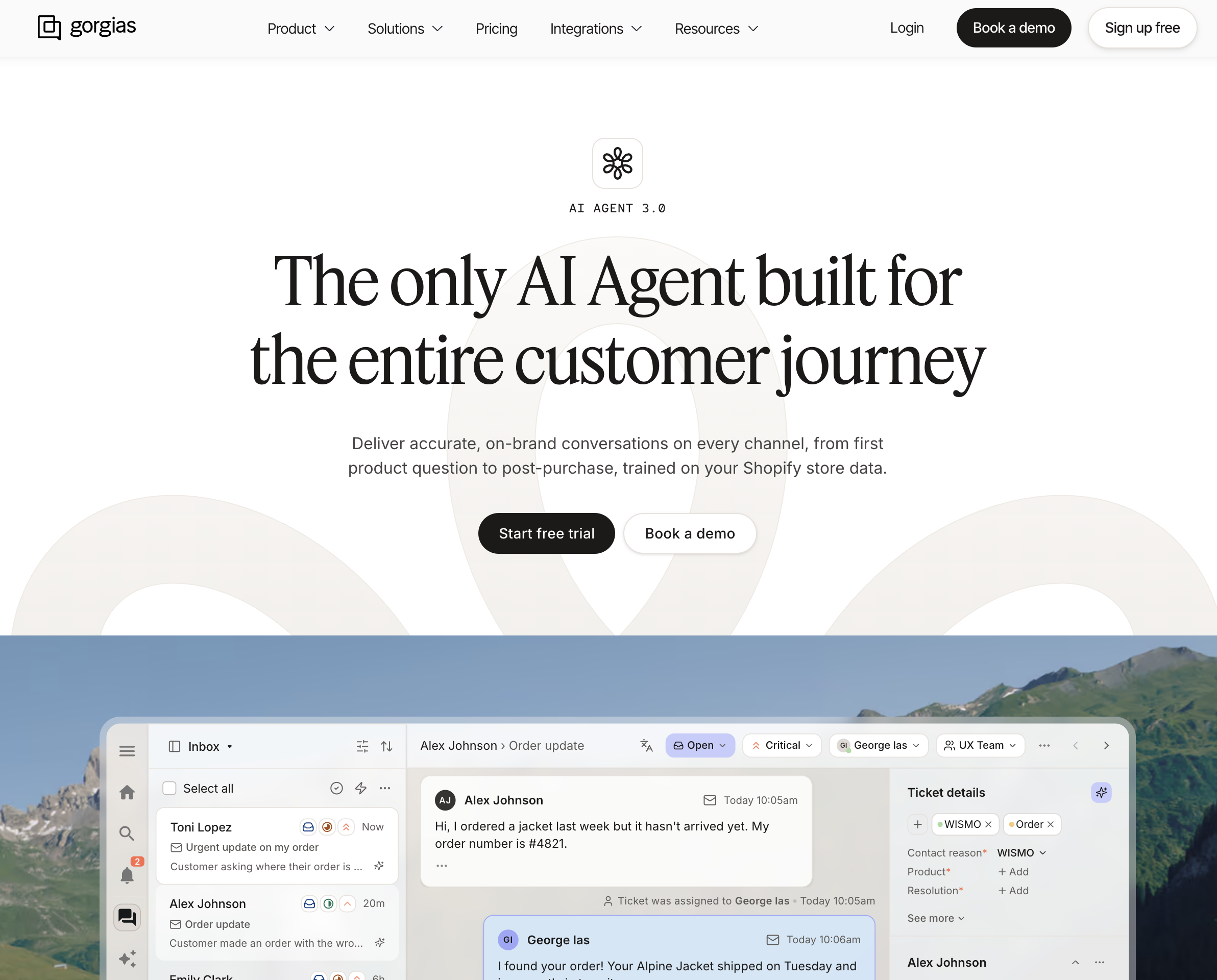 Gorgias is the most Shopify-native of the dedicated help desks, and its Shopify integration is why so many ecommerce brands land there. You create, duplicate, edit and refund Shopify orders from inside the support ticket, generate discount codes, and change an order before fulfilment. Its AI agent reads storefront details, order history, product catalogues, inventory levels and customer tags, which is what lets it give instant answers on an order. Shopify Plus is supported on every tier, so smaller stores are not locked out of the Shopify support.
Helpdesk tiers run $10 a month for 50 tickets, $60 for 300, $360 for 2,000 and $900 for 5,000, with overage at $0.40 a ticket on the lower plans and $0.36 above. Revenue attribution arrives on Pro.
Where it falls short: Model the double-charge carefully, because each AI resolution bills as an automated interaction and again as a helpdesk ticket. Replies to older threads can restart as fresh billable tickets after a period of inactivity Gorgias does not quantify. The trial is seven days. Gorgias advertises 60% automation with no methodology behind it, so test the claim on your own ticket volume first, as you should with any of these AI chatbots.
Tidio
Best for: Shopify stores on a tight budget that want to try an AI agent without buying a help desk.
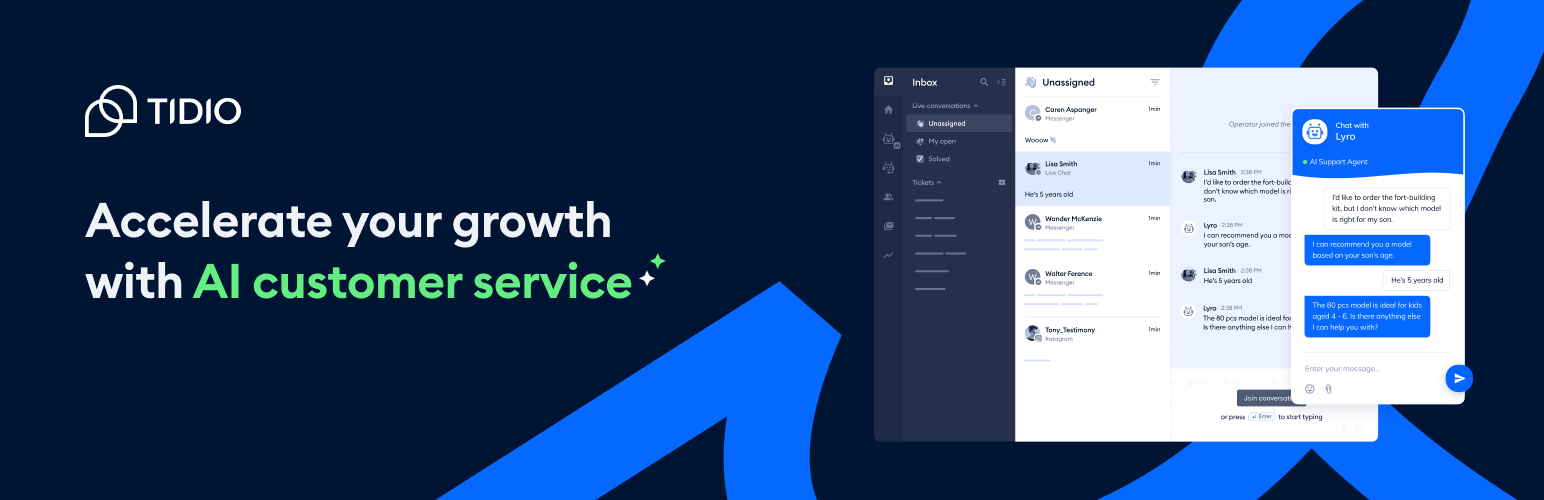 Tidio pairs live chat with Lyro, its AI agent, and meters them separately. Human volume counts as "billable conversations," triggered only when a human agent replies, while Lyro runs on its own quota. A Lyro conversation covers the whole exchange however long it runs, which makes forecasting easier than counting resolutions.
Growth is €49.17 a month annually or €59 monthly, Plus starts at €300, and the Lyro add-on runs from €32.50 annually or €39 monthly for 50 AI conversations. The free plan covers 50 billable conversations and 10 seats, the most generous free tier here after Shopify's own.
Where it falls short: The Shopify integration only arrives in full on Growth, so the cheap tiers leave Lyro with thin access to order data, the opposite of what most Shopify stores want from AI chatbots. Per-resolution billing and a guaranteed resolution rate appear only on the unpriced Premium tier. And AI capacity is a separate line item you keep topping up rather than one that scales with your plan.
Zendesk
Best for: larger support teams that need governance, audit trails and a self service portal more than they need Shopify-specific support tools.
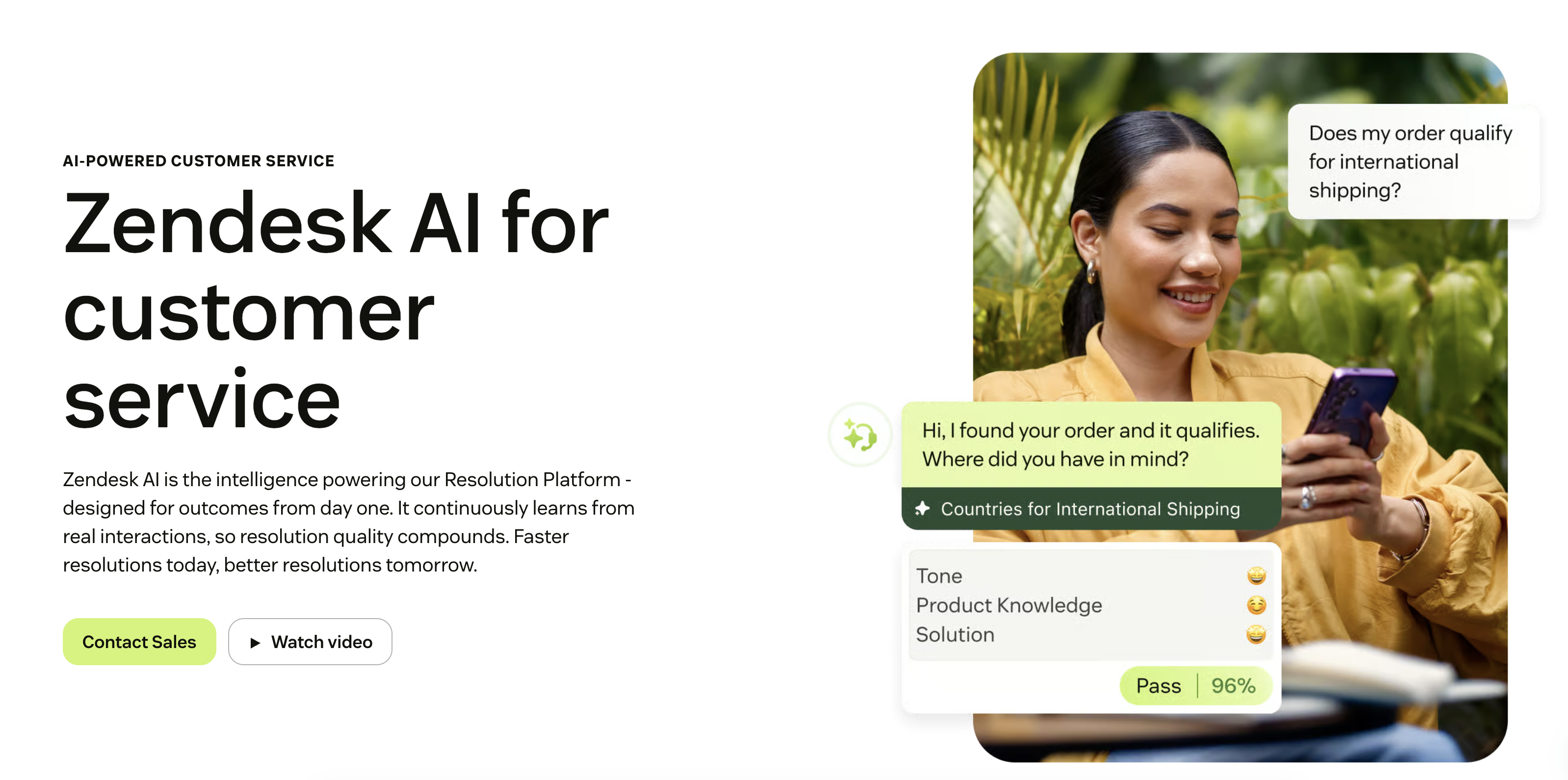 Zendesk labels its seat pricing plainly, which is more than most manage: $19 per agent per month for Support Team, $55 for Suite Team and $115 for Suite Professional, all on annual billing. Copilot, the AI assistant that drafts replies for a support agent, adds $50 per agent per month on Professional and above.
AI support comes with every Suite and Support plan, billed on what Zendesk calls Automated Resolutions, drawn against an allowance and priced by the complexity of the outcome. The money buys scale and control: a full customer self service portal, audit logs, and the workflow tooling a large team needs to handle customer support across dozens of agents.
Where it falls short: Zendesk publishes no per-resolution rate, allowance sizes or tier prices, so if order questions dominate you cannot model your AI bill without a sales call. The Shopify integration is undocumented, so pin down which order and customer data reaches the ticket before you sign. A mid-sized Shopify store pays enterprise prices for depth it will not use, and cheaper AI chatbots know more about your orders.
Intercom
Best for: teams that already run a help desk they like and want AI chatbots bolted onto it instead of a migration.
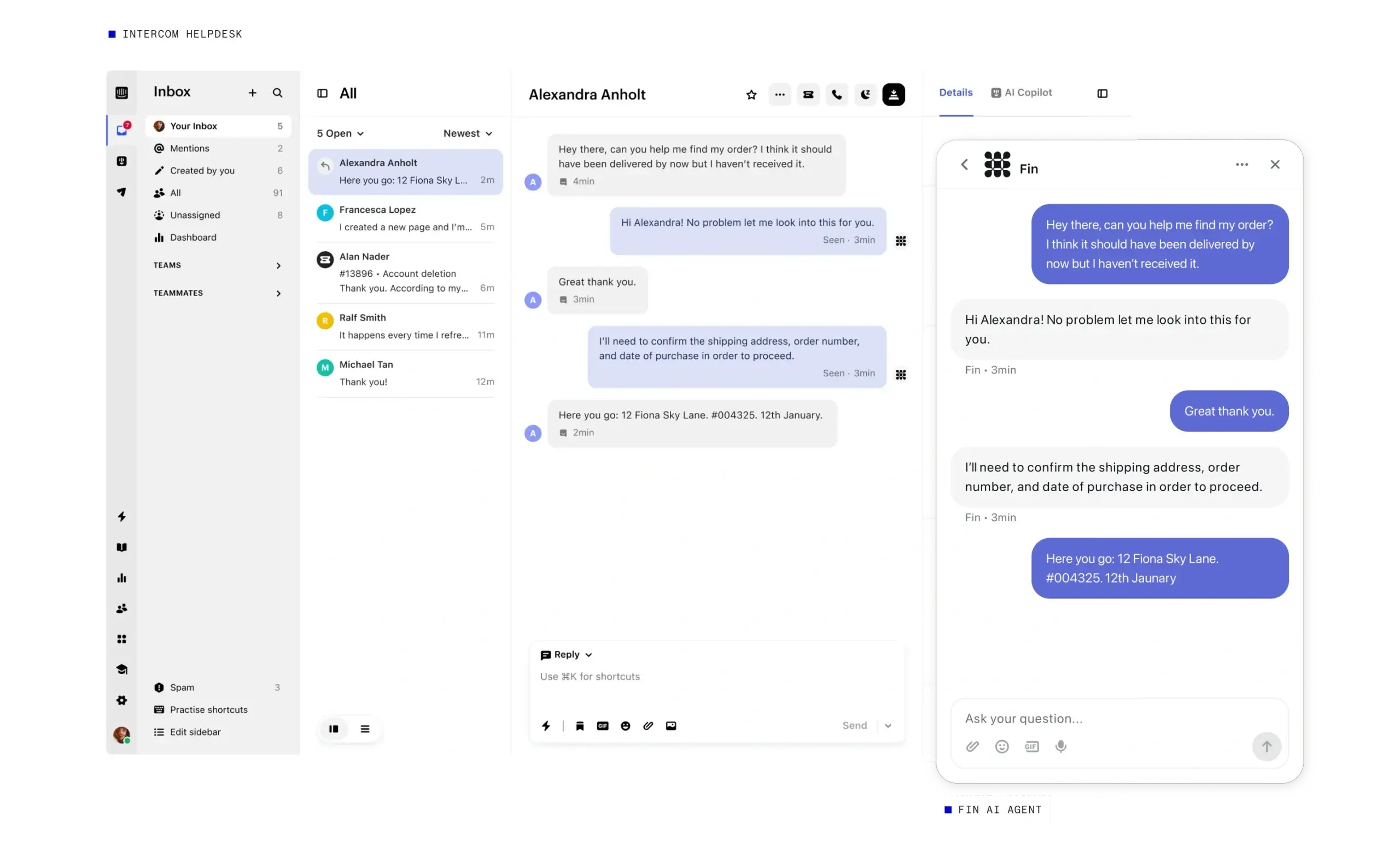 Intercom prints both billing bases, which makes it the easiest pricing here to read: Advanced at $85 per seat on annual billing or $99 monthly, Expert at $132 or $139. Fin, its AI agent, comes with every plan at $0.99 per outcome.
Read "outcome" carefully, because it is broader than a resolution. You pay once per conversation for a resolution, a handoff you configured, or a disqualified prospect, all at $0.99, and $9.99 when Fin qualifies a lead. Conversations that just pass to your team cost nothing.
The useful part is that Fin runs on other companies' help desks, Salesforce, HubSpot, Freshworks, Zoho and Gorgias among them, at the same rate with no seat fees and a 50-outcome minimum. Nothing else here sells AI support as a layer, which makes it the one AI customer support tool worth a look when replatforming is off the table.
Where it falls short: The Shopify integration is an afterthought, with nothing documented beyond one customer's own account. You also pay twice, per seat and per outcome, which makes it the most expensive way here to automate a queue full of order tracking and other repetitive queries.
Rep AI and the sales-first chatbots
Best for: stores whose problem is conversion rather than ticket volume.
A fourth category of AI chatbots sits beside the help desks, and the Shopify App Store is where you meet them. Rep AI sells "proactive AI Chat" to grow sales, is free to install, and holds 4.7 stars from 111 reviews. SmartBot follows the same playbook at 4.7 from 407 reviews with a free plan available.
These sell conversion rather than resolution. A storefront assistant reads customer behavior on the page and nudges a browsing shopper toward checkout, the way your marketing tools do. Worth a look if your carts are leaking rather than your support inquiries piling up, though these AI chatbots give your team no unified inbox and nothing tracks a return.
Which tools have a deep Shopify integration?
Text, Shopify Inbox and Gorgias read live order and customer data as standard, which is what most Shopify stores actually need. Tidio gates it behind Growth, and Zendesk and Intercom describe no Shopify integration on their pricing or product pages at all.
Tool | What the Shopify integration reaches |
|---|---|
Text | Live catalogue, cart, past orders, lifetime spend; in-chat cart recovery; checkout widget on Shopify Plus |
Shopify Inbox | Native to your admin; catalogue, inventory, cart view, automated order updates |
Gorgias | Create, duplicate, edit and refund orders in the ticket; discount codes; on every plan |
Tidio | "Native Shopify actions" from the Growth plan upward, undefined on the pricing page |
Zendesk | Nothing documented; a marketplace connection you would scope with sales |
Intercom | Nothing documented; one customer account of pulling order data |
This is the column that separates the best AI tools from support tools that merely claim the integration, because order data is what your biggest bucket of customer queries needs. AI chatbots that cannot see an order cannot give instant answers, and cannot close the ticket.
What the Shopify App Store ratings tell you
Ratings are the only evidence here that vendors did not write themselves. Shopify Inbox holds 4.6 from 5,793 reviews, much the biggest sample here. Gorgias sits at 4.3 from 704, and that average hides a split: 82% five-star against 10% one-star with almost nothing between, which usually means a tool fits some stores beautifully and fails others badly. Read the one-star reviews before you commit.
One caveat. Star ratings tell you about onboarding and customer support quality, and nothing about whether the best AI tools for a supplements brand suit Shopify stores selling made-to-measure furniture. Your catalogue and ticket mix decide that.
Text's own listing is new, launched in May 2026, and carries no reviews yet. Treat that as a reason to lean on the trial rather than on us.
Pick two and run them for a fortnight
Two support tools, not five, over the same fortnight of real traffic, measuring two numbers: what share of conversations closed without human intervention, and how many of those the customer came back about. The second is the number nobody tracks and the one that matters, because a resolution the customer reopens with a human agent was never a resolution, just lost revenue with a tidier label. The best AI tools look identical in a demo and separate fast on live traffic.
Point the AI agent at order questions on day one, where it is safest and most valuable. Hold the policy bucket until you have reread the pages it learns from. Leave judgment calls to a person, and say so in the chat widget, because customer expectations set honestly cost nothing and rescue the conversation when it needs human intervention.
Frequently asked questions
Which AI works best with Shopify?
Whichever one reads your biggest bucket. If customer queries about order tracking and delivery dates dominate, you want live order data and a price that survives volume, which points at Text or Gorgias. Both also put the shopper's order history in front of a human agent, which rescues escalations. If your volume is low and your questions simple, Shopify Inbox does more than you would expect for free, and paid support tools can wait. If you already run Zendesk across a big team, switching costs outweigh everything above.
What is the difference between an AI chatbot and an AI agent?
A chatbot follows a script you build, so it answers what you anticipated and stalls on everything else. An AI agent works from your live customer data and can take an action, which on a Shopify store means reading the catalogue, checking an order, applying a discount or routing the conversation to the right person. Both sit in the same chat window, so the difference only surfaces when a shopper asks something nobody scripted for.
Can AI chatbots answer order status questions?
Yes, as long as the AI chatbots you shortlist have live access to your Shopify order data. Text, Gorgias and Shopify Inbox all read orders as standard, Tidio does from its Growth plan upward, and Zendesk and Intercom rely on a marketplace connection neither documents. Order status is the highest-volume and lowest-risk thing on your list to automate, which is why it should be the first job you hand any AI agent, and the cheapest source of instant answers you will find.
Does ChatGPT integrate with Shopify?
Not as an AI customer support tool on its own. ChatGPT cannot reach your order data, so it cannot answer the questions that make up most of your queue. What you can buy is a layer of AI chatbots built on models like GPT and sold through the App Store, Text included. A general assistant discusses your products in the abstract, while a connected tool tells one customer where one parcel is.
Worth knowing that Gartner found customers roughly three times more likely to reach for third-party AI than a company's own chatbot, which is a decent argument for making your instant answers better than the ones a shopper can already get elsewhere.
Is there an AI chatbot available for Shopify stores?
Several dozen, and the App Store's Chat category is the sane way to browse them. Three questions separate the best AI tools from the rest of the AI chatbots on offer. Does it read your live order data? Does it show which policy page an answer came from, so you can catch a stale one? Does it hand off to a human agent with the conversation intact? Most clear the first, fewer the second. The third is where Gartner's numbers bite, because 87% of customers surveyed said reaching a person matters when a company uses generative AI.
Self service options only lift customer satisfaction when the customer can get out of them. Keep human support one message away.