
Jacquelyn Dunham
Content Marketing Specialist
Jacquelyn is a content marketing author with over 7 years of experience creating engaging and compelling content for various industries.
TL;DR: Tidio's Lyro AI bills you when the AI replies. Text's AI Agent bills you when the AI resolves. Everything else in this comparison follows from that one difference, because it means the cheaper option depends on your resolution rate and your team size rather than on the sticker price. Lyro wins on the free plan, on seats, and on not making you migrate. Text's AI Agent wins on taking actions, on running more than one agent, and on only charging when the work gets done.
I built a spreadsheet to compare these two and got the wrong answer twice.
The first time I compared headline monthly prices, which favors Tidio the moment you have more than one agent, since its plans bundle ten seats. The second time I divided by conversation volume, which favors Text, since it does not bill for the AI's failed attempts. Both runs used numbers I had copied correctly.
The problem was that I was adding up different things. Tidio counts a Lyro conversation when the AI replies at least once. Text counts a resolution only when the AI answers the customer's question. Those are not the same event, and no spreadsheet treating them as interchangeable will give you a usable number.
So this comparison starts with the billing unit, because for most e-commerce brands it decides more than any feature list. Both are live chat platforms with an AI layer on top, both sell hard into e-commerce, and both will quote you a resolution rate. All figures below come from the two companies' own public pages, retrieved 1 September 2026, and pricing moves, so check before you sign.
What is Lyro AI agent?
Lyro is Tidio's conversational AI agent. It scrapes your existing support content into a knowledge base, then uses natural language processing to answer customer questions from that material and nothing else, which Tidio positions as its main guardrail against invention. Their headline claim is that Lyro solves "up to 67% of customer problems," and Tidio reports users automating around 67% of customer inquiries on average across live chat and ticket customer interactions.
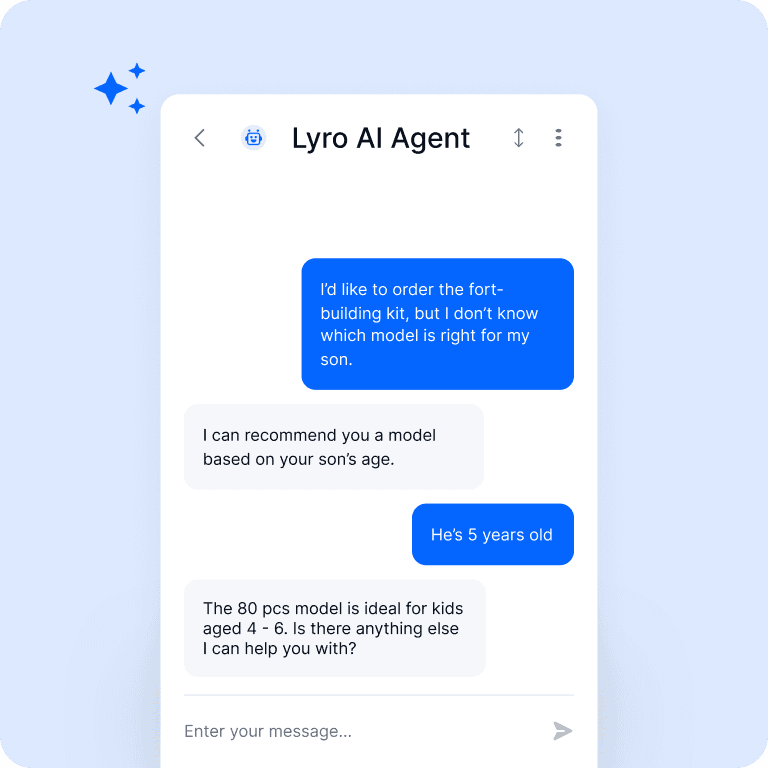 Tidio says Lyro runs on Claude, from Anthropic, plus in-house models. Unusually specific for a vendor, worth noting if procurement asks which large language models sit behind it.
Three capabilities sit on top of question answering. Lyro Smart Actions handle things like order updates and lead qualification, and Tidio notes these now work with MCP. Product Recommendations pull from your store to guide website visitors toward what they want, the e-commerce feature most likely to earn its keep. Lyro Guidance controls tone, style and escalation rules, so Lyro answers in your voice rather than a generic one.
The piece that matters most to existing support teams is Lyro Connect. It bolts Lyro onto the existing helpdesk you already run rather than switching platforms, which Tidio pitches as no migration and no risk. Tidio is listed on the Shopify app store, rated 4.7, so an e-commerce team can start without a developer.
What Text's AI Agent is
Text's AI Agent starts from the same place, learning from your site, docs, FAQs and policies rather than a scripted knowledge base. From there the design diverges.
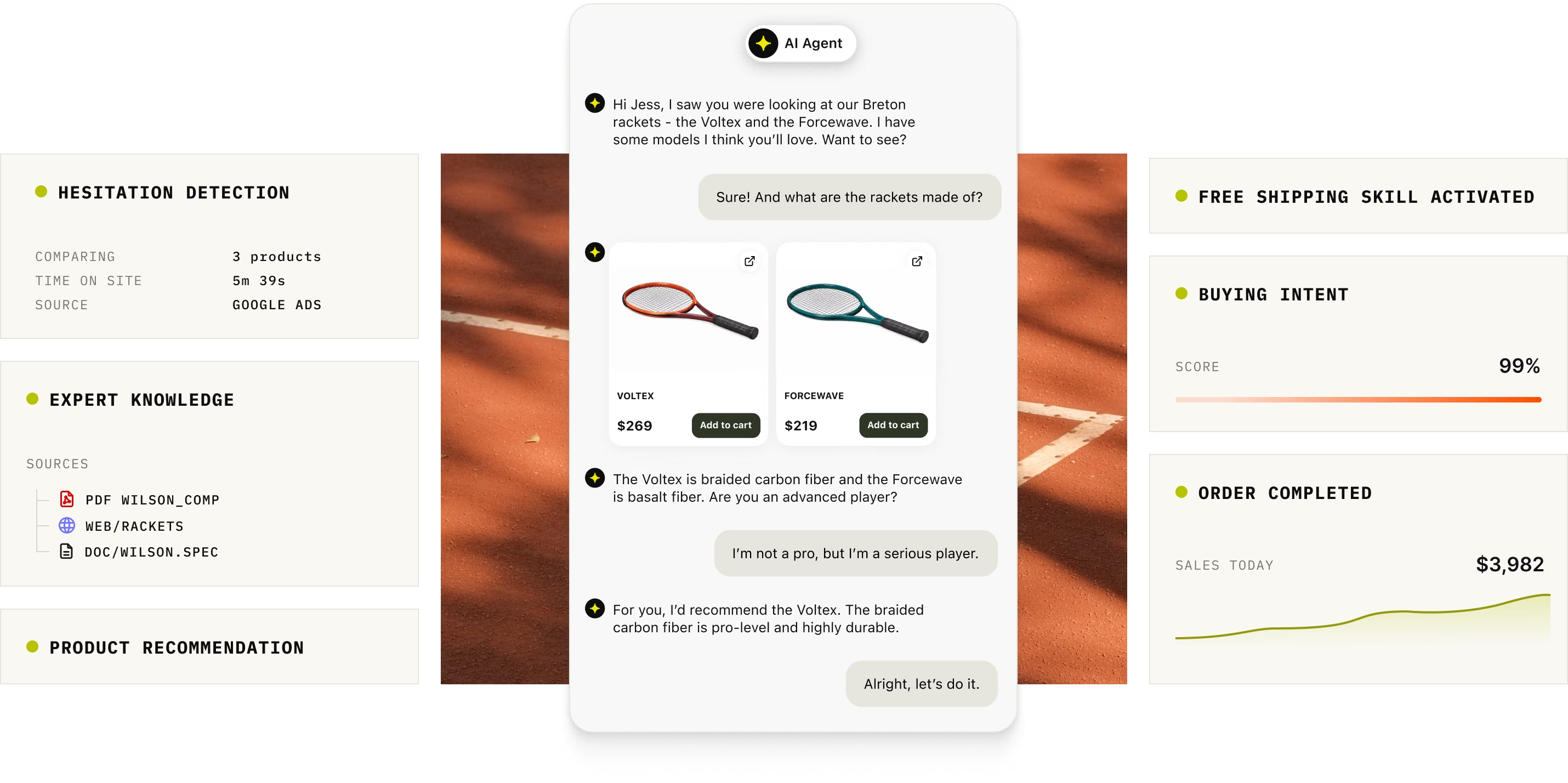 The organizing idea is skills: configurable instructions describing what the AI should do in a named situation. Text's published examples include Save the Sale when a customer mentions a competitor's price, Subscription Rescue when someone mentions cancelling, Order Status, Checkout Coupon Issuer and Abuse Detection. Several call a webhook or an API endpoint, so the AI does something in an external system rather than only composing a reply.
Text's published customer figures include an 80% AI resolution rate at Stratco and, per Text's AI Agent manager, that a few skills combined with your business knowledge "can resolve >95% of incoming chats." Both describe customer conversations the AI closed without human agents stepping in, and the second is phrased as potential rather than a measured average.
Both products run a unified inbox with live chat, hand off to human agents, and cover multiple channels. Text also bundles an AI Copilot for agents and self service content alongside the AI Agent, so its AI features reach both sides of the conversation. The interesting differences are narrower than either vendor's feature list suggests.
The difference that decides your bill
Here is the mechanic, in both companies' words.
Tidio charges when Lyro replies
Tidio defines a Lyro conversation as "a customer interaction initiated through any channel integrated with Tidio that has at least one reply from our AI Agent." Tidio adds that if Lyro replies a dozen times, or the customer leaves and comes back, it still counts once.
Read it again for what it leaves out. Nothing requires that Lyro answered. A conversation where Lyro replies, fails and escalates is still billed.
Text charges when the AI resolves
Text's pricing page states the opposite rule: "We charge per resolution, not per conversation." A resolution counts when the AI Agent gives an answer that solves at least one customer question, so you pay only where it can answer customer questions rather than where it tries. Text says that if the AI transfers to a human without answering, no resolution counts, and nor do test chats or spam.
One charge per conversation applies in both models, so across your customer interactions the difference is entirely whether a failed AI attempt costs you money.
What that gap looks like in practice
Suppose an e-commerce store fielding 1,000 customer questions a month across the customer journey, with an AI handling 65%. Every time a customer asks something the AI cannot close, the models diverge.
On the Tidio model you consume Lyro conversations for every one the AI touches, including the 350 it hands off. On the Text model you consume roughly 650 resolutions, and the 350 handoffs are free.
The arithmetic reverses if your team is large and your ticket volume modest, because the per-seat cost then dominates. That is the honest answer, and why the rest of this comparison is organized around which situation you are in.
Pricing, side by side
Both pricing models are published, and neither pricing model is a straight per-seat number. Live chat, ticketing and the AI are packaged differently on each side, with Tidio splitting the AI out into add ons. One trap: Tidio's displayed prices assume annual billing, so monthly figures run about a fifth higher.
Text | Tidio + Lyro | |
|---|---|---|
Base plan pricing | $19 per user/month billed yearly, $25 monthly (Essential); $79 and $99 (Growth) | Free €0; Starter €24.17 yearly or €29 monthly; Growth from €49.17 or €59; Plus from €300 plus usage |
Unit | Per seat | Per account, metered on conversation volume |
Seats included | Priced per user | 10 on Free, Starter and Growth |
AI included? | Yes, on all paid plans | No, Lyro is one of several add ons, from €32.50 yearly or €39 monthly |
AI meter | Resolutions: 10/mo. on Essential, 200 on Growth | Lyro conversations: 50 free lifetime, then paid quota from 50 to 1,000 |
AI overage | 50 resolutions for $49.50, about $0.99 each | No published per-unit rate; buy a larger quota |
Free plan | No free plan, 14-day trial | Yes, with 50 billable conversations |
Enterprise | Custom, contact sales | Plus and Premium, contact sales |
How much does Lyro AI agent cost?
Tidio publishes two Lyro numbers in two places, answering different questions. On the Lyro product page the figure is €0.5 per conversation, described as what one "starts from." Inside Tidio's pricing structure, Lyro is a paid add on starting at €32.50 a month on annual billing, or €39 billed monthly, covering from 50 Lyro AI conversations, with a quota ladder running 50, 100, 150, 200, 300, 500, 750 and 1,000. Above that, Tidio asks you to contact them, where custom enterprise pricing begins.
Every Tidio account gets 50 Lyro conversations free, and the pricing table marks that allowance "(lifetime)" rather than monthly, so the free tier is an entry point rather than a base plan you can live on. A paid Tidio plan alone does not change it, since Starter lists its 50 as "(one-off)" too. Only a paid Lyro quota refreshes, 30 days from payment. Tidio gates two add ons behind that quota: full access to Actions, and Lyro product recommendation. Subscription changes take effect at the start of your next billing cycle.
The second meter most people miss
Tidio runs two meters at once, and the Lyro one is the one everybody reads.
The other is billable conversations, which Tidio defines as any live chat, ticket, email or social conversation that includes a message from a human agent. Tidio is clear that Lyro and Flows replies do not count as agent replies, so the two meters are genuinely separate. Free gives you 50 billable conversations, Starter 100, Growth up to 2,000, and Plus and Premium are custom.
That structure is usage based pricing on two axes at once. Text meters only the AI and charges per seat for humans, so its total is driven by headcount and AI resolutions rather than by how many customer conversations your agents answer.
Neither approach is inherently better. They fail in opposite directions, which is the point.
Where Lyro is the better choice
A comparison written by one of the two vendors is worth reading only if it tells you when to buy the other one.
You want a genuine free tier
Tidio has a free plan with 50 billable conversations, 10 seats and 50 lifetime Lyro conversations, which is enough live chat for small e-commerce brands to run something real before paying for add ons. Text has no free plan at all, only a 14-day trial. If your requirement is to run something real without a card, on a tight budget, that is a decisive difference and Tidio wins it outright.
You have a large team and modest volume
Tidio includes 10 seats on Free, Starter and Growth. Text charges per user. Ten part-time agents handling low ticket volume costs $190 a month on Text's Essential plan at yearly billing, against €24.17 for Tidio Starter before Lyro. For that shape of team, and for mid sized businesses carrying many part-time agents, the seat model is the wrong end of the trade.
You are not willing to leave your existing helpdesk
This is Lyro's real distinguishing feature. Lyro Connect adds the AI layer to the customer support software you already run, so you get support automation without switching platforms. If you have just finished a migration to Zendesk, or your team lives in Salesforce, keeping that and renting an AI layer is a rational choice that Text does not offer in the same way.
Two caveats before you plan around it. Lyro Connect is available only on Plus and Premium, where Tidio's advanced features sit, and those start at €300 a month plus usage. And Tidio does not publish a Lyro Connect price, so the real number arrives on a sales call.
You mainly need good answers to routine customer questions
If your ticket mix is genuinely dominated by shipping details, order status and returns policy, and you have no ambition to hand the AI more complex tasks in other systems, then the extra machinery in Text's AI platform is capacity you would pay for and not use. Lyro answers that class of question from your support content, and decent self service absorbs the rest. That applies to plenty of saas companies with thin technical resources as much as it does to small stores.
Where Text's AI Agent pulls ahead
Skills that take actions
Both products can act, and the difference is how much of that is yours to define. Lyro Smart Actions cover a published set of tasks, with more available through Tidio's custom AI agents engagement. Text's skills are written as instructions carrying variables and webhook calls, so a skill like Subscription Rescue can call your discount service, offer the result, and open one of your support tickets in a single flow you configured. For enterprise workflows and multi step workflows reaching external systems, including processing refunds or pulling specific data out of your order system, that is a different level of reach. Both lean on retrieval augmented generation to ground answers in your own material, so the real gap is the actions rather than the answers.
Multiple AI agents rather than one
Text supports running a dedicated AI Agent per brand, website, region or use case, with routing between them so a conversation reaches the specialist without the customer noticing. Text's Growth plan includes 10 AI Agents against 1 on Essential.
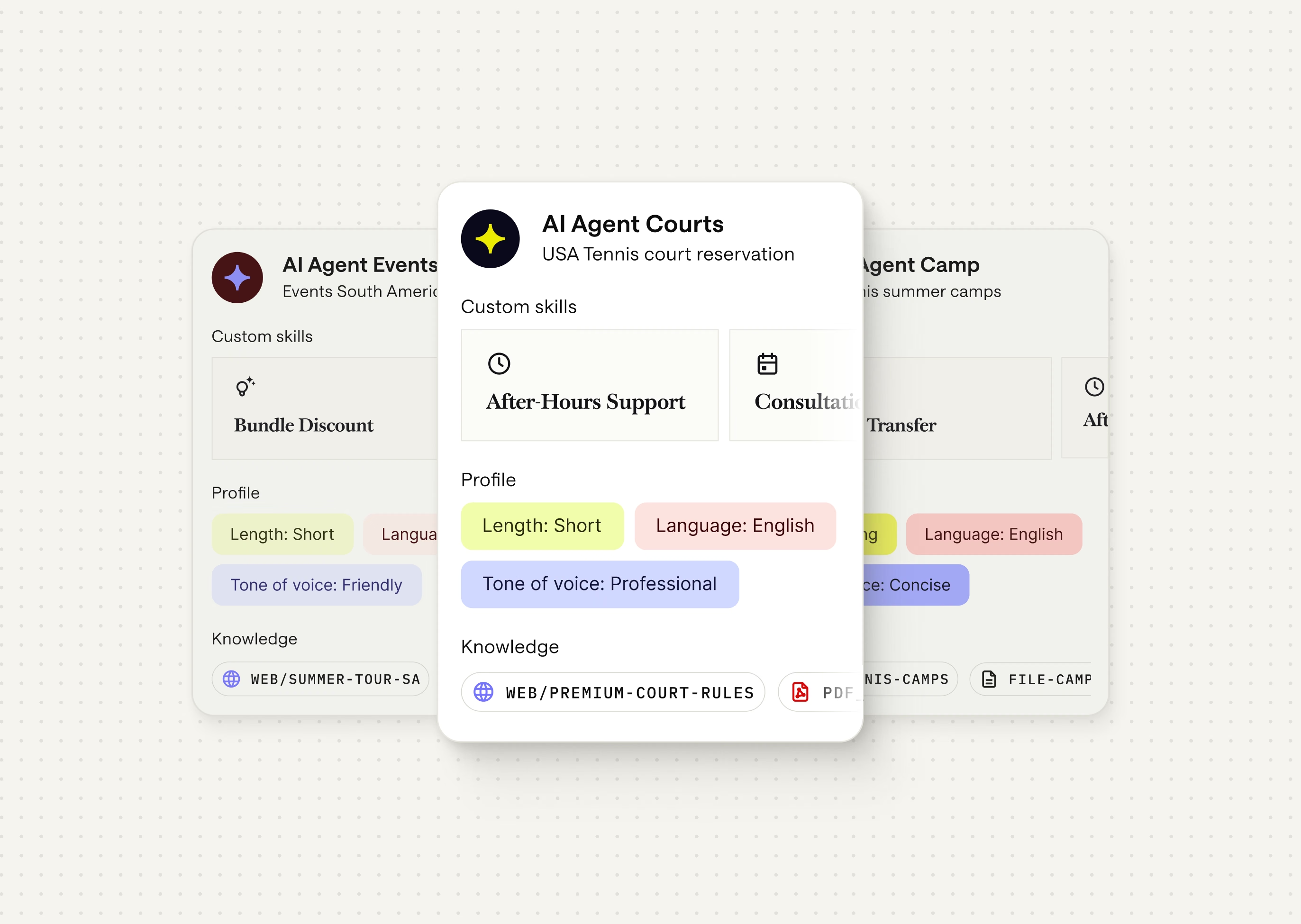 If you run several storefronts or several languages with genuinely different policies, one agent trained on everything is a compromise. Lyro is positioned as a single agent with guidance rather than a fleet, which enterprise teams running multiple brands should test before committing.
It only charges when the work gets done
Resolution based billing is cheaper in some scenarios and better aligned in all of them. It ties the bill to the outcome, so a bad month for the AI is a cheap month, and you never pay for the AI's failures or for the edge cases it cannot handle.
Reporting built around revenue
Text's AI Agent reporting attributes earned sales, captured leads and retained customers, and separates what AI handled from what the team handled. Tidio's Lyro analytics report resolution rates, satisfaction scores and conversation patterns across live chat and tickets.
That difference reflects positioning. Text is selling AI automation that sells, with published claims of up to 266% higher conversion and $1.5M at Wembley over eight months. Lyro is selling cost efficiency and customer satisfaction, with a savings calculator on the page. Pick the one whose measure matches what your board asks you about.
Setup, knowledge and control
Both learn from your existing support content rather than requiring a knowledge base built from scratch, and both are honest that quality depends on what you feed them. Tidio says Lyro goes live in a few clicks without technical knowledge, drawing on your help center articles. Text trains on your site, docs, FAQs and policies, then lets you test before launch. The AI capabilities on either side are only as good as that material.
Tidio's line is that Lyro "works only with the content and guidance you provide," which they present as the reason it does not invent answers. Text lets you test the agent against your own questions before it goes live, which is the same concern approached from the other end.
On control, both let you set handoff rules, monitor conversations live and step in. Text publishes a figure of 46 languages with consistent tone. Tidio does not publish a language count on the Lyro page, so ask if that matters to you.
Handoffs and escalation
Lyro's documented behavior is that a question outside its knowledge gets forwarded to a human, and in the Lyro Connect setup it creates a ticket in your existing support solution. Tidio says Lyro then learns from the human's response.
Text's AI Agent escalates with the full conversation history attached, and can also route to a different specialized agent instead of to a person. Text describes this as a unified customer timeline, where past conversations travel with the customer rather than restarting at every handoff. It also supports handing work back the other way, with the team passing routine requests to the AI.
For customer support teams, the practical question is whether the customer repeats themselves at the handoff, and whether complex issues arrive with context intact. Both vendors claim they do.
Security and compliance
Text's AI Agent page lists SOC 2, GDPR, CCPA, PCI DSS SAQ A, WCAG 2.2 and Data Privacy Framework.
Tidio displays a SOC badge and publishes a trust site. SOC 2 and HIPAA compliance appear specifically under its custom AI agents offering, which is a sales-led engagement rather than a self-serve plan. Enterprise support teams with a HIPAA requirement should start that conversation early, because on both sides the compliance answer sits in the enterprise tier.
Which AI agent is considered the best?
There is no honest answer in the abstract, so here is a decision rule instead.
Choose Lyro if your customer support teams need a free tier, if you have up to 10 agents and modest conversation volume, or if keeping the helpdesk you already run matters more than what the AI can do. Lyro Connect is a real advantage and Text has no equivalent.
Choose Text's AI Agent if your AI needs to take actions across external systems, if you need more than one agent for multiple brands or regions, if you want the bill tied to resolutions rather than attempts, or if the case you are making internally is about revenue rather than cost per ticket. For e-commerce brands measuring AI automation against revenue instead of headcount saved, that is the shorter argument.
Choose neither yet if you cannot estimate your resolution rate, because that number decides the comparison and no vendor page can tell you what it will be for your own customer base. Both offer a way to find out: Tidio's 50 free Lyro conversations and Text's 14-day trial.
What to test before you commit
Run the same 30 real customer questions through both. Not your easiest 30, the ones your agents complain about.
Count three things. How many the AI answered correctly without a human. How many it escalated. And how many it answered confidently and wrongly, which is the number neither vendor's resolution rate will show you.
That third count is the one that should decide it, because a high resolution rate on wrong answers is worse than a low one on right answers, and customer satisfaction follows the accuracy rather than the percentage. It is also the only figure in this comparison you can generate yourself rather than take from a marketing page. Whichever customer support AI you pick, run that test first.
Frequently asked questions
How much does Lyro AI agent cost?
Tidio's Lyro is a separately priced add-on starting at €32.50 a month for a quota beginning at 50 Lyro AI conversations, with quota tiers up to 1,000 and custom plans above that. Tidio's Lyro page separately quotes conversations starting from €0.5 each. Every account includes 50 free Lyro conversations once, and refreshing monthly requires a paid quota. Figures as published on 1 September 2026.
What is Lyro AI agent?
Lyro is Tidio's AI agent for customer support. It learns from your existing support content and answers customer questions using only that material, with Smart Actions for tasks like order updates and lead qualification, Product Recommendations for e-commerce, and Guidance for tone and escalation rules. Tidio says it runs on Claude plus in-house models, and reports an average resolution rate of 67%.
Does Text have a free plan like Tidio?
No. Text offers a 14-day free trial with no card required, and its paid plans start at $19 per user per month billed yearly. Tidio does publish a genuine free plan covering 50 billable conversations, 10 seats and 50 lifetime Lyro conversations. If a permanent free tier is a hard requirement, Tidio meets it and Text does not.
Can I use Lyro without leaving my current helpdesk?
Yes, through Lyro Connect, which adds Lyro to existing customer service software rather than replacing it. Two constraints apply: it is available only on Tidio's Plus and Premium plans, which start at €300 a month plus usage, and Tidio does not publish a Lyro Connect price, so you get it on a sales call.
What are the 5 types of AI agents?
The standard classification from AI research lists simple reflex agents, model-based reflex agents, goal-based agents, utility-based agents and learning agents. Customer support AI agents are usually a blend of the last three, since they pursue a goal such as resolving a ticket, weigh options like answering versus escalating, and improve as more knowledge and feedback arrive.
Which is cheaper, Text or Lyro?
It depends on two numbers you can measure and no vendor can guess for you: your AI resolution rate and your seat count. Tidio bills a Lyro conversation whenever the AI replies, including attempts that fail and escalate. Text bills only when the AI resolves something, at roughly $0.99 per resolution beyond your plan's included allowance. High seat counts and low volume favor Tidio's included 10 seats. High resolution rates favor Text's model.