
Tomasz Ziętek
Content Creator
Experienced content and SEO specialist working with SaaS businesses since 2016. After hours, he's cycling, cooking, traveling, or digging through record crates.
You type the whole thing out: order number, dates, what went wrong. What comes back is a help article about something else entirely. You ask for a human. It sends the same article again.
Two things are true at the same time right now, and most articles about AI in customer service only tell you the first one.
The first: AI genuinely works. Companies that have matured their deployments report a 17% higher customer satisfaction percentage and a 38% lower average inbound call handling time, according to IBM. Those aren't pilot-program numbers. They're what happens when the technology is wired into real customer service operations.
The second: customers are not happy about it. In a December 2025, SurveyMonkey survey of 2,017 US adults, 79% said they strongly prefer a human over an AI agent, 84% believe human agents are more accurate, and 81% think companies deploy AI to save money rather than to improve service. Half said they'd cancel a service that was solely AI-driven.
So the interesting question isn't whether AI in customer service works. It does. The question is why something that measurably improves service quality is landing so badly with the people receiving it, and what you do differently because of that.
This guide covers both halves.
What is AI in customer service?
AI in customer service refers to the use of artificial intelligence technologies, including natural language processing, machine learning, and generative AI, to understand customer requests, resolve them automatically, or assist the human agents who resolve them.
Ask most people what customer service AI is and they'll describe a chat widget. It runs across the whole customer journey: predicting a problem before the customer notices it, answering the first message, routing what it can't answer, feeding the human agent context mid-conversation, writing the summary afterward, and updating the knowledge base based on what it learned.
The useful mental model is that AI handles volume and pattern. Humans handle judgment and stakes.
How does AI support customer service across the journey?
Most guides give you a flat list of AI tools. It's more useful to see where each one sits in the sequence of a real customer interaction. The customer service experience is that whole sequence, and AI now touches every stage of it.
Before contact: proactive support
Predictive analytics models watch customer behavior for the signals that precede a complaint. A failed payment, three password resets in ten minutes, a shipment that missed its scan, a usage pattern that historically precedes churn. AI proactively identifies these customer problems and triggers outreach before the customer contacts you.
This flips the economics. A ticket you prevent costs nothing to resolve, and proactive customer service reliably raises satisfaction because the customer experiences competence rather than recovery. The customer never has to ask, which makes automated customer engagement the least intrusive form of AI in customer service. Predictive analytics can also identify at-risk customers in real time, which turns the customer service team into a retention function rather than a cost center.
At first contact: conversational AI
This is what people picture when they hear customer service AI. Customer service chatbots, virtual assistants, AI agents — the market uses all three names for roughly the same thing. They answer FAQs, check order status, process straightforward customer queries, and provide instant support at 3 a.m. on a Sunday. Because they handle customer service interactions in parallel rather than in a queue, response times stay flat when volume spikes.
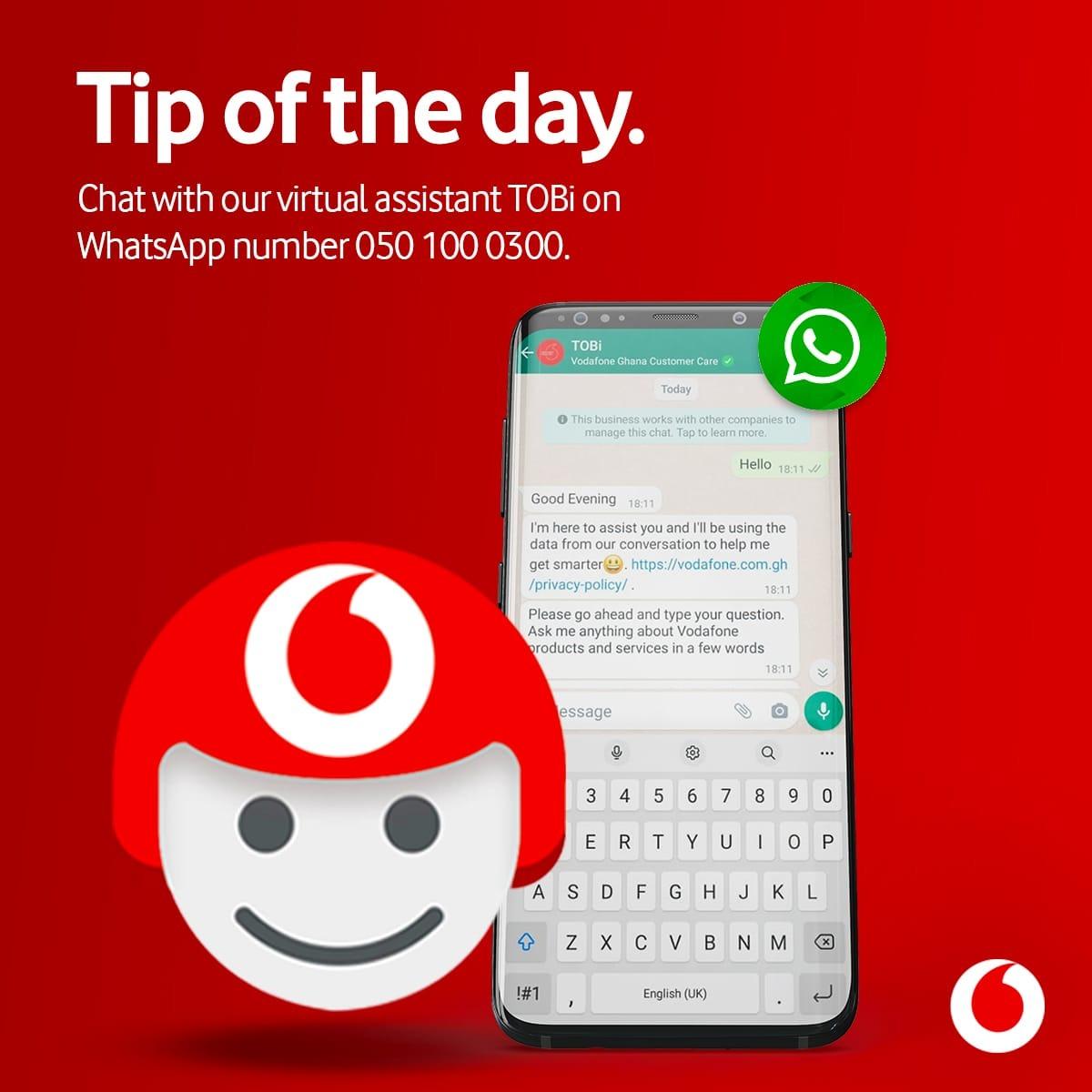
The ceiling here is higher than skeptics expect. Vodafone's TOBi assistant, built with IBM Watson, handles around a million interactions a month at a 70% first-time resolution rate. Well-scoped deployments can automate the large majority of tier-0 and tier-1 routine customer inquiries, because that traffic is genuinely repetitive.
 Voice is catching up fast. AI-powered voice systems replace the phone tree that everyone hates. Instead of navigating an interactive voice response menu by pressing 4, then 2, then 1, the customer says what's wrong in natural language and the system routes or resolves from there.
Best Buy put a generative AI assistant on its main customer support line in 2024, built on Google's Gemini models, and it troubleshoots product issues, reschedules deliveries, and manages subscriptions without a menu tree in sight.
For anyone who has ever shouted "representative" at an IVR, this is the single most welcome application on the list.
During the conversation: the agent co-pilot
When AI hands off to a person, it doesn't stop working. It supports human agents in real time by suggesting responses based on conversation context, surfacing relevant customer history, and pulling the right knowledge base article into the agent's sidebar before they think to search for it.
Google's Agent Assist is a representative build: Knowledge Assist surfaces the relevant article as the dialogue unfolds, Smart Reply drafts the next message above the agent's text box, and a live sentiment score runs alongside both. The agent still decides what to send.
This is the least glamorous and possibly most valuable application of AI in customer service, because it raises agent productivity without touching headcount. It doesn't remove the human. It removes the twelve seconds of dead air while the agent alt-tabs to find an account record, and it shortens the ramp time for new support agents from months to weeks.
After the conversation: the invisible work
AI generates automatic conversation summaries, so agents stop spending the last two minutes of every interaction writing notes. It automates backend actions like processing refunds and updating records. It categorizes and prioritizes incoming tickets so ticket management stops being a manual triage queue.
It also maintains the knowledge base by identifying content gaps from real customer conversations, which is customer feedback arriving continuously rather than once a quarter in a survey. If forty people asked about a shipping policy this week and the AI had no good answer, that's a documented gap with a volume number attached, which is a far better way to prioritize documentation than guessing.
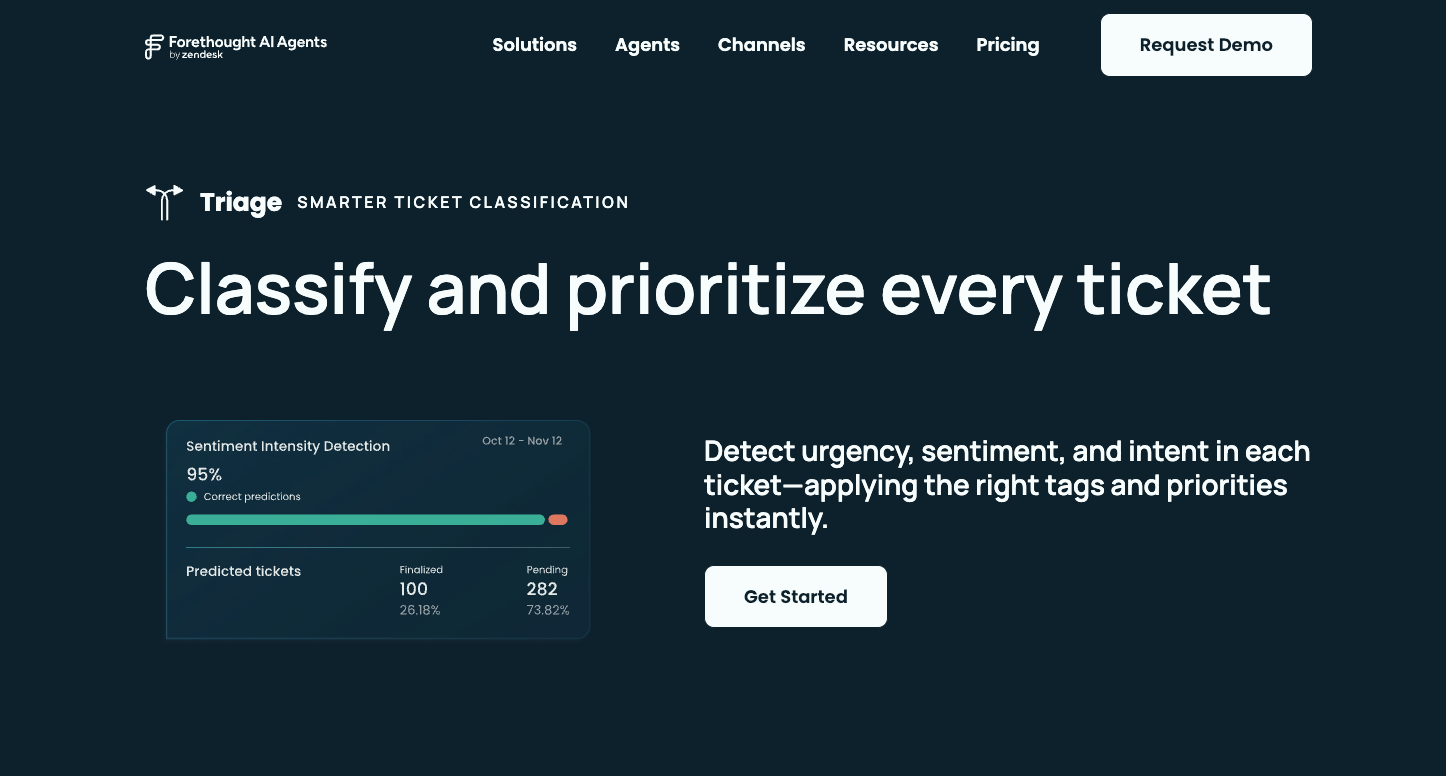
Forethought splits this work across separate agents, which is a useful way to see the shape of it: Triage tags each incoming ticket against historical data and scores it for tone and urgency, while a second agent reads the conversations in aggregate to find what the documentation is missing.
 Across every channel at once
Everything above happens in more than one place, and consistency across those places is harder than it sounds. The same question asked in chat, in email, and on the phone has historically produced three different answers, because three different people were reading three different documents. One model grounded in one knowledge base ensures consistent answers across omnichannel platforms by construction, and it keeps context when a customer starts in a chat widget and finishes on the phone, so the switch between online and offline channels is a continuation rather than a restart.
Language works the same way. AI enables multilingual support by translating conversations in real time, and the value isn't the flag icons in your footer. It's that you no longer need a Portuguese speaker on the night shift to answer a shipping question. Rituals' AI agent, Ray, runs across 19 countries in 15 languages, and during the Black Friday-to-Christmas stretch — a peak that used to require 300 temporary agents — it helped the cosmetics retailer hit zero customer relations backlog for the first time, which is a coverage problem no realistic hiring plan solves.
Self-service belongs here too. A help center that answers in natural language is a channel rather than a filing cabinet, though hold that thought until the section on deflection below.
When the AI has to do something, not just say it
The distance between an assistant that answers and one that resolves is mostly plumbing, and it's worth seeing what closing it involves. In Text, which is our own product so read this accordingly, the mechanism is a custom skill: a workflow the AI agent runs when it detects a particular intent.
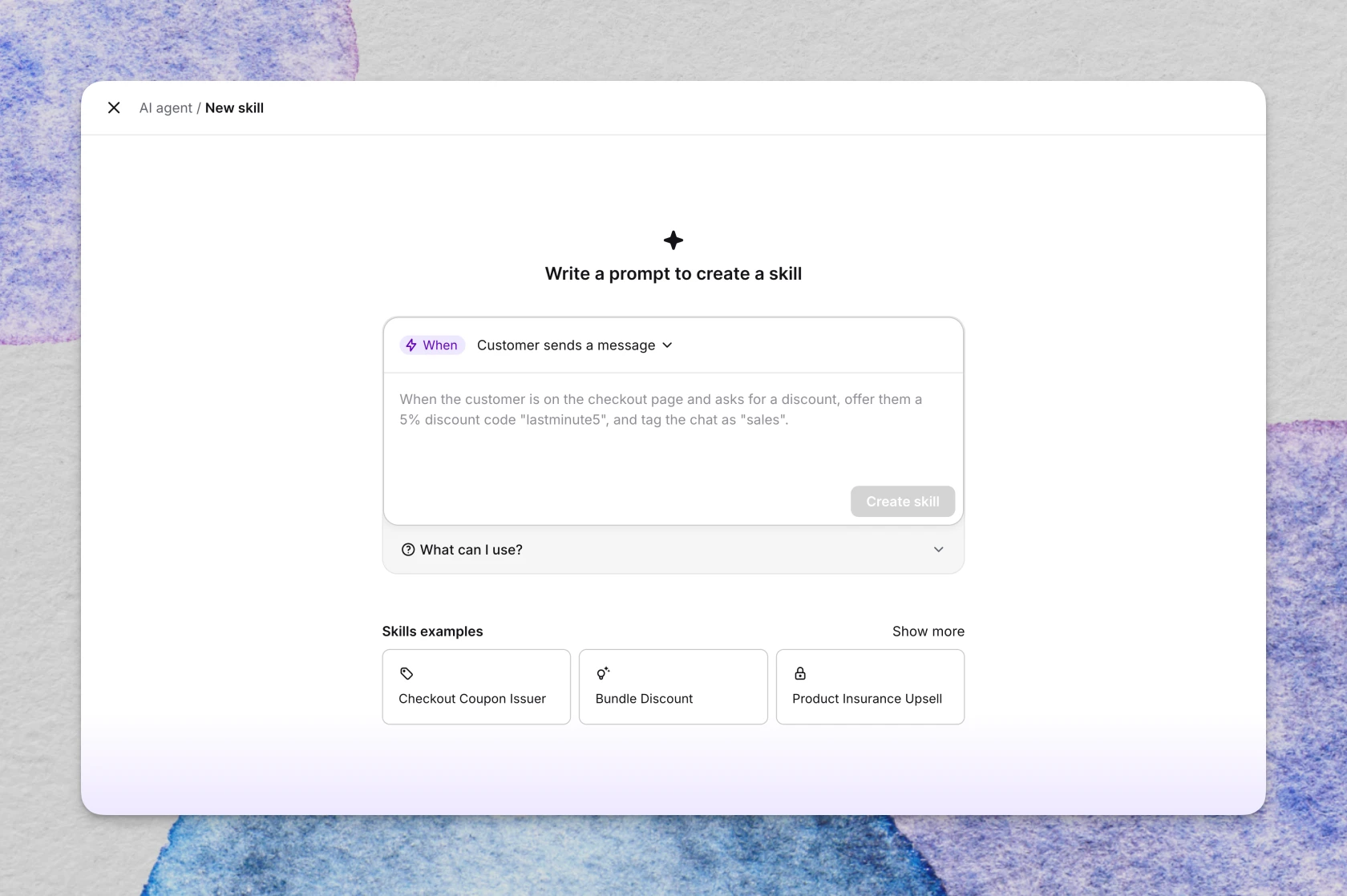 Triggers aren't limited to what the customer types, either. A skill can fire on the page someone is viewing, their location, or the time of day in their timezone, which is what makes proactive outreach practical rather than theoretical. Once running, it carries the context you'd want a human to have — order data, ticket history, the current page, the full transcript — and it can act on that: update a customer record, create or update a ticket, tag or transfer the chat, detect the language and switch. The constraint worth knowing is that one agent holds up to ten of these. That ceiling is a feature. It forces you to decide which ten journeys actually matter instead of automating forty of them badly.
What AI technologies power customer service?
Four capabilities do most of the work, and knowing which is which helps when you're evaluating customer service solutions.
Natural language processing interprets what the customer actually means, including typos, fragments, and phrasing that doesn't match your help center's vocabulary. NLP is why a modern system understands "my thing never showed up" as an order status query.
Machine learning improves routing, tagging, and prediction over time by learning from historical customer data. This is what powers predictive analytics and the models that anticipate customer needs.
Sentiment analysis reads tone and word choice to gauge customer sentiment. AI tools analyze both text and voice inputs to detect emotions like frustration or satisfaction, then flag negative interactions for human agents and prioritize urgent cases. A furious message about a wedding gift that didn't arrive should not sit behind a routine billing question in the queue, and sentiment analysis is what moves it.
Generative AI writes the responses, the summaries, and the drafts. It's also the newest and least predictable layer, which matters for the failure modes discussed below. Globally, 62% of executives say generative AI can disrupt how their organization designs experiences, per IBM.
Most customer service solutions on the market combine all four. What separates them is less the underlying AI models than how well the AI technology is wired into your order, billing, and CRM systems, because that integration is what lets the AI act instead of merely answering.
What do the AI customer service numbers actually show?
Here's what holds up, with sources, separated from what gets repeated without one.
On cost
Gartner predicts that by 2029, agentic AI will autonomously resolve 80% of common customer service issues without human intervention, producing a 30% reduction in operational costs. That 30% figure is the one behind most "AI cuts costs by a third" headlines, and it's a forward-looking prediction about AI systems that can act autonomously, not a current average for support operations. Treat it accordingly.
On efficiency
The IBM figures cited at the top, 38% lower average inbound call handling time and 17% higher customer satisfaction, apply specifically to mature adopters: organizations that have moved past piloting and are operating or optimizing AI inside their customer service functions. Immature deployments do not get these results, and pretending otherwise is how AI projects get killed in month four.
On personalization
McKinsey found that the fastest-growing companies derive 40% more of their revenue from personalization than slower growers, and that personalization efforts typically lift revenue 5 to 15%. AI makes personalized support possible at a scale humans can't staff for, by analyzing customer data and delivering recommendations grounded in actual history rather than a segment guess.
On scale
AI-powered chatbots handle multiple customer interactions simultaneously, which is a structural advantage no amount of hiring replicates. Volume spikes stop being staffing emergencies.
The part most guides skip: customers don't trust this yet
Now the uncomfortable half.
The SurveyMonkey numbers above aren't an outlier, and they're not simply technophobia. Look at what people actually object to. 84% believe human agents are more accurate. 61% feel humans better understand their needs. 81% believe AI is deployed to save the company money rather than to help them. 89% say companies should always offer the option to speak with a human.
That last number is the tell. The complaint isn't really "AI exists." It's "AI is being used as a wall." That loop at the top of this piece is the ordinary version, not the extreme one. What it communicates is that the company would rather you go away than be helped, and customers are reading that correctly. The technology usually isn't the problem. Somebody decided the cheapest outcome was you giving up.
Customer expectations here are not unreasonable or nostalgic: people want the fast answer when a fast answer exists and a competent human when it doesn't. Customer service strategies that deliver only the first half damage customer relationships faster than the cost savings accumulate.
Which means the trust problem is largely a design problem, and it's fixable.
Make the exit obvious and cheap. The one-click path to a human agent gets treated as a hole in the automation strategy. I think that's backwards. Available from the first message, it's what makes customers willing to try the automation at all, and hiding it depresses trust far more than it deflects tickets.
Don't pretend. Customers work out that they're talking to AI within about two exchanges. Saying so upfront costs you nothing and buys back credibility that a fake human name burns immediately.
Escalate with the context attached. Nothing generates more rage than repeating your whole story to the human you finally reached. The handoff should carry the full transcript, the account record, and the AI's read on sentiment and urgency. A well-designed handoff is the difference between AI that feels like triage and AI that feels like a barricade.
Let AI fail fast. Configure it to escalate after two failed attempts rather than looping. The customer who reaches a human on their third message leaves with a better impression than the one who spent nine minutes trapped in a decision tree.
Give it authority to act. Much of the frustration with customer service chatbots is that they can answer but can't do. A bot that explains the refund policy is annoying; one that issues the refund is useful. If your AI agent can't take backend actions, you've built an expensive FAQ.
Handle these five things and you get the efficiency gains without the backlash. Skip them and the CSAT damage will eventually exceed the labor savings.
What this looks like in practice
Full disclosure: Text is built around exactly this problem, so read the following as a worked example rather than a neutral survey.
The AI Agent resolves orders, returns, and FAQs end to end across multiple languages, at a 74% resolution rate. That's our own figure, measured on our own customers' ticket mixes, so weigh it accordingly and measure your own. The word doing the work there is resolution, not deflection, for the reasons in the next section.
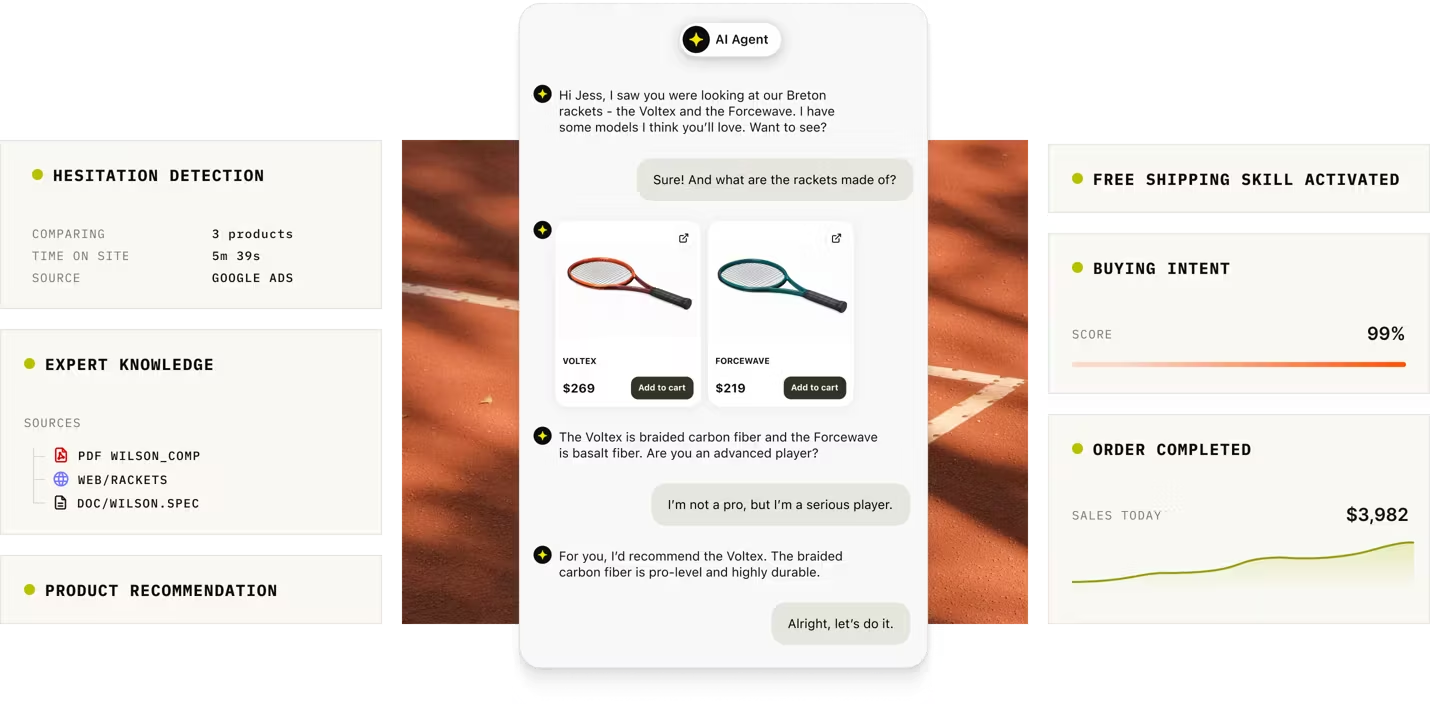 It runs in the same workspace as AI Live Chat and the AI Help Desk, which means the escalation isn't a handoff between two systems that don't know about each other. The human agent picks up the conversation with the transcript, the account, and the sentiment read already in front of them.
That single-workspace detail sounds like an implementation footnote. It's most of the difference between the five rules above being achievable and being a slide deck.
Where does AI in customer service actually break down?
The standard challenges list, data quality, integration cost, bias, is real but abstract. Here's what breaks in live customer conversations.
Ambiguity and sarcasm. AI can misinterpret ambiguous language, and sentiment analysis in particular struggles with "great, another delay" or dry understatement. A misread sentiment score can deprioritize exactly the case that needed escalating.
Confident wrong answers. Generative models produce fluent text regardless of whether they know the answer. In customer service, a confidently wrong statement about a return window or a warranty term isn't a curiosity, it's a commitment the customer will hold you to. This is why grounding the model in your own verified knowledge base matters more than raw model quality.
Edge cases dressed as routine. A refund request is routine. A refund request from a customer whose last four orders arrived damaged is a retention conversation, and it looks identical to the classifier unless you've built the customer history into the routing logic.
Integration reality. Connecting AI to your CRM, order system, and billing platform requires significant technical effort, and this is where timelines slip. The model is rarely the hard part.
Data privacy. Using customer data to power AI raises legitimate concerns about privacy and security, and it's the top objection in most enterprise evaluations. Know where conversation data goes, how long it's retained, and whether it trains anyone's model but yours.
And the honest overall limit: AI is best at routine tasks and high-volume patterns. Complex customer issues, emotionally loaded situations, and anything involving genuine judgment still require human agents. That isn't a temporary state that better models will fix next year. It's the design boundary.
Measure it honestly: deflection is not resolution
This is the single most common self-inflicted wound in AI customer service programs.
Most dashboards report deflection rate: the percentage of conversations that ended without reaching a human. The problem is that a customer who gave up in frustration and a customer whose problem was fully solved both register as deflected. One of them is a success. The other is churn with a nice-looking metric attached.
Track these instead, because these are the data driven insights a dashboard is for:
Resolution rate, confirmed by the customer, not inferred from the absence of a follow-up.
Escalation quality: how often the human agent had to re-ask something the AI already collected.
Repeat contact rate within 48 hours, which catches false resolutions better than any other single number.
CSAT split by path: AI-only, AI-then-human, human-only. If AI-then-human scores well below human-only, your handoff is broken.
Containment on the right things: automating a query you should never have received is a documentation failure, not an automation win.
If your reporting can't distinguish a solved problem from an abandoned one, you don't know whether your AI is working. You know how many people stopped talking to you.
How do you roll out AI in customer service?
Implementing AI in customer service goes wrong most often from starting too broad. A sequence that works:
Pick the boring, high-volume queries first. Order status, password resets, business hours, return policy. Nobody's loyalty hinges on how these are answered, and they're a large share of your customer requests.
Clean the knowledge base before you connect anything. AI grounded in outdated documentation produces confidently wrong answers at scale. This step is unglamorous and non-negotiable.
Run it in suggest-only mode. Let the AI draft responses that human agents approve or reject for a few weeks. You get an accuracy baseline and a labeled training set at the same time, at zero customer risk.
Automate the confident band. Turn on full automation only for intents where measured accuracy is high, and route everything else to people.
Instrument the handoff before you scale. Get escalation right at low volume, because it's the part customers judge you on.
Expand from evidence. Review sentiment trends and failure transcripts monthly, and let the data pick the next intent to automate.
Skipping to step 4 is the fastest way to end up in the SurveyMonkey statistics.
What this does to the job
The common framing is that AI replaces customer service agents. What actually happens is that it removes the easy tickets, which changes the job rather than eliminating it.
When AI handles routine inquiries, the queue that reaches human support agents is more complex, higher stakes, and more emotionally demanding on average. That's harder work, not easier. It also means the skills that matter move toward judgment, de-escalation, and owning a messy problem end to end. Customer support teams that plan for this, by hiring differently and retraining, come out ahead. Teams that cut headcount proportionally to deflection rate discover their remaining agents are drowning in exactly the cases that need the most time, and their operational costs come back as attrition.
The uncomfortable strategic read is that AI is reshaping customer service around the opposite of what everyone is measuring: as it commoditizes fast answers, the human interaction becomes the differentiator. Everyone will have instant support. Not everyone will have someone competent to talk to when instant support isn't enough.
The short version
AI in customer service is transforming customer service into something faster and cheaper that runs at 3 a.m., and there's real evidence behind the efficiency claims. It is also being deployed in ways that a large majority of customers experience as a barrier rather than a service.
Both things are true, and the gap between them is where the opportunity sits. The teams that win are the ones whose customers stop noticing which path they're on, because either path solves the problem. You'd have been fine with a bot that fixed the order. The one at the top of this piece was configured to keep you out, and it did that job perfectly.
Start with the boring queries, ground the model in documentation you trust, make the human always reachable, and measure resolution instead of silence.
If you're evaluating platforms against that list, it's the list we built Text against.
FAQ
What is AI in customer service?
AI in customer service refers to using artificial intelligence technologies like natural language processing, machine learning, sentiment analysis, and generative AI to automate customer interactions, assist human agents, and personalize support across the customer journey.
Will AI replace customer service agents?
No, though it changes the role substantially. AI handles routine customer inquiries and high-volume patterns well. Complex issues, emotionally sensitive situations, and anything requiring judgment still need human agents, and those cases become a larger share of what human customer service teams handle.
How much of customer service can AI actually automate?
It depends heavily on your ticket mix. Strong deployments like Vodafone's TOBi hit a 70% first-time resolution rate across roughly a million interactions a month, and Gartner predicts agentic AI will autonomously resolve 80% of common issues by 2029. Companies with more complex or bespoke products should expect considerably less.
Does AI in customer service improve customer satisfaction?
For mature adopters, yes. IBM reports a 17% higher customer satisfaction percentage among organizations that have operationalized AI in customer service. Poorly designed deployments, particularly those that hide the escalation path, reduce satisfaction instead.
What's the biggest mistake companies make with customer service AI?
Optimizing for deflection instead of resolution, and making it hard to reach a human. 89% of consumers say companies should always offer the option to speak with a person, and blocking that path damages trust faster than automation saves money.
How does AI sentiment analysis work in customer service?
AI tools analyze tone, word choice, and, in voice channels, vocal patterns to detect customer emotions such as frustration or satisfaction. The system uses that reading to prioritize urgent cases and flag negative customer interactions for human agents. It's reliable on clear signals and unreliable on sarcasm and ambiguity.
Is customer data safe when using AI for customer service?
That depends entirely on your vendor. Before implementing AI, confirm where conversation data is stored, how long it's retained, whether it's used to train third-party models, and how the system meets your regulatory obligations. Data privacy is the most common blocker in enterprise evaluations for good reason.