
Jacquelyn Dunham
Content Marketing Specialist
Jacquelyn is a content marketing author with over 7 years of experience creating engaging and compelling content for various industries.
Twenty minutes after ordering a jacket I realized I'd sent it to my old apartment. The help center had an article called "How do I track my order?", which it offered me three times. Nothing about changing an address. The contact form wanted an order number, and the confirmation email hadn't arrived yet.
So I ordered a second jacket to the right address and returned the first one. That store paid for two shipments, one return, and a restocking, because nobody had written eighty words about address changes.
Gartner surveyed 5,728 customers in December 2023 and found that 73% of them use self-service somewhere in their journey, while only 14% of issues are fully resolved there. That gap is where the money goes, and it is almost never a technology problem.
In the same survey, Gartner asked why the other 86% failed, and the reasons were embarrassingly fixable: 45% of customers who started in self-service said the company didn't understand what they were trying to do, and the most common reason for failure, in 43% of cases, was that customers couldn't find content relevant to their issue. Both are content problems, which means customer self-service is a customer experience decision before it is a cost decision.
What is customer self-service?
Customer self-service refers to any channel where a customer resolves an issue without a human on the other end: a help center article, an FAQ, an order-tracking page, an account portal, a community thread, or an AI agent in chat.
The definition sounds administrative until you notice what it excludes. A page explaining your returns policy is information. A flow that actually starts the return is self-service. Most companies build the first and count it as the second, which is one reason customer self-service stalls at 14%.
Why is customer self-service important?
Cost is the obvious answer. Gartner's 2024 benchmarks put the median cost per contact at $1.84 against $13.50 for assisted channels, so roughly seven self-served contacts for the price of one that reaches a person. At volume, that is the difference between support costs that track headcount and operational costs that don't.
The better answer is that customers expect it. Nobody calls their bank to check a balance anymore, because the mobile banking app answers in four seconds at eleven at night. That is the customer experience standard your help center is judged against, and it was set by companies in other industries.
Why customers start with self-service channels
Most people try customer self-service channels first. They are open at 2am, they don't put you in a queue, and they don't require explaining your problem to a stranger who will ask for your order number twice.
Customers prefer self-service for the same reason they prefer a supermarket checkout to a butcher's counter: for simple things, the interaction is the cost. For simple things, self-service turns a five-minute conversation into a ten-second click. People aren't choosing a channel—they're choosing time.
The 14% problem
The failure is rarely total. Customers don't just try and bounce. They try it, half-solve it, then contact you anyway. In a 2022 survey of 6,138 customers, Gartner found that 88% of customer journeys that start in self-service end up touching multiple channels, including phone, live chat, and email.
That is the expensive outcome. You paid to build the content, the customer spent their effort reading it, and you still paid $13.50 for the contact. Deflection numbers look healthy in that scenario, which is precisely why deflection is the wrong thing to measure.
Some self-service customers don't come back at all. In the same 2022 survey, 38% of Gen Z and millennial customers said they were likely to give up on an issue entirely if they couldn't resolve it in self-service, against 11% of baby boomers. Taking things even further, 52% of Gen Z and millennial customers said that if self-service failed them, they wouldn't buy from that company again.
The types of customer self-service
Five channels cover almost everything, and most products on the market combine them. The list is shorter than vendor categories suggest, and each channel fails in its own way.
Knowledge bases and help centers
The searchable library of articles. Knowledge bases are the backbone of most self-service programs and the source of most of the disappointment, because they answer the questions a company finds interesting rather than the questions customers ask. For the full build, we have a guide on how to create a knowledge base.
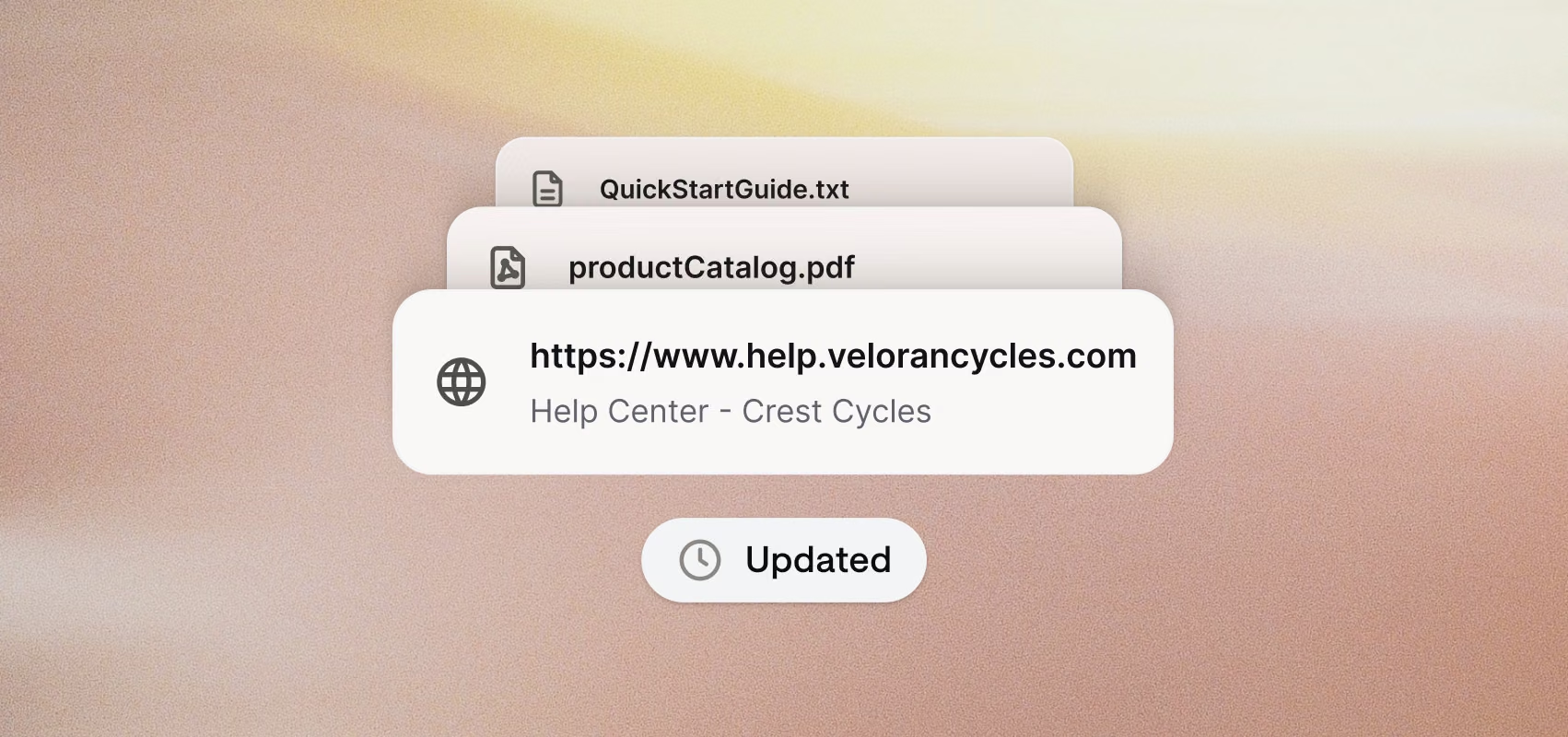 Two things separate a knowledge base that work from filing cabinets. Coverage has to follow ticket volume rather than product structure. And somebody has to own maintenance, because a knowledge base decays the moment a policy changes and nobody tells the person who writes the articles. The tell is your search log. If customers can't find answers to your top query, you don't have a service channel.
FAQ pages
Short question-and-answer pairs that sit alongside your knowledge base, useful for the twenty things everyone asks and hopeless beyond that. They are also the cheapest self-service tools to launch. An FAQ page works when there are genuinely frequent questions. It stops working when it becomes the dumping ground for everything nobody wanted to write properly.
AI agents in chat
Instead of the customer searching, an AI agent reads your knowledge base for them and answers in their words. This is the real shift in self-service over the last two years, and it attacks the 45% finding directly, because the customer no longer has to guess your vocabulary.
Customer self-service portals
Account areas where customers do things rather than read about them: track an order, download an invoice, change a delivery address, start a return, cancel a subscription. Customer self-service portals are the highest-value channel here because each action removes a whole ticket type, and they are the rarest because they need real integration work.
Community forums
Peer answers with light moderation. Community forums earn their place for products with power users and edge cases, and they need critical mass before they repay the effort.
What to automate, and what to leave alone
Sort your last 200 tickets into two piles before you build anything.
Safe to automate
Anything with one correct answer that doesn't change with the customer. Order status, delivery windows, returns eligibility, invoice downloads, password resets, sizing, stock. These are repetitive, high-volume, and low-risk, and they make up the bulk of most ecommerce queues. Customers resolve issues like these faster alone, and your support agents notice.
Leave to a human
Anything where the answer depends on judgment about this person. A wedding order that missed the date. A chargeback threat. A complaint about a fourth failed delivery. Automating these does not save money. It converts a solvable complaint into a public one, and your support teams exist for exactly this.
How to design a self-service strategy
Start from your ticket log. A content plan is the wrong starting point. Export three months of customer interactions, sort by volume, and write for the top twenty questions in the words customers used. Your self-service strategy is a ranked list of real questions before it is anything else.
Match the customer's vocabulary
The 45% who said the company didn't understand them were usually trying to do something your content had no verb for. "Delivery address" is a noun. "I need to change where this is going" is a self-service customer. Title the article after the job.
Tell customers the channel exists
Self-service adoption is a distribution problem as much as a design one. Put your self-service tools in order confirmations, shipping notifications, and the chat widget's opening message, because customer self-service channels only repay the effort at volume. Connecting self-service to the moment a question arises beats a link in the footer.
Put the way out in plain sight
Hiding the contact route raises your deflection rate and lowers your resolution rate, and Gartner's February and March 2026 survey of 3,566 customers is blunt about the cost: 87% of customers say access to a human agent is essential when a company uses generative AI in service. Make the escape hatch obvious and the self-service path gets used more, because trying it stops feeling like a trap.
What your self-service content has to do
First, your knowledge base has to hold an answer to the question being asked. This is where most programs fail. In 43% of failed attempts customers couldn't find relevant articles, which is a coverage problem wearing a search problem's clothes.
Second, it has to be current. Knowledge base articles rot quietly, and a confidently wrong returns window costs you the refund and the customer. Set a review cadence against your policy pages rather than a content calendar, and keep knowledge base articles on the same schedule as the policies they describe.
Third, your self-service content has to be readable by a machine as well as a person. If an AI agent is reading it on the customer's behalf, structure matters more than tone: one question per article, the answer in the first line, no preamble.
 Escalation to a human agent
Every self-service program needs a documented handoff, because self-service fails often enough that the failure path is part of the product. Human intervention should be one click from every step, and when it happens, customer support agents should inherit the conversation along with the transcript, what the customer already tried, and any details they typed. Making someone repeat their order number after five minutes of self-service is how you turn a small problem into a complaint.
The stakes on that handoff are higher than they look. In Gartner's 2026 survey, only 27% said they would be willing to try a chatbot again after a negative experience. Eric Keller, the analyst who published the findings, called it a leaky bucket and warned that chatbots "should serve as seamless connectors to human support, not containment traps."
Two self-service flows that work
Changing a delivery address
The customer asks in chat. The AI agent checks whether the order has shipped. If it hasn't, it updates the address and confirms the new one back. If it has, it explains what happens next and offers to open a ticket with the carrier reference attached. Either way the customer knows what happens next, and only the shipped branch reaches a person, with everything they need already attached.
Starting a return
The customer says the boots don't fit. The agent checks the order date against your returns window, confirms eligibility, issues the label, and says what to expect. Compare that to a returns policy article, which tells the customer they are eligible and then asks them to email you.
How to measure customer self-service
Resolution rate, not deflection rate
Deflection counts contacts that didn't happen, which rewards you for hiding. Self-service resolution counts issues that ended. Measure the share of sessions where the question was answered and the customer didn't come back within 48 hours. Self-service resolution always comes out lower than a deflection dashboard, and truer. Or ask your support agents how many of their tickets started in the help center.
CSAT, split by who handled it
Run customer satisfaction separately across self-served, human-handled, and mixed customer interactions. Blended CSAT hides the interesting case, which is the mixed conversation, because that is where you learn whether your escalation works or merely happens. Customer feedback on a self-service experience is also the cheapest content review you will ever run, and it tells you where customer satisfaction drops between the bot and the person.
The questions nobody can answer
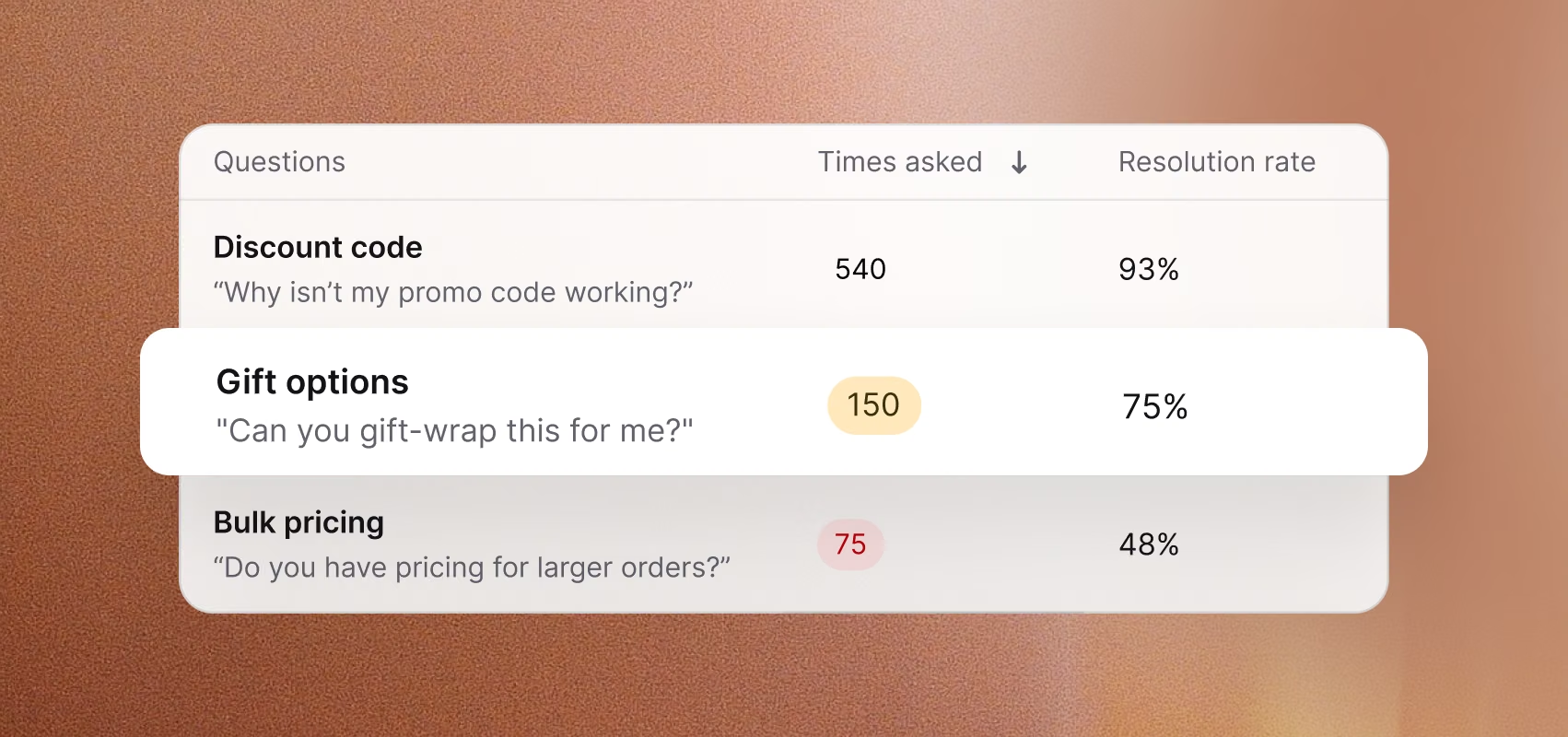
Log every customer self-service session that ended without an answer, cluster them, and rank by frequency. That list is the roadmap for your knowledge base, and it is the only metric that tells you what to do on Monday.
How AI changes self-service
Self-service has quietly split in two. There is the version where customers search your documents, and the version where they ask a question and something reads the documents for them. Gartner's 14% figure covers every kind of self-service, and it was measured before most companies had anything that could answer in the customer's own words. The asking version is what most people now mean by AI self-service, and it moves the work from the customer to the machine.
The shift is not just better language models. It changes what your content is for, from browsing surface to retrieval source, and it changes who owns the last mile, because virtual assistants that answer in a customer's own words remove the vocabulary problem behind the 45% finding. Customers used to have to learn your interface. That has flipped.
The ground is shifting underneath all of this. Gartner's 2026 research found customers are roughly three times more likely to reach for third-party AI tools than a company's own chatbot when resolving a service issue, and that use of company-provided chatbots has been statistically flat since 2022. If your tools are worse than the general-purpose assistant already open in another tab, customers will use that one and arrive misinformed. Virtual assistants outside your control are now part of your customer self-service channels whether you like it or not.
Where Text fits
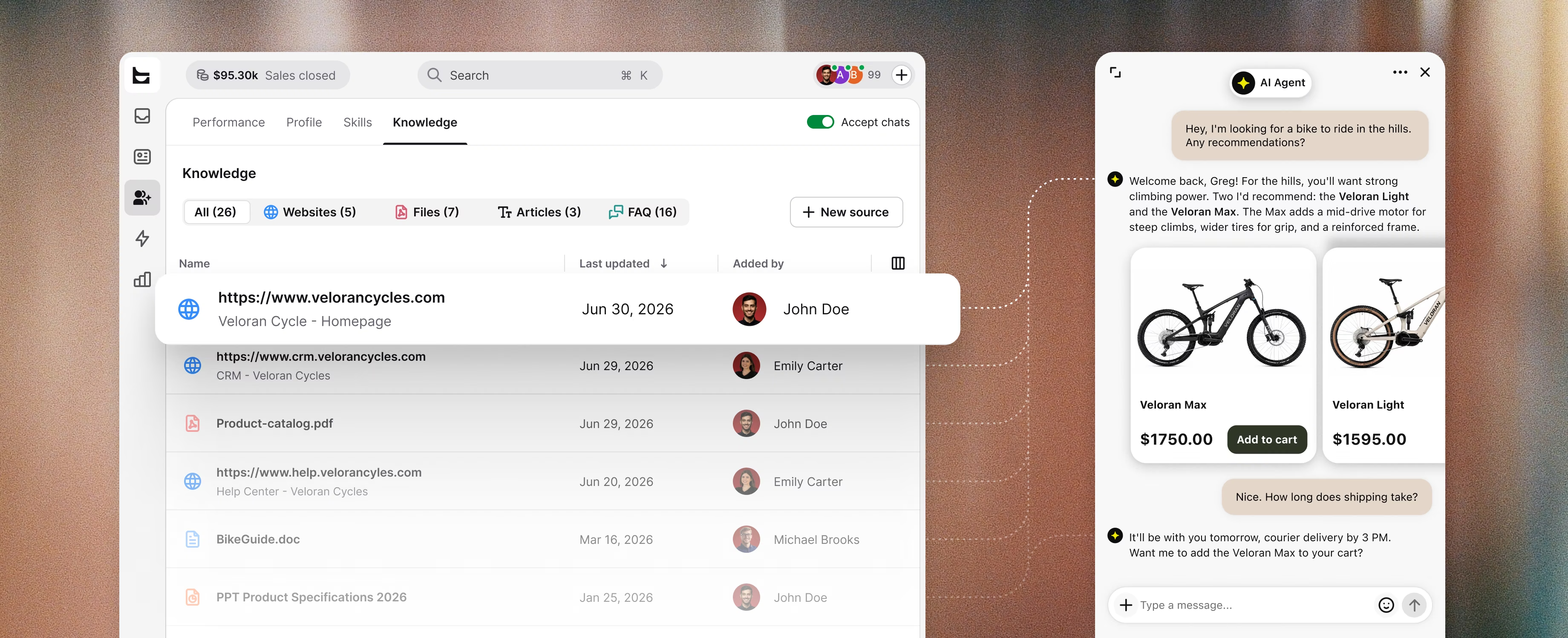
Text's self-service is conversational rather than browsable. The AI Agent trains on sources you already have, combining your website, help docs, policies, and FAQs and answering customers directly in chat. With an ecommerce integration it also reads live order and customer data, which is what turns an explanation into an action. The AI Agent reads from Knowledge hub. If you're looking for a searchable help center customers browse themselves, that is our sibling product KnowledgeBase.
 What matters more here is what counts as a resolution, and it’s worth knowing upfront that the same definition is also what you’re billed on. A resolution requires the AI Agent to answer at least one customer question: it doesn’t count if no issue was solved, if the answer was irrelevant or incomplete, or if the agent transferred the chat without answering anything. That’s a stricter bar than most vendors use, but since resolutions also set your usage, limits, and pricing, the strictness isn’t purely a quality feature. It’s also the meter.
The AI agent report shows resolution rate, AI chats, AI CSAT, transferred chats, and resolutions, and only CSAT is broken out by automated, manual, and assisted conversations, so you can see where satisfaction holds up by conversation type even though the other numbers aren’t split that way. The Knowledge Gaps view lists recurring questions your sources can’t answer, ranked by how often customers asked.
Your implementation checklist
Export three months of tickets and rank the top twenty customer self-service candidates by volume.
Write or fix the content for those twenty, each titled after the customer's job.
Connect your self-service tools to your order data so the portal can act instead of explain.
Put your contact route on every help center page.
Define what a resolution means for you before you report on one.
Once a quarter, check your top articles against live policy.
Read the unanswered-question log monthly and write the top three.
Start with the address-change article. Somebody is about to order a second jacket.
Frequently asked questions
What should self-service cover first?
The list that matters for self-service design is narrower than the marketing version. Customers need to know where their order is, whether they can return it, what that costs, how to change something they already submitted, and how to reach a person when the first four fail. Cover those five self-service options and you have covered most of the queue, and most of what customer expectations actually amount to. Beyond those five, let the unanswered-question log tell you what to write next.
Can you give me an example of customer self-service?
Tracking a parcel from an order confirmation link is the cleanest example. The customer completes the task, no agent is involved, and no article gets read. Checking in for a flight on your phone is the same pattern with better design.
What are some examples of customer portals?
An ecommerce account area with order history, returns, and saved addresses. A SaaS billing portal with invoices and seat management. A utility account with meter readings and payment plans. What these customer self-service portals have in common is that customers manage their own records instead of asking customer service representatives to look them up.
Why does 24/7 support matter?
Demand doesn't follow your shifts. Self-service resources are the only affordable way to answer at 3am. It only works if the content is right, since nobody is there to correct it and prevent accuracy from becoming a service quality problem first and a customer experience later. Overnight is also where customer self-service earns its keep, because the alternative is a queue that opens at nine.