
Tomasz Ziętek
Content Creator
Experienced content and SEO specialist working with SaaS businesses since 2016. After hours, he's cycling, cooking, traveling, or digging through record crates.
I canceled a subscription at 11:40 on a Tuesday night. It took four screens, and the third one asked me whether I was sure.
I never opened a ticket. Nobody at that company heard a word from me, so their customer service was perfect that night; I never used it. The argument over customer service vs. customer experience is about who owns those four screens.
It's an ownership problem. When nobody agrees where customer service ends and customer experience begins, two things happen: the support team gets blamed for churn caused by a confusing checkout, and the product team ships a feature that quietly triples ticket volume. Both teams are working hard. Nobody's covering the gap between them.
Customer service is what happens when a customer asks for help. Customer experience owns what happens before, between, and after those moments, which means the real problem isn't defining the difference. It's deciding who has authority over the gaps.
Customer service vs customer experience in one line
Customer service is what happens when a customer needs help. Customer experience is everything that happens, including the part where they need help.
Customer service is a subset of customer experience. That's the whole distinction, and every other difference between customer service and customer experience is a consequence of it. You'll also see the pair written as CX vs CS.
 What is customer service?
Customer service is the direct support your company provides when someone has a question, a problem, or a request. A customer service interaction has a clear beginning and end: a customer reaches out through phone calls, live chat, email, or a support form, someone helps them, and the ticket closes.
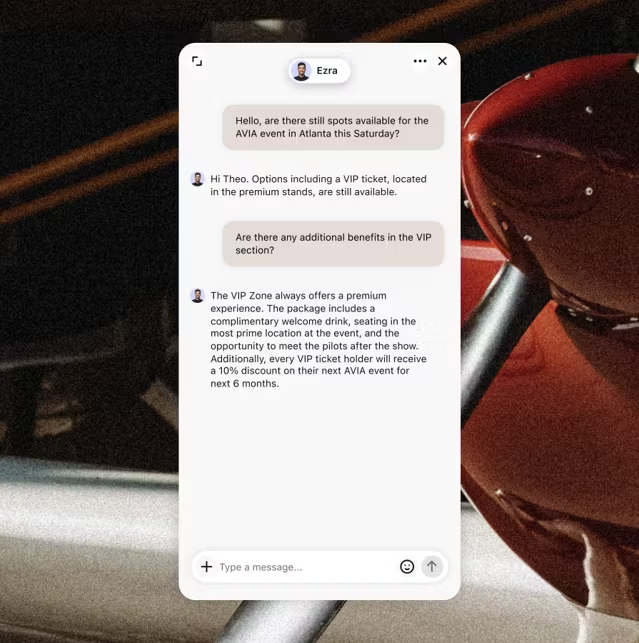 Customer service is mostly reactive: someone reaches out, someone responds. The best teams also open the conversation first. It exists to address immediate customer needs and to anticipate them. The customer service team owns it, and effective customer service gets measured on whether the problem was solved, how hard the customer had to work, and how long it took. Most customer service happens after the purchase, because that's where customer issues surface.
What is customer experience?
Customer experience refers to the overall perception a customer forms of your brand, built from every interaction they've ever had with it. Customer experience encompasses the entire customer journey, for example:
The ad they scrolled past
The pricing page they compared against a competitor's
The onboarding email that made sense
The app that loaded slowly on the hotel WiFi
The support chat that saved the account
The renewal notice that arrived three weeks early
Customer experience encompasses everything the customer touches, whether or not a human is involved. It's proactive; the work optimizes touchpoints before issues arise, not after. And it belongs to the entire organization: product, marketing, sales team, billing, engineering, and support.
McKinsey's research makes the case for why this framing matters. Studying journeys rather than individual touchpoints, they found that customer journeys correlate far more strongly with business outcomes than touchpoints do. In one study, even with a 90% chance that any single touchpoint would go well, average customer satisfaction fell by nearly 40% across the entire journey. Every individual interaction can be fine, and the overall customer experience can still be poor.
Customer service vs customer experience: key differences at a glance
Customer service | Customer experience | |
|---|---|---|
Scope | One customer interaction | The entire customer journey |
Owner | A dedicated service function | Cross-functional |
Stage | Mostly post-purchase | Entire lifecycle, from awareness to advocacy |
Trigger | Usually a customer need or request | Any touchpoint in the journey |
Key metrics | CSAT, FCR, AHT, response time, service level | NPS, CES, customer retention, customer lifetime value |
Time horizon | This conversation | The customer relationship |
Success looks like | Customer issues resolved fast, with low effort | A customer who doesn't need to contact you and stays anyway |
Failure looks like | An unresolved ticket | A quiet cancellation you never saw coming |
Five differences that change how you actually work
1. Scope: one interaction vs the entire journey
A customer service interaction is a scene. The customer experience is the film.
This sounds like a semantic distinction until you try to diagnose a retention problem. If the customer satisfaction score is high on every ticket, but customers keep leaving, your service is working, and your experience isn't. The problem lives somewhere customers never contact you about, the part of the product they gave up on silently, the invoice they couldn't parse, the four-screen cancellation flow that told them exactly how you feel about them.
My four screens never produced a ticket, so on every dashboard that the company owns, I left happy.
2. Nature: a function vs a discipline
The usual shorthand is that customer service is reactive and customer experience is proactive. It's directionally useful, and it falls apart under pressure.
Customer experience is full of reactive work: service recovery after a bad month, communication during an outage, a returns policy rewritten because customer feedback said it was hostile. And customer service is routinely proactive, notifying someone about a delayed order, flagging a card that's about to expire, reaching out when an account looks stuck halfway through setup.
The distinction that holds is altitude. Customer service is a function: a set of interactions someone performs. Customer experience is a discipline concerned with the whole journey and the perception it leaves behind. Service is interaction-level; experience is journey-level; and either can be reactive or proactive depending on the day.
So the shipping delay test isn't proactive vs reactive. A notification sent before the customer notices is proactive customer service, doing customer experience work. The apology after they call in is reactive customer service, cleaning up after an experience that already failed upstream. Same delay, same customer, completely different feeling, and only one of them generates a ticket.
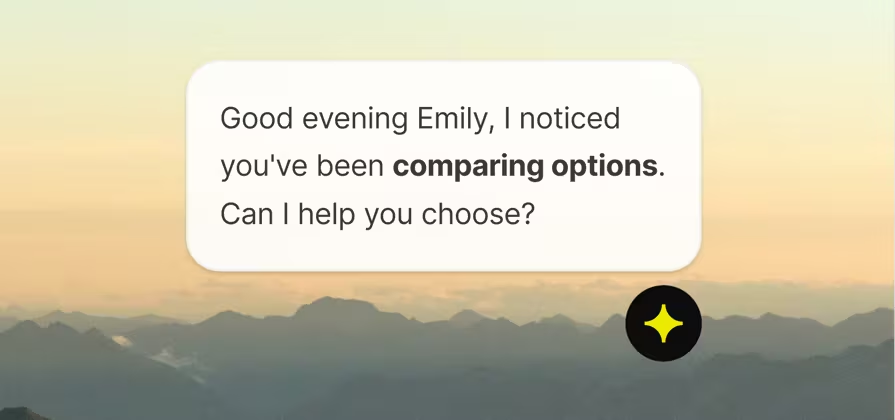
In ecommerce, some customer service platforms can track a buyer's behavior and open a personalized interaction before anyone asks for help:
 Every customer service team knows the ticket types that shouldn't exist. "Where's my order?" "How do I reset my password?" "What does this line on my bill mean?" Those are customer experience failures arriving in a customer service queue. Fixing them upstream is CX work, but the intel comes from CS.
3. Ownership: a dedicated function vs cross-functional journey ownership
Customer service is owned by a support team with a manager, a headcount, and a budget line. Customer experience is shared across an organization, which means it's routinely owned by no one.
This is where most CX strategies quietly die. When the ownership question remains vague, CX becomes a values statement rather than a function. A bigger customer service team won't fix it. You need a named person who owns the journey map and has authority over the touchpoints on it, including the ones that live in product and billing.
4. Metrics: resolution vs perception
Customer service metrics measure an event, while customer experience metrics measure whether the relationship survived it.
Question you're asking | Metric to use | What it belongs to |
|---|---|---|
Did we solve it? | First Contact Resolution (FCR) | Service |
Did we solve it fast? | Average Response Time, Average Resolution Time | Service |
How long did the interaction run? | Average Handle Time (AHT) | Service |
Are we answering enough of them? | Service level | Service |
Did that interaction land well? | Customer Satisfaction Score (CSAT) | Service |
How much work did we make the customer do? | Customer Effort Score (CES) | Both |
Would they recommend us? | Net Promoter Score (NPS) | Experience |
Are they staying? | Customer retention, churn | Experience |
What's the relationship worth? | Customer lifetime value | Experience |
CSAT sits at the boundary. Ticket-level CSAT is a service metric. Relationship-level CSAT, gathered through periodic customer surveys, is a customer experience metric. Confusing the two is how teams end up with 96% CSAT and a retention problem.
5. Payoff: satisfaction now vs lifetime value later
Great customer service can leave a customer satisfied, reassured, or even more loyal than before. Whether that customer stays depends on the experience surrounding the conversation.
The numbers support both. SQM Group's research across North American contact centers found that 93% of customers expect their issue resolved on the first call — meeting customer expectations at that single moment is not optional. And on the experience side, SuperOffice found that customers who rate a company 10/10 on experience spend 140% more and stay loyal up to six times longer.
The downside is symmetrical. Zendesk's 2025 CX Trends Report found that 63% of consumers would switch to a competitor after a single bad customer service experience, up nine points year over year. Qualtrics XM Institute puts the aggregate cost of poor experience at $3.8 trillion in global sales at risk, with consumers reducing or stopping spend after more than half of negative experiences.
Customer experience examples: one journey, one service moment
Abstract definitions get slippery, so here are customer experience examples you can actually picture. Start with one journey: a customer buying running shoes:
Sees an Instagram ad — CX
Reads a comparison review on your blog — CX
Lands on a product page that loads in under a second — CX
Filters by width, because you thought to include width — CX
Checks out in three fields, guest checkout available — CX
Gets a confirmation email with a tracking link that works — CX
Receives the wrong size, opens live chat — CS begins
An agent sees the order without asking for a number, sends a prepaid label, and ships the replacement same day — CS
Gets a follow-up two days later, confirming the right pair arrived — CX (proactive)
Leaves a five-star review mentioning the exchange — customer advocacy
Eight of those ten steps happen without a support agent. That's the ratio worth internalizing. Customer service was decisive at step 8 — a bad exchange there wipes out steps 1 through 7. It was one moment inside an experience that the rest of the company designed.
Customer experience examples by industry
The CX vs CS split looks different depending on what you sell, but the shape holds:
E-commerce. Service: an agent chasing a delayed order for a shopper.
Experience: a checkout that doesn't ask for an account, delivery estimates that turn out to be true, a returns policy written in plain language and the support conversation itself.SaaS. Service: answering a billing question about a proration nobody understood.
Experience: the onboarding flow, in-app guidance, and whether the confusing screen that generated the ticket ever got rebuilt.In-store retail. Service: a staff member processing a refund at the counter.
Experience: store layout, queue length, signage, and whether the online account and the in-store till know about each other.Healthcare. Service: the front desk confirming an appointment.
Experience: the referral, the parking, the wait, and whether the post-visit instructions make sense at the kitchen table three hours later.
In every one of them, the customer service interaction is a single moment inside a much longer customer journey. A great one can repair the journey around it. No amount of service recovery builds the rest of it for you.
Customer support vs customer experience: a three-way distinction
"Customer support" and "customer service" get used interchangeably, and mostly that's fine. Where the distinction matters:
Customer support is the technical subset — troubleshooting, bugs, how-to. Common in SaaS.
Customer service is the broader helping function — returns, billing, orders, complaints, plus support.
Customer experience contains both, plus everything else.
So CX vs CS is a scope question. Customer support vs customer experience is the same question with a narrower CS on one side of it.
When customer service and customer experience pull against each other
Here's what most customer service vs customer experience explainers leave out: the two disciplines optimize for different things, and their metrics fight. This is where CX vs CS stops being a definitions exercise and starts costing money.
AHT vs FCR
Push average handle time down and agents start closing conversations before the underlying problem is solved. Repeat contacts rise, first contact resolution drops, and the customer experience gets worse while the customer service dashboard looks better than ever.
Deflection vs resolution
Routing more customers to self-service lowers cost per contact. Route the wrong ones there and you've built a maze. The customer effort score climbs, and the customers who need a human most are the ones you've made work hardest to find one.
Service recovery vs root cause
Excellent customer service can redeem a poor experience. A great agent turns an angry customer into an advocate. But a team that's world-class at recovery can mask a product defect for quarters. If the same issue generates 400 tickets a month and every one of them ends in a delighted customer, service is doing its job and CX is failing.
You don't have to pick a side. Pair every service efficiency target with an experience guardrail: AHT with FCR, deflection rate with CES, CSAT with 30-day repeat contact rate.
How your customer service team improves customer experience
Your support team is one of the few groups that hears from customers in their own words, at the moment something breaks. That's the highest-signal customer feedback in the company, and most organizations use it to plan headcount and nothing else.
Three things worth building:
Tag for cause, not category. "Billing" tells you nothing. "Invoice PDF doesn't show tax breakdown" tells product what to fix. Retag your top ticket drivers by root cause and the customer experience roadmap writes itself.
Send the top five ticket drivers to the people who can fix them. Monthly, in writing, to product and marketing, not to a shared dashboard nobody opens. Volume plus revenue impact plus a verbatim quote.
Close the loop out loud. When a ticket driver disappears because someone fixed it, say so. It's the only way support keeps reporting and product keeps fixing.
This is the flywheel: customer service surfaces the friction, customer experience removes it, ticket volume falls, and the tickets that remain get the attention they deserve.
Building this without dismantling your support team
A workable sequence:
Map the entire customer journey, including the steps you don't control: the review site, the comparison spreadsheet, the colleague who recommended you.
Mark every touchpoint where customers interact with you, then mark which ones you actively measure. The gap is your blind spot.
Name an owner per stage. Not a committee.
Instrument both layers. Service metrics per interaction, experience metrics per relationship.
Consolidate your support channels. Fragmented tooling is why a customer explains their problem three times — one of the most reliable ways to make a good service team produce a bad experience. Platforms like Text pull live chat, help desk, and AI Agents into one place so context follows the customer across channels instead of resetting at each handoff.
Run the feedback loop on a schedule, with a named recipient.
Review quarterly against retention, not against ticket volume alone.
The short version
Customer service is what you do when the experience doesn't go to plan. Customer experience is the plan.
You need both. Get service right and you keep the customers who ran into trouble. Get experience right and fewer of them do.
I never went back to that subscription and I never told them why. Their support team is probably still hitting every target it has. That's what a customer experience failure looks like from inside the company — nothing at all.
Frequently asked questions
What is the difference between customer service and customer experience?
Customer service is the help you provide when a customer contacts you. Customer experience is the customer's overall perception of your brand across every interaction, including that support conversation. Service is a subset of experience.
Is customer service part of customer experience?
Yes. Customer service is one component of the customer experience — a decisive one, but a single stage in the entire journey.
What is CX vs CS?
CX is customer experience: the entire lifecycle, owned across the entire organization, measured by NPS, retention, and customer lifetime value. CS is customer service: individual interactions, owned by a dedicated service function, measured by FCR, CSAT, and response time.
Which matters more?
Both are critical for business success, and they fail differently. Weak service loses customers loudly, at the worst possible moment. Weak experience loses them quietly, without a ticket, and you find out at renewal.
Can great customer service fix a bad customer experience?
It can rescue an individual customer relationship — a genuinely great service interaction often strengthens customer loyalty more than a smooth transaction would. It can't fix a broken product, an unclear price, or a checkout that fails on mobile. Recovery is not a strategy.
Do small teams need a separate CX function?
No. They need one person who is accountable for the entire customer journey and has the authority to change things outside the support queue. Below roughly 50 employees, that's usually a founder.