
Paweł Hałabuda
Content marketing and SEO expert
Paweł writes about support content, turning real customer feedback into resources that answer what people actually ask.
TL;DR Drift’s security slip and limited scope have teams looking elsewhere. From AI-first platforms like Text to enterprise giants like Zendesk, these 15 alternatives offer safer, smarter ways to manage conversations.
Drift helped define the category of conversational marketing. But in 2026, many teams are asking whether it’s still the safest or smartest choice.
The August OAuth breach tied to Salesloft’s Drift integration raised alarms for security teams — tokens tied to Salesforce and Google Workspace were abused before Google forced a reset.
At the same time, the market has shifted: AI-first platforms can now resolve tickets end-to-end, not just capture leads. And pricing has evolved from per-seat licenses to usage-based AI billing, changing the economics of scale.
If you’re evaluating Drift alternatives, you’re not alone. The good news? There are mature, AI-powered options that cover the same ground — and more — without the trust or cost trade-offs.
At-a-glance comparison
If you don’t have time to read every profile, start here. This table shows you the big differences at a glance — what each tool is best at, how their AI is priced (per seat or per resolution), how deep they go with Salesforce, and whether they double as a full helpdesk or just chat.
Think of it as your quick filter: spot which platform actually fits your team before you dive into the details.
Tool | Best For | AI and pricing model | Key strengths |
Text | Unified support + automation | AI-first, built-in (no add-on billing) | Live chat, ticketing, AI agents, omnichannel |
Intercom | Product-led growth & in-app engagement | Fin AI: $0.99 per resolved conversation | Proactive messaging, behavioral targeting |
Zendesk | Enterprise workflows & reporting | Seat-based + AI add-ons | Marketplace depth, robust ticketing |
Kustomer | CRM-centric, WhatsApp/social support | Seat-based with AI automations | Customer timeline, omni-channel |
Tidio | SMBs & e-commerce | Lyro AI for FAQ deflection | Affordable, quick setup, Shopify-friendly |
Freshdesk | Budget-friendly helpdesk | Freddy AI add-ons | Easy rollout, strong ticketing features |
HubSpot | Inbound-heavy sales & support | AI embedded across CRM/Marketing Hub | CRM-native, unifies sales + marketing + support |
Zoho SalesIQ | Teams inside Zoho ecosystem | AI chat + CRM automations | Tight Zoho suite integration, affordable |
Qualified | B2B SaaS, Salesforce-first ABM | AI-driven routing & chatbots | Salesforce-native, account-based marketing focus |
Conversica | AI SDR + lead follow-up | Conversational AI per-contact volume | Automates outreach via email/SMS |
Crisp | Developer-friendly all-in-one messaging | Seat-based with automation packs | Modern UI, strong API ecosystem |
LivePerson | Enterprise-scale messaging & voice | Usage-based AI/automation | Telecom-grade scale, trusted by global brands |
Gorgias | E-commerce (Shopify, BigCommerce) | AI macros + intent detection | Tight Shopify integration, fast support automation |
Front | Shared inbox + light automations | Seat-based | Blends email + chat + collaboration |
HelpCrunch | Affordable all-in-one support | Seat-based with AI chatbot add-ons | Chat, email, knowledge base in one package |
1. Text
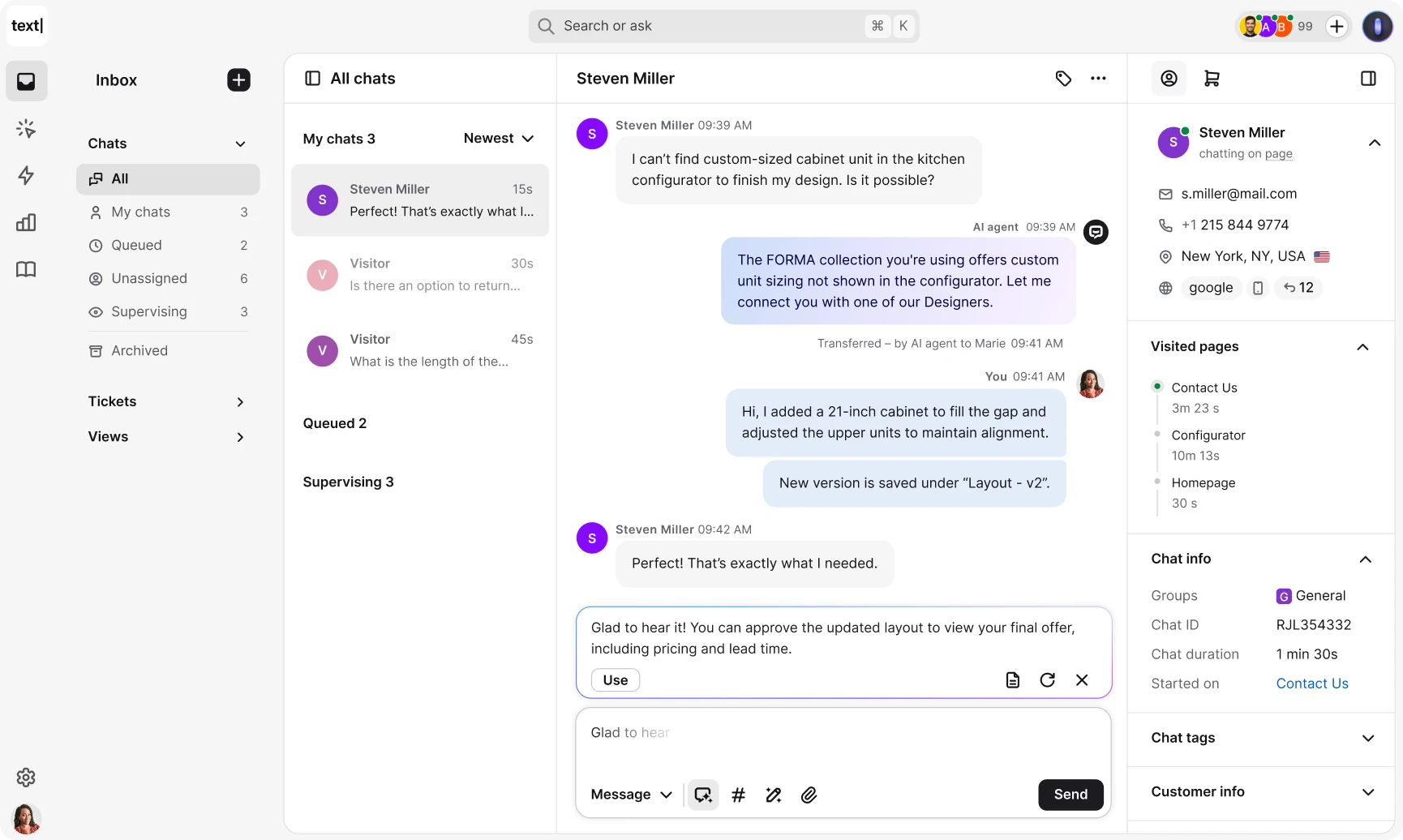
If Drift was built for capturing leads, Text was built for running the entire customer conversation cycle. Instead of stitching together chat, helpdesk, and automation from different vendors, it gives you a single workspace where AI agents, live chat, ticketing, and workflows all live under one roof.
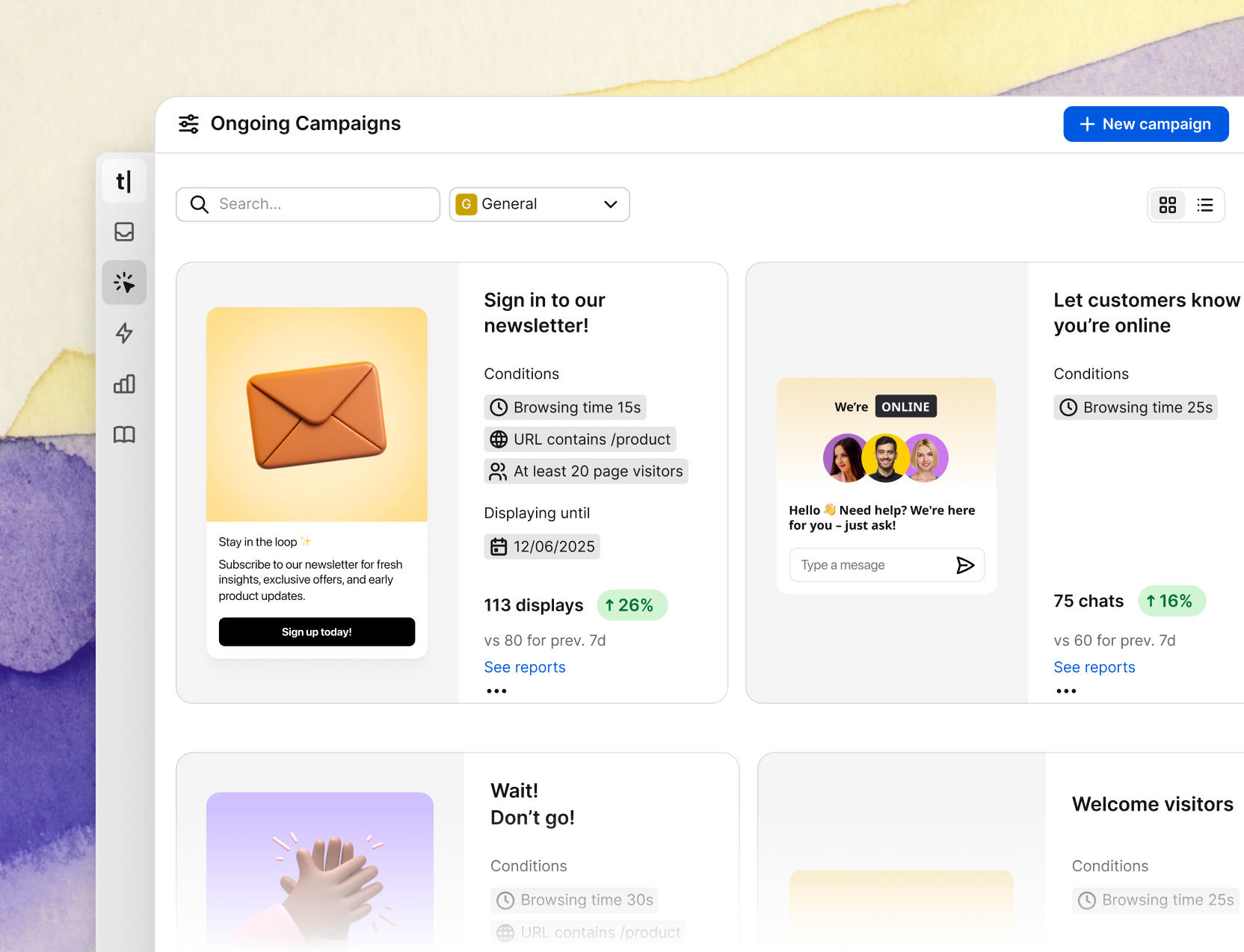
The difference is in the design. With Drift, AI often feels bolted on — useful, but secondary to the chat widget. Text takes the opposite route: AI is the core.
Our Text Intelligence engine understands context from your knowledge base, executes tasks (like issuing refunds or updating orders), and knows when to escalate to a human.
No more bots that just “suggest.” These agents actually get work done.
Why teams pick Text over Drift:
AI-first, not bolt-on: Automates repetitive cases with agents that act, not just respond.
Unified workspace: Live chat, tickets, and automation in one view — less tool switching, fewer silos.
Omnichannel by default: Email, chat, social DMs, and even messaging apps are handled in one thread.
Predictable costs: Unlike Drift or Intercom’s per-resolution AI billing, Text doesn’t surprise you with usage spikes. AI is built-in.
Scales with growth: Whether you’re a lean support team or a multi-region operation, the platform expands without requiring another layer of tools.
2. Intercom
SaaS and product-led companies that want to guide users inside the product, not just on the website.
Intercom’s strength is in-app engagement: tooltips, banners, and nudges that reduce onboarding friction and boost upsells. Recently, it added Fin AI, charging per resolved conversation instead of per seat.
Strengths
Proactive in-app messaging that Drift never fully mastered
Strong ecosystem for SaaS (analytics, CRMs, product tools)
AI that plugs into the chat experience for instant deflection
Trade-offs
Usage-based AI pricing can spike with heavy traffic
Limited ticketing depth compared to all-in-one platforms
AI feels like an add-on, not the backbone of the system
If your growth play is product-led and you’re comfortable with variable AI billing, Intercom is one of the best-known Drift alternatives. But if you want AI baked into the core — not a layer on top — platforms like Text cover more ground.
3. Zendesk
Enterprises and scaling teams that need complex workflows, deep reporting, and a mature helpdesk backbone.
Zendesk isn’t just chat. It’s a full-scale customer service hub with routing, macros, reporting, and a huge integration marketplace.
Strengths
Battle-tested ticketing and automation at enterprise scale
Marketplace with thousands of integrations
Strong analytics and reporting for leadership visibility
Trade-offs
Can feel heavy for smaller teams
AI is an add-on, not central to the platform
Costs rise quickly with seats and modules
Zendesk is overkill if you only want a Drift replacement for lead capture. But if you’re moving beyond chat into enterprise-grade service automation, it’s a solid option.
4. Kustomer
Teams that want to see every interaction in a single timeline, especially brands heavy on WhatsApp and social channels.
Instead of a ticketing system, Kustomer builds a CRM-like timeline for each customer — all conversations, orders, and history in one view.
Strengths
Timeline view helps agents see full context instantly
Strong integrations with WhatsApp and social platforms
Automation features layered onto the CRM approach
Trade-offs
Less traditional helpdesk depth than Zendesk or Text
Best fit for teams willing to adapt to its CRM-first model
Pricing scales quickly for larger teams
A strong Drift alternative if social messaging and customer context are more important to you than classic ticketing.
5. Tidio
Small businesses and ecommerce brands looking for a quick, affordable Drift replacement.
Tidio combines live chat with Lyro AI, which is trained to handle repetitive customer questions like shipping status or return policies.
Strengths
Low cost, easy setup
Shopify and ecommerce integrations built-in
Lyro AI deflects repetitive tickets effectively
Trade-offs
Not designed for enterprise scale
Limited reporting and workflow depth
AI is basic compared to higher-end platforms
If you’re an SMB or ecommerce team, Tidio is a fast, low-risk Drift alternative. But if you plan to scale, you may outgrow it quickly.
6. Freshdesk
SMBs that want the structure of a helpdesk without enterprise-level costs.
Freshdesk is often called “Zendesk for smaller teams.” It brings solid ticketing, automations, and reporting into an approachable package. Freddy AI (their automation layer) is available, but optional.
Strengths
Affordable compared to Zendesk
Strong ticketing foundation
Marketplace of integrations
Trade-offs
UI feels dated next to modern platforms
AI is add-on, not central to the product
Limited proactive engagement vs. Drift/Intercom
If you’re leaving Drift because you want a real helpdesk but don’t need Zendesk’s bulk, Freshdesk is a safe, budget-friendly choice.
7. HubSpot
Companies that already run sales and marketing in HubSpot, especially inbound-heavy teams.
HubSpot Conversations lives inside the same CRM as your sales and marketing, so support can see the full funnel context. Chat, bots, and a shared inbox are all bundled with CRM workflows.
Strengths
Native connection to marketing and sales data
Easy for inbound-heavy teams
One login, one ecosystem
Trade-offs
Support features less mature than dedicated helpdesks
AI still catching up to specialist platforms
Can get pricey if you’re outside their bundles
As a Drift alternative, HubSpot shines if your team already lives in its CRM. But if you need advanced support automation, you may want more depth.
8. Zoho SalesIQ
Businesses running on Zoho CRM and other Zoho apps.
SalesIQ ties chat and visitor tracking directly into Zoho’s CRM. For teams in that ecosystem, it keeps everything in one place.
Strengths
Seamless integration with Zoho CRM and apps
Affordable pricing
Decent automation capabilities
Trade-offs
Limited appeal outside Zoho ecosystem
Smaller third-party integration set
AI isn’t best-in-class
If your stack is Zoho-heavy, this is the natural Drift replacement. If not, you’ll probably want a broader platform.
9. Qualified
B2B SaaS companies running account-based marketing on Salesforce.
Qualified is built directly on Salesforce. Instead of generic chat, it’s tuned for account-based routing, so sales can instantly engage high-value visitors.
Strengths
Deep Salesforce integration (native objects, data, workflows)
Account-based chat triggers for target prospects
Proven for sales-driven GTM teams
Trade-offs
Narrow focus: sales engagement, not support
Pricing reflects enterprise Salesforce budgets
Limited outside Salesforce ecosystem
If Salesforce is your system of record and Drift was your chat-to-Salesforce bridge, Qualified is the most natural replacement.
10. Conversica
Sales orgs that need consistent, scalable lead follow-up without adding headcount.
Conversica positions its bots as “AI SDRs.” They email and text leads, follow up automatically, and pass only qualified responses to humans.
Strengths
Automates repetitive sales follow-up
Multi-channel outreach (email + SMS)
Proven for lead qualification at scale
Trade-offs
Not designed for support use cases
Expensive for SMB budgets
AI is narrow: sales follow-up, not general CX
Conversica isn’t a full Drift replacement, but it’s a strong add-on if you used Drift mostly for sales prospecting.
11. Crisp
Startups and tech-savvy teams that want a flexible, affordable messaging tool.
Crisp is lightweight but surprisingly full-featured: chat, email, shared inbox, and a strong API ecosystem for developers.
Strengths
Clean, modern UI
Affordable plans for startups
Developer-friendly integrations
Trade-offs
Limited enterprise depth
AI features are basic compared to leaders
Smaller ecosystem than Zendesk/Intercom
If you liked Drift’s simplicity but don’t need heavyweight automation, Crisp is a refreshing, modern alternative.
12. LivePerson
Global enterprises with heavy messaging and voice volumes.
LivePerson powers messaging for some of the biggest brands in telecom, banking, and retail. It handles not just chat but SMS, WhatsApp, and even voice interactions with enterprise-grade AI.
Strengths
Trusted at massive enterprise scale
Covers messaging + voice in one stack
Advanced automation and AI routing
Trade-offs
Complex to implement
Enterprise pricing
Overkill for smaller teams
If Drift feels too small for your global footprint, LivePerson is the heavyweight alternative.
13. Gorgias
Ecommerce brands on Shopify, BigCommerce, or Magento.
Gorgias is purpose-built for online stores. It plugs directly into ecommerce platforms and automates common tasks like “where is my order?”
Strengths
Deep Shopify/BigCommerce integrations
Macros for common ecommerce tickets
Strong intent detection for retail queries
Trade-offs
Limited outside ecommerce verticals
Not enterprise-grade for complex workflows
Smaller ecosystem compared to Zendesk
If you run a Shopify store and used Drift for chat, Gorgias gives you a support stack tailored to ecommerce.
14. Front
Teams managing high email volume alongside chat.
Front blends email, chat, and collaboration into one shared inbox. Think of it as Gmail/Outlook supercharged for teams.
Strengths
Smoothly combines email + chat
Strong collaboration (comments, assignments)
Clean, intuitive UI
Trade-offs
Not a full helpdesk
AI features are basic
Limited for complex automation
If your team still lives in email and Drift was just one extra channel, Front is a natural step up.
15. HelpCrunch
Startups and SMBs that want to cover support basics without big spend.
HelpCrunch bundles chat, email campaigns, and a knowledge base into a single low-cost package.
Strengths
Very affordable
Covers chat, email, and KB in one
Quick to set up
Trade-offs
Smaller ecosystem
AI features are limited add-ons
Not built for enterprise complexity
For small teams on a budget, HelpCrunch is a lightweight Drift alternative that covers the essentials.
Security and trust watch
Choosing a Drift alternative isn’t just about features. It’s also about trust.
The recent OAuth-token breach tied to Drift’s Salesloft integration was a reminder of how fragile security can be when a chat tool sits at the center of your stack. Tokens tied to Salesforce and Google Workspace were abused before Google forced resets and revoked access.
For buyers, this raised the right question: if a vendor is your entry point to customer conversations, how well do they protect that door?
What happened:
Attackers abused OAuth tokens connected to Drift through Salesloft.
Data from Salesforce and Google Workspace could be exposed until tokens were revoked.
Salesforce pulled Drift’s AppExchange listing while the review was ongoing.
Before you sign a contract, ask every vendor:
Do you support SSO/SAML and SCIM?
What’s your process for OAuth token rotation?
How do you communicate incidents, and within what SLA?
Can I audit all access (apps, users, API keys) from one dashboard?
Vendors that take these seriously won’t just sell you features — they’ll protect your customers’ trust.
How to choose the right Drift alternative
When you line up fifteen different text tools for customer service automation, it’s tempting to default to a checklist. But the smarter approach is to anchor the decision in what’s holding your team back right now.
Start with the kind of conversations you’re dealing with. If most of your volume is simple, repetitive questions — order lookups, policy clarifications, tracking requests — then you’ll benefit from an AI-first platform that can resolve these at scale. Text, Tidio, and even ecommerce-focused tools like Gorgias thrive in that space. But if your world is made of complex, multi-step cases that don’t follow a script, you’ll want the process depth of Zendesk or the customer timeline of Kustomer.
Next, think about where conversations begin. For some companies, it’s almost entirely inbound: customers showing up with issues to solve. In that case, a structured helpdesk like Freshdesk or HubSpot makes sense. For others, growth depends on being proactive — nudging users inside the product, catching high-value visitors on the site, or surfacing upsells in the right moment. Intercom and Qualified were designed for exactly that.
Then there’s the gravitational pull of your CRM. If Salesforce is the center of your universe, tools like Qualified or Kustomer will feel like natural extensions. If you’re all-in on Zoho, SalesIQ is the easy fit. And if HubSpot already runs your sales and marketing, layering in its Conversations module avoids adding yet another platform.
Pricing models are another hidden pivot point. Some vendors bundle AI into the platform, so you’re never surprised by usage spikes — Text is a good example. Others, like Intercom, now charge per AI resolution. That works if your support volumes are predictable, but can sting if they’re not.
Finally, consider time. Do you need something live this month, solving customer pain points with minimal setup? Then lean toward the lighter-weight players like Tidio, Crisp, or HelpCrunch. If you’re thinking long term, and enterprise extensibility matters more than speed, Zendesk or LivePerson are safer bets.
The bottom line is this: the “best” Drift alternative is not the one with the longest features page. It’s the one that removes today’s bottleneck without creating tomorrow’s regret.
Pricing math: beyond the sticker price
Pricing is where many teams get tripped up when they move away from Drift. On the surface, most vendors look comparable: a chat seat here, an automation add-on there. But dig deeper, and the models diverge in ways that can dramatically change your total cost of ownership.
Why pricing models matter
Take Intercom’s Fin AI as an example. On paper, paying $0.99 per resolved conversation feels fair. You’re only charged when the bot actually delivers an outcome. For small teams with predictable volumes, that can even be a bargain. But as your traffic grows — say a holiday spike in ecommerce or a sudden surge of inbound SaaS signups — those charges multiply fast. What looked like an efficient add-on can suddenly rival the cost of a full-time agent.
Text takes the opposite approach. Instead of treating AI as a metered service, it’s baked into the platform. You don’t have to budget separately for automation or worry about unexpected bills when conversation volume jumps. The trade-off is philosophical: would you rather pay for usage, or for stability?
Zendesk and Freshdesk keep things more traditional with seat-based pricing. The model is simple: every new agent means a new license. Add AI on top, and you’re usually looking at an extra tier. This predictability is comforting for finance teams, but it also creates a ceiling — every headcount increase comes with a noticeable bump in spend.
How to stress-test the numbers
The real trick is to run scenarios before you decide. Imagine your team with today’s volume, but also with the kind of spikes you’ve seen in the past year. How would each model behave? What if your conversation mix shifts — more repetitive FAQs resolved by AI, or more complex, multi-touch cases that always escalate to humans? These thought experiments quickly reveal whether you’re about to lock yourself into a cost curve that bends in your favor, or against it.
Pricing isn’t just a line item. It’s a reflection of how the vendor sees AI: as a product you buy on top, or as an engine that powers the whole experience. Choose the model that matches your tolerance for unpredictability — because nothing erodes trust in a new platform faster than the finance team flagging surprise overages.
Migration playbook
Any migration begins by pulling what Drift holds today: conversations, routing rules, and lead logs. Don’t just move it all over — this is your chance to clean house. Retire old workflows, merge duplicates, and decide what actually earns its place in the new system. Otherwise, you’ll carry the same clutter into a different tool.
Rebuild and shadow-test workflows
Once the data is ready, it’s time to re-create how things run. In Zendesk, that might mean routing rules and macros; in Text, configuring AI intents and escalations; in Qualified, mapping Salesforce objects. After that, run the new stack in “shadow mode.” Customers still see Drift, but your team watches the new system quietly in the background. It’s the safest way to confirm bots resolve the right issues, agents get the right escalations, and integrations behave as expected.
Cutover with confidence
The switch itself works best in phases. Start by moving just one channel — usually web chat — while keeping Drift active for everything else. Once the new system proves itself, add email, in-app, or messaging one at a time. The final step is shutting down Drift’s access entirely, revoking OAuth tokens and old integrations so the security risk is gone for good.
With that process, a complete migration rarely takes longer than thirty days. The secret is discipline: clean your data, rebuild only what matters, test it in parallel, then switch. Do it right, and the transition feels less like ripping out the heart of your stack and more like upgrading to one that actually beats stronger.
Real-world patterns
Across SaaS, ecommerce, and enterprise, the choice of a Drift alternative boils down to the same question: is the platform designed to grow with your customers, or does it just capture them at the door? Teams that answer honestly find it much easier to pick the right fit.
SaaS teams chasing product-led growth
For SaaS companies, the pressure point is often activation and retention. Drift helped capture leads, but once users were inside the product, it had little to offer. That’s why many SaaS teams land on Intercom — its in-app nudges and behavioral targeting drive onboarding forward. Others prefer Text, especially when ticketing and automation need to live alongside growth messaging. The deciding factor tends to be whether the team values proactive engagement or all-in-one coverage.
Ecommerce brands managing repetitive demand
Retail support has its own rhythm: “where is my order,” return requests, discount codes. Drift handled pre-purchase conversations well enough, but once the sale was made, it fell short. Tools like Gorgias and Tidio stepped into that gap with Shopify integrations and AI that can deflect repetitive questions at scale.

Text also resonates here, as its AI agent doesn't just answer but can actually take action — like generating return labels on the spot.
Enterprises balancing scale and security
For global organizations, the story is different. Drift’s lead-first design rarely met the demands of enterprise compliance and complex workflows. These teams are more likely to gravitate toward Zendesk or LivePerson, where scale, reporting, and governance are part of the DNA. That said, the recent OAuth breach has sharpened focus on security postures across the board. Vendors that offer clear audit logs, strict token policies, and enterprise-grade certifications now get extra scrutiny in every RFP.
Choosing trust and momentum
Drift helped define conversational marketing, but the landscape has moved on. Security expectations are higher, AI is no longer optional, and teams want more than a chat widget bolted to the front of the funnel. The alternatives aren’t just substitutes — they’re platforms designed to handle the entire customer journey, from first touch to long-term support.
The right choice depends on your context. SaaS teams chasing product-led growth lean toward Intercom or Text. Ecommerce brands reach for Gorgias or Tidio. Enterprises still favor Zendesk or LivePerson, but with a sharper eye on trust. What matters most is fit: the tool that solves your biggest bottleneck today without boxing you in tomorrow.
If you’re ready to move past Drift, start with a platform that puts AI and security at the core, not as an afterthought. That’s where Text stands out: a single workspace where agents and automation work side by side, and costs don’t spike with every resolved conversation.
FAQ
Is Drift still safe to use after the OAuth breach?
Google and Salesforce forced resets and revoked access, but the incident highlighted a bigger issue: any platform that sits between your CRM and your customers is a potential entry point. If you keep Drift, make sure you’re rotating tokens, auditing integrations, and pressing them for transparency on their security roadmap.
Which Drift alternative is best for small businesses?
Text is a fit for lean teams that want to grow into AI automation without adding more tools later.
Can I migrate off Drift in under a month?
Yes. With a structured approach — export, clean, rebuild, shadow-test, then cut over — most teams are fully live within 30 days. The key is running both systems in parallel long enough to trust the new workflows before you pull the plug.
How does Text compare to Intercom?
Intercom excels in product-led growth, especially with in-app nudges and proactive messaging. Text goes broader, combining AI live chat, ticketing, and AI agents in one platform. If you need a complete support workspace with AI baked in, Text will cover more ground.