
Tomasz Ziętek
Content Creator
Experienced content and SEO specialist working with SaaS businesses since 2016. After hours, he's cycling, cooking, traveling, or digging through record crates.
In March, a Shopify merchant three years into a Gorgias contract found $14,000 in charges sitting on top of the $13,500 they had already paid for the year. Their one-star review is still up on the Shopify App Store, one of 54 one-star reviews out of 630.
That bill was not an error. Gorgias replied to the review nine days later: "Our AI Agent is usage-based, and as outlined in the plan details, additional charges apply when usage exceeds the included volume." Which is true. It was the pricing model doing exactly what it was built to do.
Here is the distinction this entire category keeps fuzzy: the cost of the work and the price of the meter are two different things. Every vendor selling customer service software right now promises that AI will cut your support costs. Almost none of them will tell you what happens to the meter when the AI starts working. Gorgias's own billing documentation will: "You are charged both a ticket fee + automation fee. If an AI agent responds to a ticket and does not hand over the conversation to a human agent".
When Gorgias automation handles a conversation end to end and nobody on your customer service team touches it, you pay for the ticket and you pay for the resolution. The work went to zero. The meter went up.
Full disclosure before we go any further: Text is ours. So I'm going to publish our meter too, and name the caveats.
Text vs Gorgias at a glance
Gorgias | Text | |
Pricing model | ||
Free plan | None. 30-day free trial, no card | None. 14-day free trial, no card |
Entry price | Monthly billing only: Starter $10/mo, $40/mo with AI, 50 tickets, 30 automated interactions | Annual billing: Essential $19/user/mo with 10 AI resolutions |
Mid tier | Annual billing: Pro $360/mo, $550/mo with AI, 2,000 tickets, 190 automated interactions | Growth $79/user/mo with 200 AI resolutions |
Enterprise | Custom, contact sales | Enterprise custom, contact sales |
AI resolutions included | Starter: 30 | Essential: 10 Enterprise: 2000 + |
AI resolution cost | $0.90 annual / $1.00 monthly, then $1.50 past your bundle, plus the ticket fee | Essential is $1.90, Growth is $0.4 per resolution, then $0.99 past your bundle |
Channels | Email, chat, phone, SMS, WhatsApp, Instagram, Facebook | Email, chat, voice, social media, Messenger, WhatsApp, voice, SMS |
Integrations | Its own app store page says "100+" | 200+ marketplace integrations |
1. Pricing model
In Gorgias, tickets and AI are what moves the bill: they set which tier you need, and every ticket over your quota costs extra, uncapped, every month.
From the billing docs: "A ticket is considered billable when at least one message in the ticket is sent from your Gorgias helpdesk — whether the message comes from a human agent, AI Agent, or an automatic reply from a Rule." One conversation can be billed three separate times if it crosses channels — "1 billable helpdesk ticket, 1 billable Voice ticket, and 1 billable SMS ticket." And conversations re-bill on inactivity: an email reply on a ticket closed more than 10 days ago starts a new billable ticket, as does a phone callback after 3 days.
Merchants notice. "You get billed for tickets that are either SPAM, or interactions with the same customer," wrote a reviewer named Jason on Trustpilot in July, which directly contradicts Gorgias's own FAQ promise that spam is filtered out and never billed.
The sharpest version of the objection isn't about volume at all. It's about whose volume. In a May 2025 r/ecommerce thread, a merchant put the cost at around $1,100 a month on roughly 3,000 emails. A large share of those emails were automated Amazon and eBay marketplace notifications: machine-generated messages nobody needs to read. A ticket meter bills you for them anyway. They stayed on per-agent pricing because "our costs are fixed and lower than with Gorgias."
Gorgias is not raising prices every year. What changed is that automation moved from a flat monthly add-on to a second meter running alongside the first. Apart from this, AI usage is another thing that moves the bill, but it’s quite straightforward.
Text prices the other way. AI Agent is included on every plan. There's no separate toggle to pay for, like there is with Gorgias. What's metered is resolutions, and Text defines the unit tightly: a resolution counts only when the AI Agent actually answers a customer's question, not when it merely responds. Hand the conversation to a human without answering it, and nothing gets billed. Answer three questions in one thread, and it's still one resolution — the meter counts conversations solved, not messages sent.
2. AI agents: what an AI resolution costs, and what it can do
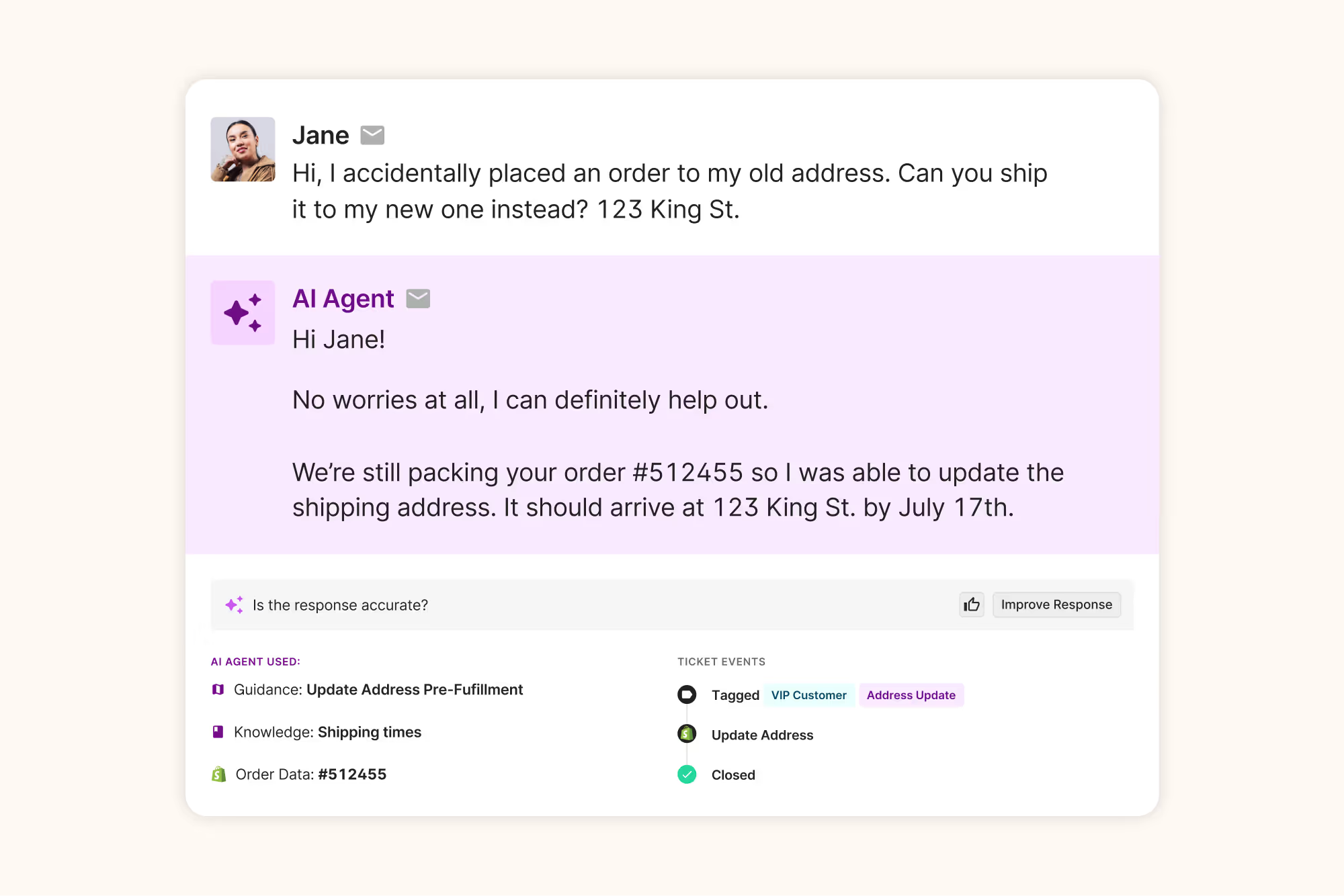
Gorgias's AI Agent is an operations agent first. It's positioned to "automatically handle order tracking, returns, and FAQs," and its named sub-features — Order Management, Flows, Article Recommendations — go further than answering questions: it can edit subscriptions, issue refunds, and update shipping details directly, and offer discounts or upsells "based on live inventory + shopper data." It pulls real-time Shopify data — storefront details, order history, product catalogs, inventory levels, and customer tags — but also broader customer data, giving the AI and team more full context inside the conversation, and runs across chat, SMS, and voice, not just text channels, since Gorgias's phone support feeds into the same AI layer. Training draws on "millions of [ecommerce] scenarios" plus your own help center and internal docs, on top of OpenAI's models, and merchants can write brand-specific "Guidance" or tweak behavior instantly with a thumbs-up.
 Text's AI Agent is a sales agent that also does support. Its named behaviors read less like a helpdesk and more like a rep: it's built to "save the sale" when a customer asks for a discount, mentions a competitor's lower price, or hesitates at checkout, issuing coupon codes on its own; a "Subscription Rescue" skill calls a webhook to generate a targeted retention deal when someone tries to cancel; it recommends upsells like an extended warranty add-on; and it can tag a chat "sale" or pull in a specific teammate to supervise a live conversation. Handoff rules let you decide exactly when a human steps in, and it closes conversations outright if a customer violates policy. That means routine inquiries can stay with AI while more nuanced issues go to human agents. It trains directly on "your website, docs, FAQs, and policies" with no scripts to write, replies consistently across 46 languages, and runs on chat, email, and messaging apps — notably not voice, since Text has no phone channel at all.
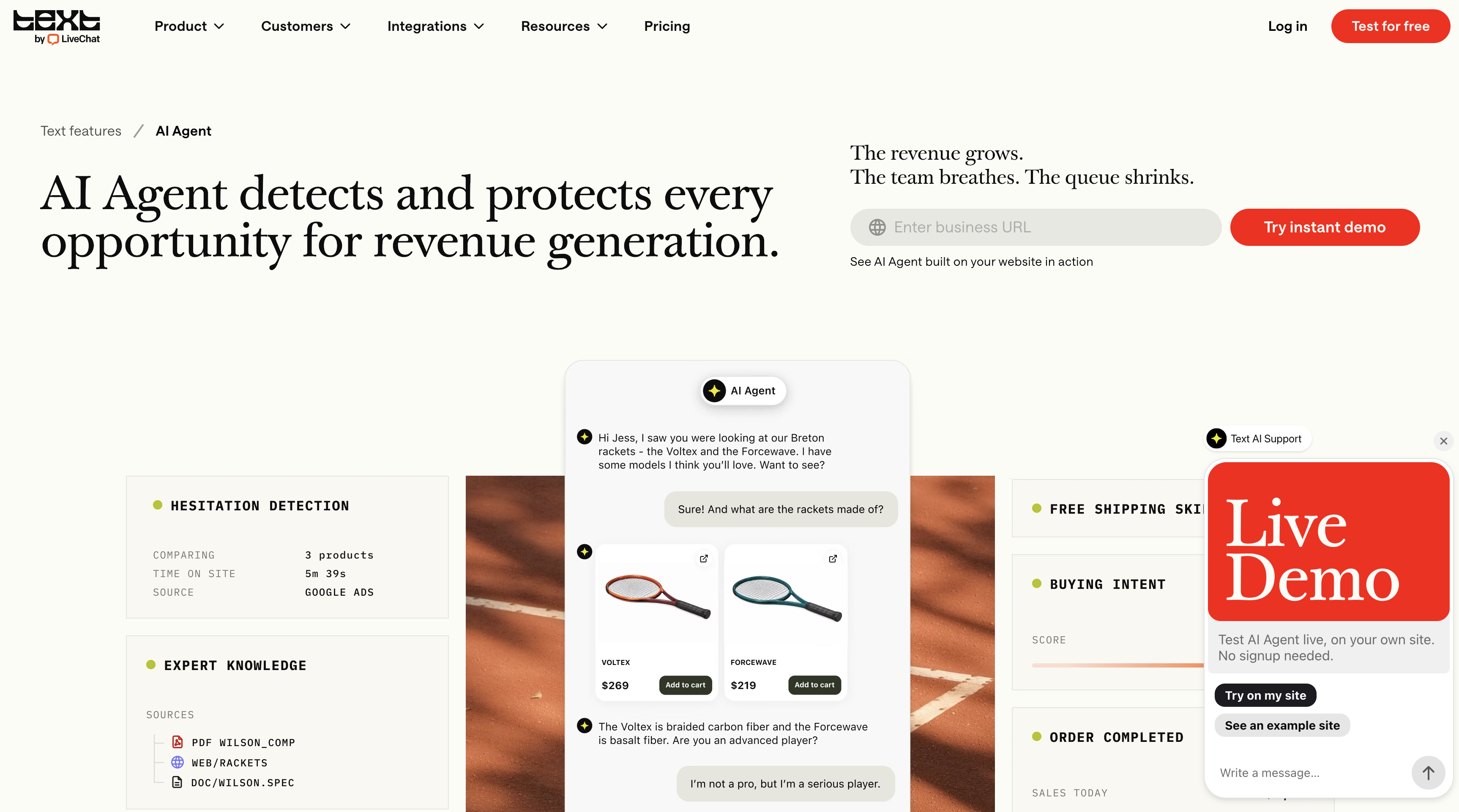 The practical difference: Gorgias's AI Agent is built to resolve tickets quickly — the WISMO question, the return, the subscription edit — as fast as possible. Text's AI Agent is built to notice a commercial moment inside a support conversation and act on it before the customer leaves. Both can technically do a version of the other's job, but the named features and demo scenarios on each company's own page point in those two different directions.
The difference that actually shows up on your invoice is the billing.
Gorgias. AI Agent interactions run $0.90 each on annual plans, $1.00 on monthly, and $1.50 for every automated interaction past your bundle (30/190/530). A resolution counts when a request is "fully handled by AI Agent or another automation feature including Flows, Order Management and Article Recommendations" and no human agent gets involved within 72 hours. And then the line that changes the math: "Each AI Agent interaction also counts as a helpdesk ticket and is billed accordingly."
That double charge is new. Accounts created before 28 May 2025 sit on legacy pricing, where "a ticket is either counted toward your usage for helpdesk tickets or automated interactions, but not both." Gorgias changed the rule, in writing, in the direction of costing more.
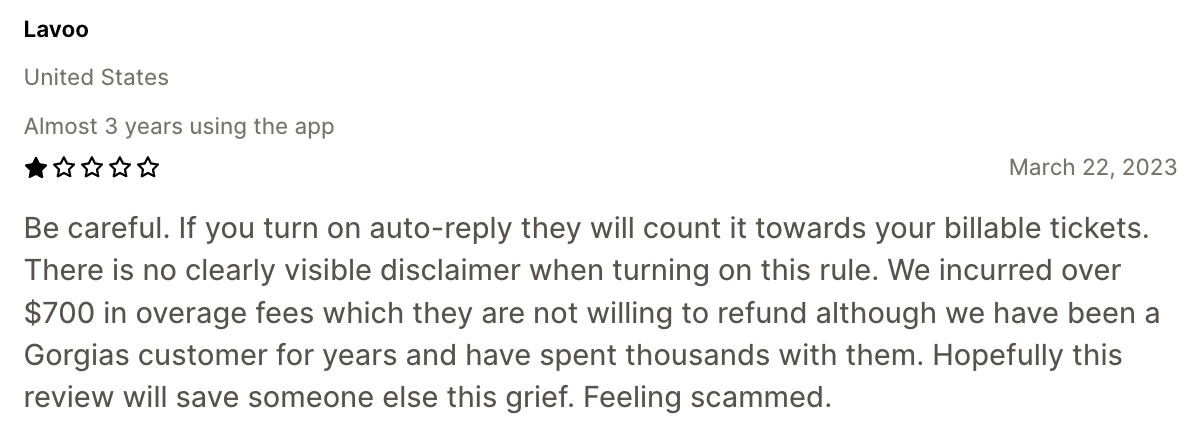
The effect on buying behavior is visible in a Shopify App Store review:
 Text. Our AI Agent is metered too, and I'd rather you hear the caveat from us: a resolution is "counted when the AI Agent provides an answer that directly solves at least one customer question," one charge per conversation no matter how many answers it sends. Essential includes 10 resolutions a month ($1.90 per resolution). Growth includes 200 ($0.4 per resolution). Go past your bundle and Text auto-adds a 50-resolution refill for $49.50, or $0.99 each, so the AI Agent doesn't stop working mid-month while you upgrade. Conversation volume still doesn't touch the seat price: handle 500 conversations or 50,000, and the per-user line on your invoice is identical either way.
Under Text's model, the incentives point the other way: as AI Agent absorbs a larger share of conversations, the same per-seat price is doing more work, so the blended cost per resolved case falls rather than climbs — at least up to your plan's bundled allotment, past which additional resolutions are a flat $0.99 each rather than getting cheaper with volume.
So both of us charge for AI. Only one of us charges for the ticket underneath it.
3. Channels
Gorgias has native phone support. Text does not.
The Gorgias Voice add-on handles inbound calls and outbound phone calls, transfers to agents or external numbers, IVR menus, call queues, voicemail, recording with transcription, and live call monitoring for supervisors. Missed calls are handled properly: "When a call connects, is missed, or someone leaves a voicemail, a ticket is created in your helpdesk."
Text covers more channels than Gorgias out of the box: website chat, in-app messaging, a standalone chat page, Facebook Messenger, WhatsApp, email ticketing, and SMS through your own connected Twilio account. However, Text doensn't support voice.
If a meaningful share of your customer communication arrives as inbound phone calls, stop reading comparisons and buy Gorgias. It's the better tool for that job, and no amount of chat volume changes it.
4. Ecommerce integrations
Gorgias covers fewer platforms — Shopify, BigCommerce, Magento, and WooCommerce. The Shopify integration is quite powerful. Shopify Actions let agents create an order, duplicate an order, cancel an order, and process refunds without leaving the ticket, with live stock levels alongside. The refund modal handles partial quantities, shipping refunds, restocking, and customer notification. Its limits are documented: single payment gateway only, no gift cards.
 Text connects natively to nine ecommerce and web platforms: Shopify, WordPress, WooCommerce, Webflow, BigCommerce, Adobe Commerce, Swell, Medusa, and commercetools — the last three aimed squarely at headless and custom-storefront setups, working through each platform's API rather than storefront code.
Text's Shopify integration is built for the conversation rather than the back office. "For Shopify stores, the agent sees the live cart, past orders, and total spent right in the chat." Agents get notified when items are added, removed, or ordered mid-conversation. Order details stay pinned to the conversation so whoever picks it up later has the full history. With the store connected, the AI Agent "handles 'where is my order' without pulling in a human, along with shipping times and product availability" — order tracking, shipping status, and shipping details answered without tab switching.
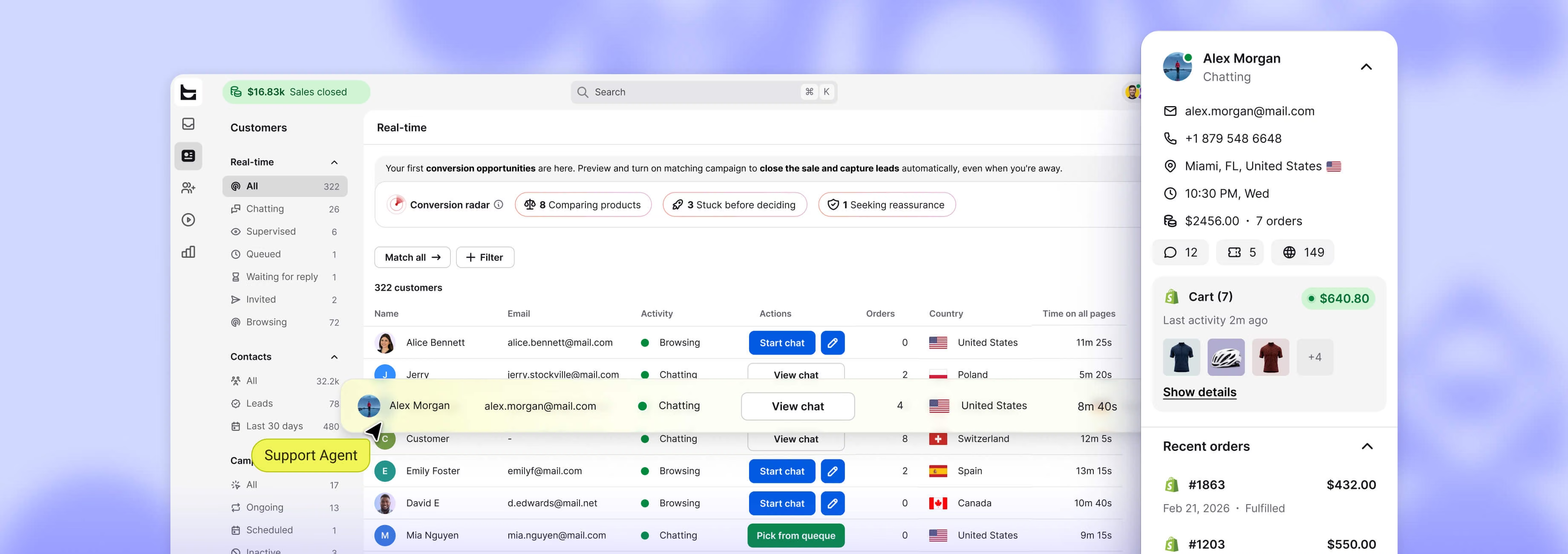 The real comparison is "one platform where Gorgias does everything, and three where it only looks things up," against Text's broader but more uniform set of storefront integrations.
5. The shared inbox: routing tickets across multiple departments
Text's inbox routes tickets two ways at once: automatically to the right team, or into a shared queue agents pick from manually, so a returns desk and a wholesale queue can run different workflows without fighting the same rules. Chats convert to tickets, carrying their transcript and tags with them, so a conversation that starts in live chat and needs to land with another department doesn't lose its history on the way. Teams can save their own views on top of one shared inbox, and every channel — chat, Messenger, SMS, WhatsApp — already lives in that same workspace, so a multi-department setup isn't stitched together from separate tools.
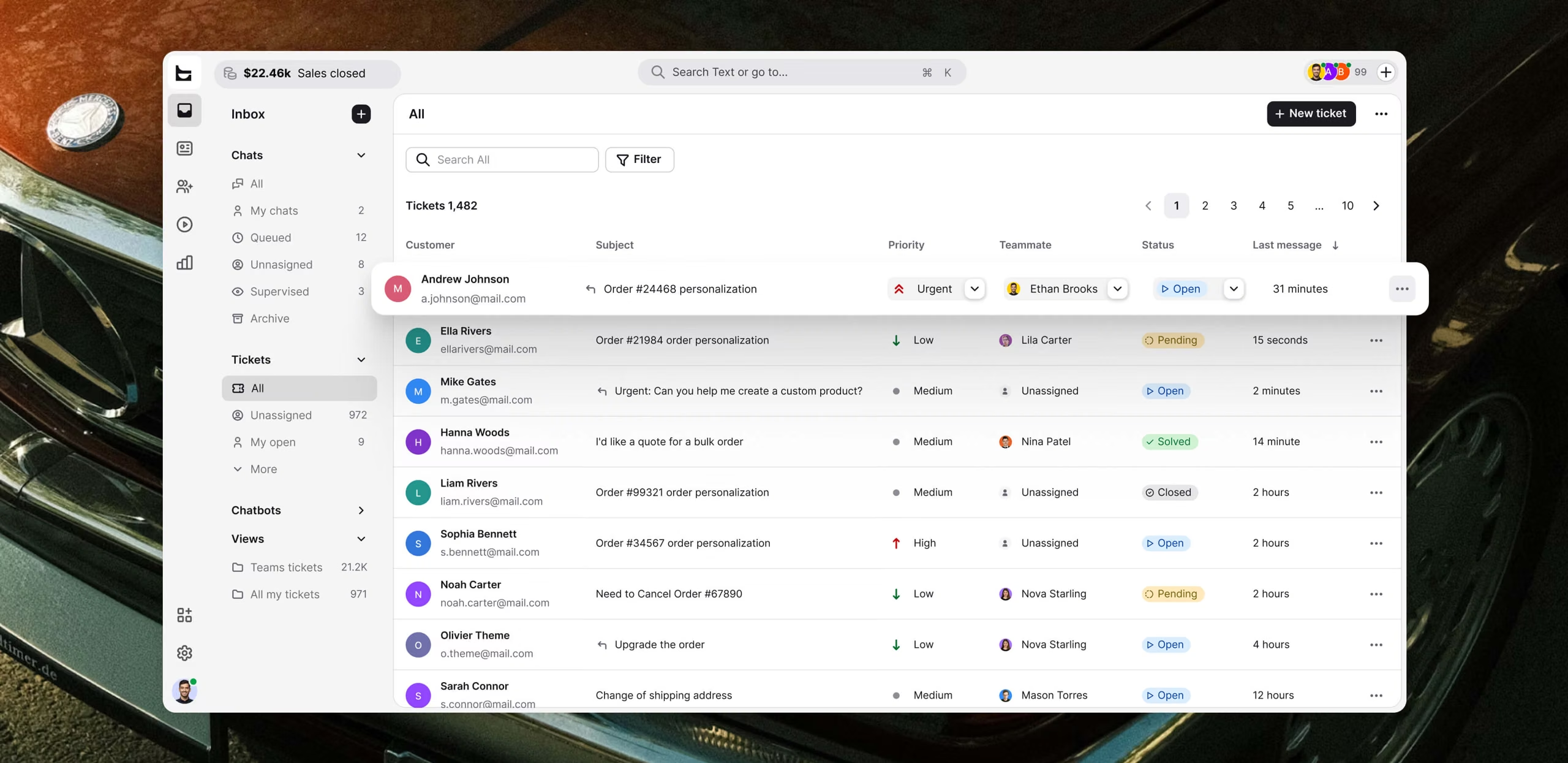 Gorgias's help desk page makes the same starting claim, a single inbox for every conversation, but stops there. It doesn't describe how a ticket actually moves between departments. What it emphasizes instead is what surrounds the inbox: native Shopify, BigCommerce, Magento, and WooCommerce integrations feeding order data into every ticket, backed by outcome metrics like faster first response time rather than routing mechanics.
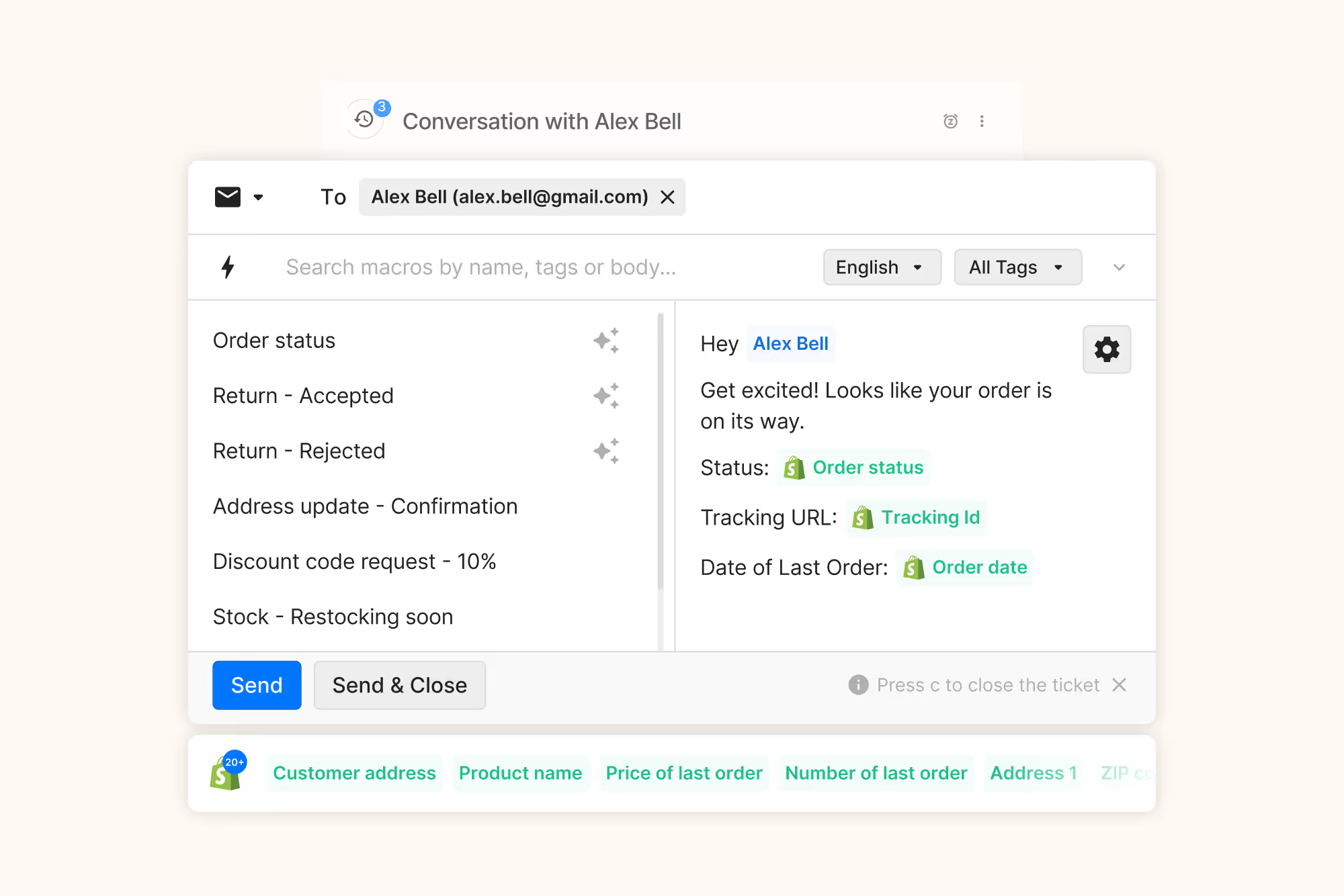 For multi-department routing specifically, Text is the better-documented tool. It names the actual mechanism, while Gorgias's own product page leaves routing as an assumed feature under "one inbox," not something it explains. That's not proof Gorgias's routing is worse, just that you'd need to go digging in its documentation (or a sales call) to find out how it behaves, where Text tells you on the feature page itself.
6. Knowledge base and self-service
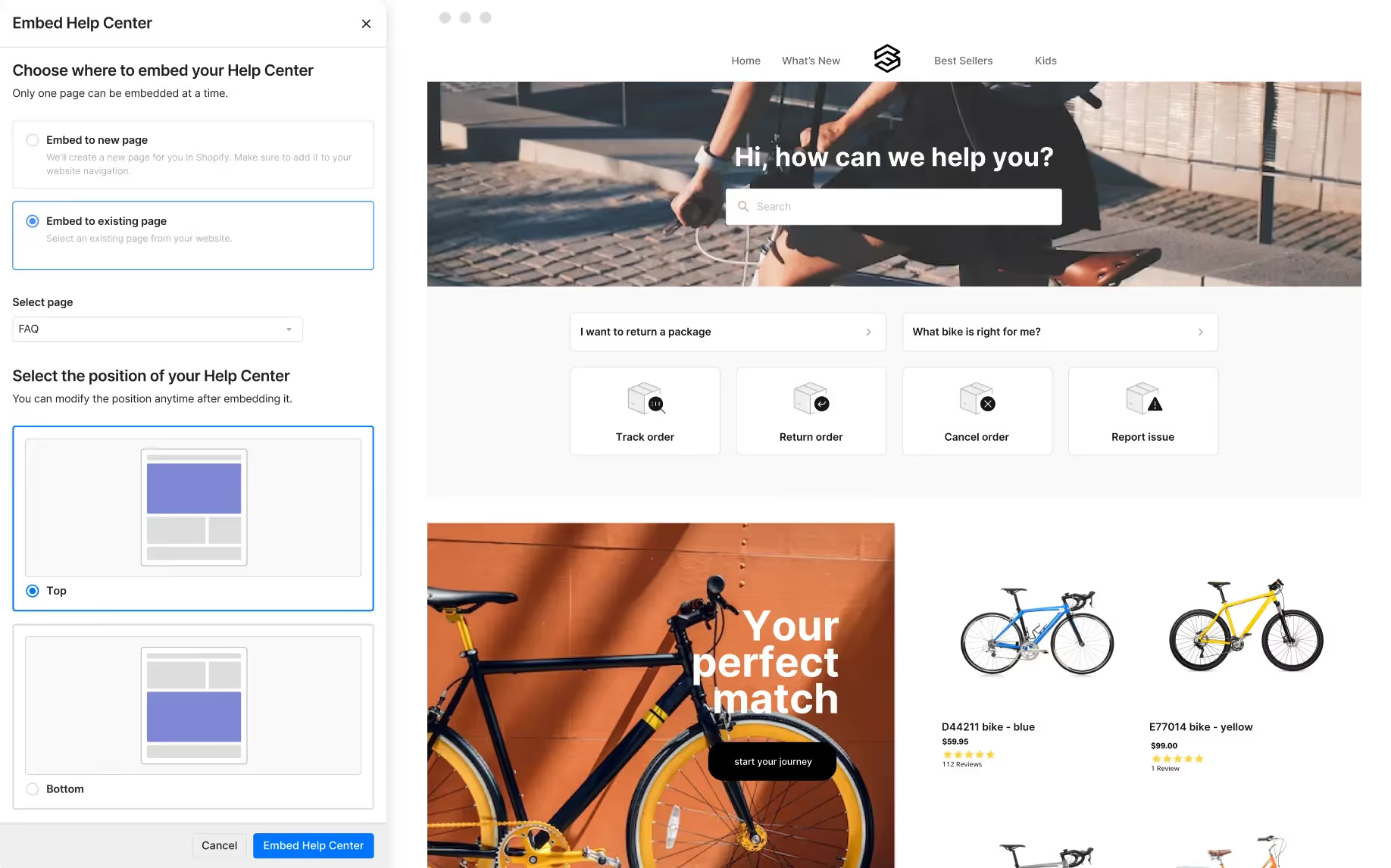
Gorgias includes up to 10 help centers on every plan except Enterprise, which is uncapped, with custom fonts, colors, logos, and custom code for branding, and those articles feed directly into the AI Agent's answers. Translation is manual and per-article. There's no built-in machine translation, so multilingual coverage means writing or pasting each translation yourself.
The bigger self-service gap sits on the customer's side, not the agent's. Gorgias's own documentation is explicit that Order Management doesn't actually self-serve: "Shoppers can't trigger automatic refunds or cancellations through Order Management — clicking the refund or cancellation buttons will only submit a request and an agent will still need to intervene". The self-service button files a ticket. Which is billable.
 Text's Knowledge hub trains on your existing content directly: whole websites up to 5,000 subpages with automatic re-scanning on a cycle you set (every 5 to 365 days), plus PDF, Word, PowerPoint, TXT, TSV, CSV, and Markdown files up to 50 MB each (PDFs capped at 200 pages).
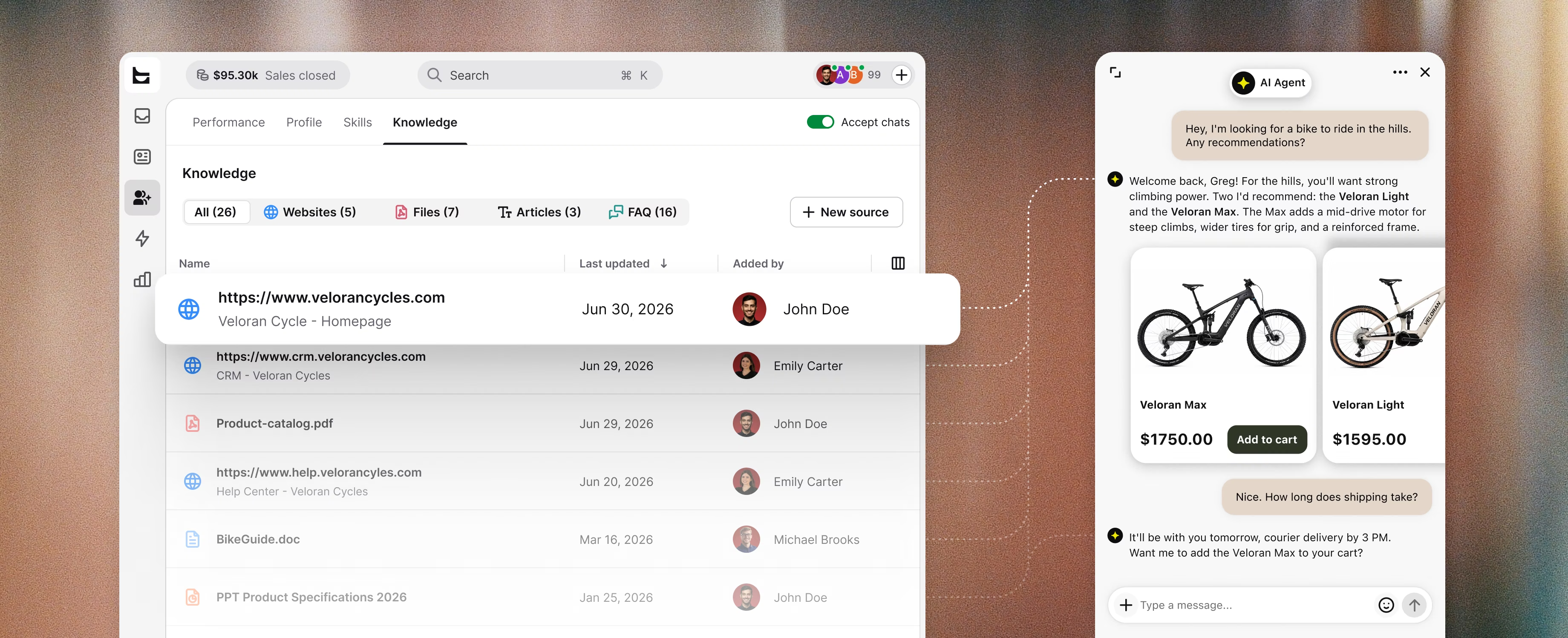 Which is better depends on what you're building. For feeding an AI agent, Text's ingestion is the more flexible tool — it crawls a live site on a schedule and accepts more file formats without a separate purchase. For a branded, public-facing help center, Gorgias wins. Gorgias's help center is the more complete, cheaper-to-start option. If the knowledge base exists mainly to make the AI Agent smarter, Text needs less extra tooling to get there.
7. Integrations with the rest of your support stack
Gorgias's pricing page advertises "254 apps." Its own app store page says "Connect 100+ apps." Both numbers are Gorgias's, published simultaneously, and I can't reconcile them for you. What I can confirm is that the ecommerce integrations are genuinely good: CloudTalk adds VoIP with click-to-call and calls exported as tickets from $25/month, Loop Returns drives self-service return workflows with return data in the customer sidebar, and Klaviyo brings marketing-aware support — it can pause campaigns and flows for any customer with an open ticket, which is the kind of detail only an ecommerce-native tool bothers to build.
Text's marketplace runs "over 200 integrations" by its own count, across CRM, email marketing, ecommerce, analytics, and payments. Fewer ecommerce-specific ones than Gorgias. For scale on the category: Zendesk claims 1,500+ apps and integrations on that same comparison page, and counts "roughly 200" for LiveChat, which is consistent with our number.
8. Reporting and revenue attribution: the cost center question
This is the criterion the two products don't even agree is a criterion.
Gorgias reports on support as a support function: statistics per agent, per channel, per tag, live dashboards, CSAT, AI and automation metrics. The documented ceilings are 10 dashboards at 20 charts each, all shared across the organization with no per-team private reporting. Audit logs are Pro and Advanced only. If you sync to a warehouse, note that the API rate limit is 2 requests per second on all four paid plans.
This is the criterion the two products don't even agree is a criterion.
Gorgias reports on support as a support function: statistics per agent, per channel, per tag, live dashboards, CSAT, AI and automation metrics. The documented ceilings are 10 dashboards at 20 charts each, all shared across the organization with no per-team private reporting. Audit logs are Pro and Advanced only. If you sync to a warehouse, note that the API rate limit is 2 requests per second on all four paid plans.
Text's whole argument is that the report should be a revenue report, and its analytics page is built around that argument rather than around ticket metrics. Reporting is split into four categories — Leads, Cases, Sales, and Team performance — and the "Sales" category is the tell: it tracks "revenue generated from chats," "revenue at stake right now," "average revenue per conversation," and revenue broken out specifically from AI-only conversations, alongside a dedicated AI Agent sales report. Support metrics are still there underneath it — CSAT, first response time, and resolution time are tracked separately for chats versus tickets, chat topics get their own breakdown, and customer profiles merge activity across chat, Messenger, SMS, and email into one view — but they sit next to the sales numbers rather than standing alone.
Where Text wins
Billing structure: Gorgias charges twice for one automated conversation: "You are charged both a ticket fee + automation fee." Text charges once. Post-28-May-2025 Gorgias accounts lost the legacy protection where a ticket counted toward helpdesk or automation, "but not both."
No ticket meter at all: Gorgias bills any ticket where one message leaves the helpdesk, including auto-replies from Rules, and re-bills the same conversation across channels ("1 billable helpdesk ticket, 1 billable Voice ticket, 1 billable SMS ticket") and after inactivity windows (10 days email, 3 days phone). Machine-generated Amazon/eBay notifications get billed like real tickets — the r/ecommerce merchant at ~$1,100/mo on 3,000 emails. Under Text, seat price is identical at 500 or 50,000 conversations.
Tighter resolution definition: counted only when the AI "provides an answer that directly solves at least one customer question." Handoff without an answer bills nothing; three answers in one thread is still one resolution.
Overage economics at volume: Growth is $0.40/resolution with 200 included, $0.99 past bundle. Gorgias is $1.50 past bundle plus the ticket fee.
AI included on every plan: No paid AI toggle. Gorgias begins at Starter $10 → $40/mo with AI, Pro $360 → $550/mo with AI.
Platform breadth: 9 ecommerce integrations vs 4, including headless (Swell, Medusa, commercetools). 200+ marketplace integrations vs the app store's "100+."
Documented multi-department routing: Auto-routing plus a manual shared queue, chats converting to tickets with transcript and tags intact, per-team saved views. Gorgias's product page asserts "one inbox" and doesn't explain the mechanism.
Knowledge ingestion for AI: Site crawl to 5,000 subpages with scheduled re-scans (5–365 days), PDF/Word/PPT/TXT/TSV/CSV/MD up to 50 MB. Gorgias translation is manual, per-article; Text replies in 46 languages.
Revenue attribution: Leads/Cases/Sales/Team reporting, revenue per conversation, revenue at stake, and revenue isolated to AI-only conversations. Gorgias reports support as a cost center: 10 dashboards × 20 charts, org-wide only, no per-team private reporting, audit logs on Pro/Advanced only, 2 req/sec API limit on all paid plans.
Commercial AI behaviors: Save-the-sale discounts, Subscription Rescue via webhook, warranty upsells, teammate pull-in on a live chat.
Where Gorgias wins
Voice: Native PSTN: inbound/outbound calls, transfers, IVR, queues, voicemail, recording with transcription, live supervisor monitoring, and tickets created on missed calls. Text has no phone channel, no numbers, no IVR. If inbound calls are a meaningful share of your volume, the comparison ends here.
Shopify write-depth: Shopify Actions create, duplicate, and cancel orders and process refunds inside the ticket, with a refund modal handling partial quantities, shipping refunds, restocking, and customer notification. Limits are disclosed: single gateway, no gift cards.
Operations-first AI: order management, returns, subscription edits, refunds, live-inventory-aware discounts and upsells; trained on "millions of [ecommerce] scenarios"; runs across chat, SMS, and voice because phone feeds the same AI layer.
Branded help centers: Up to 10 on every plan below Enterprise, custom fonts, colors, logos, and custom code. Text has no equivalent public-facing help center.
Entry price and trial: $10/mo Starter with monthly billing, no annual commitment; 30-day trial vs Text's 14. Per-resolution list price is lower at the bottom too: $0.90–$1.00 vs Essential's $1.90.
Ecommerce-native integrations: Loop Returns for self-service returns, Klaviyo pausing campaigns for any customer with an open ticket, CloudTalk VoIP from $25/mo. Text has fewer ecommerce-specific ones.
FAQ
Does Gorgias charge per user or per ticket?
Per ticket. Gorgias charges based on ticket volume, not user count — its pricing page says the helpdesk is "never priced per agent." Seats are capped per plan (3 on Starter, 500 on the rest), and extra tickets run $0.36–$0.40 depending on plan.
How much does a Gorgias AI resolution cost?
$0.90 on annual billing, $1.00 on monthly, and $1.50 per automated interaction past your included bundle. Each AI interaction is also billed as a helpdesk ticket.
Does Text have a free plan?
No. There's a 14-day free trial with no card required. Gorgias doesn't have a free plan either — its trial is 30 days.
Can Text's AI Agent look up order status on Shopify?
Yes, with the Shopify integration connected. It handles "where is my order," shipping times, and product availability from live store data. It does not process refunds or edit orders.
Does Gorgias or Text have native phone support?
Gorgias does, through its Voice add-on — inbound and outbound calls, IVR menus, call queues, voicemail, recording with transcription, and live call monitoring, with missed calls and voicemails automatically turned into tickets. Text has no phone channel at all; it handles customer conversations across chat, email, Messenger, WhatsApp, and SMS through your own connected Twilio account.
What counts as an AI resolution in Text?
A resolution is "counted when the AI Agent provides an answer that directly solves at least one customer question" — one charge per conversation, regardless of how many messages the agent sends. That model avoids charging for AI replies that do not actually resolve tickets. It matters most for teams handling high ticket volumes.